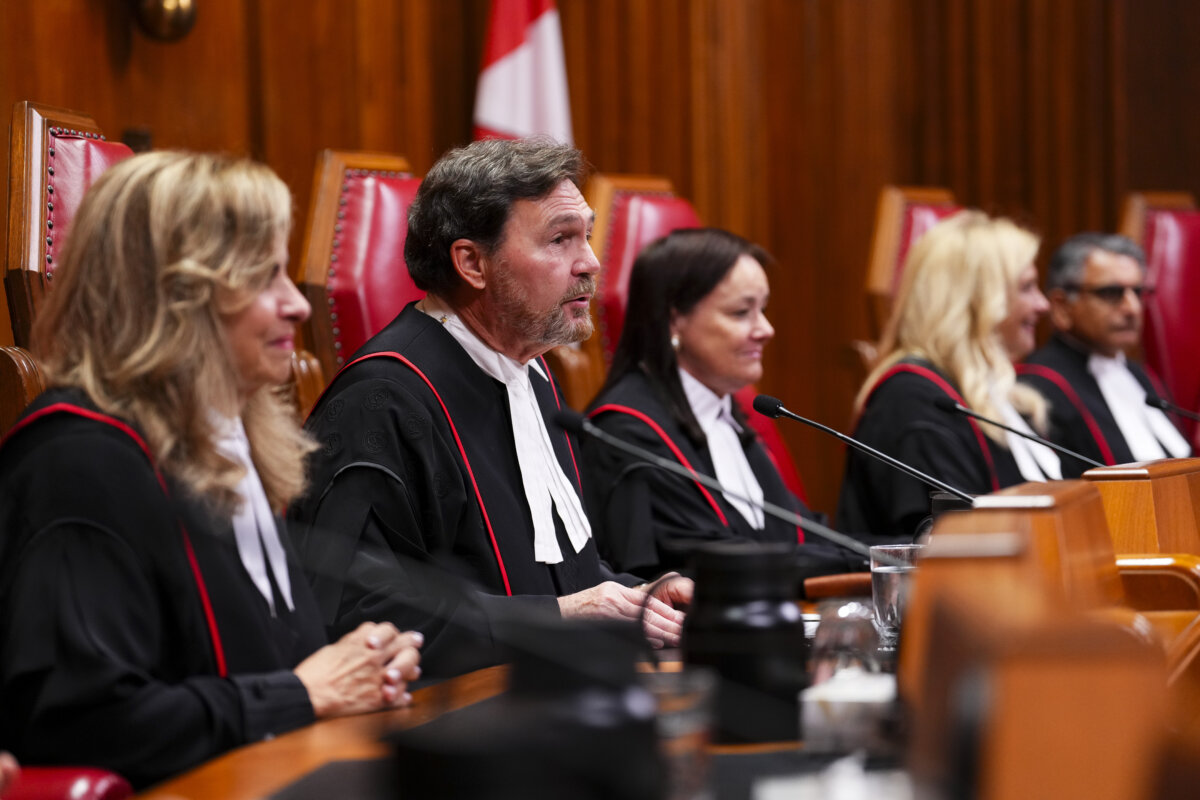

Supreme Court Chief Justice Richard Wagner has denied a request to recuse himself from the Emergencies Act case, after a group suggested he should do so because of previous comments critical of the Freedom Convoy protest.
Supreme Court of Canada registrar Chantal Carbonneau said in an April 29 letter first obtained by The National Post that Wagner sees no legal basis to recuse himself from the case, which the court is considering whether to hear.
“In this respect, Chief Justice Wagner has advised that he did not, at any time, either directly or indirectly, comment on the Emergencies Act, RSC 1985, c 22 (4th Supp) or matters at issue in the proceedings,” Carbonneau wrote.
The federal government filed an application with the Supreme Court in March to appeal a January decision by the Federal Court of Appeal. That court had rejected Ottawa’s appeal of a 2024 lower court decision, finding that it “correctly” determined that the Emergencies Act was unreasonably invoked.
Canadian Frontline Nurses (CFN) filed an appeal application with the Supreme Court, saying it could be “inappropriate” for Wagner to take part in the court’s discussions on whether to hear the case due to his past comments about protesters. Some CFN members participated in the Freedom Convoy protest in 2022.
In that filing, CFN’s lawyer, Alexander Boissonneau-Lehner, cited Wagner’s comments which were published in an April 2022 article in the Quebec newspaper Le Devoir. The chief justice said the Freedom Convoy protest was the “beginning of anarchy, where certain people decided to take other citizens hostage, to take the law into their own hands.”
Wagner was also quoted as saying the protest was fuelled in part by a “certain ignorance” and a “bad understanding” of Canadian law. At a news conference in June 2022, Wagner also called the impacts of the protests in Ottawa “deplorable,” according to The Globe and Mail.
The CFN filing said Wagner made comments about the protest that “could lead to an apprehension of bias,” and that it could be “inappropriate for that judge to take part in the adjudication of the proceedings in the Court.”
A group of 13 lawyers also sent a complaint to the Canadian Judicial Council in 2022 in response to Wagner’s past comments. The council threw out the complaint, saying it was “manifestly without substance, and does not concern judicial conduct.”
Emergencies Act
Former Prime Minister Justin Trudeau’s government invoked the Emergencies Act on Feb. 14, 2022, to deal with the Freedom Convoy, which began as a demonstration against mandatory COVID-19 vaccinations for truckers crossing the Canada-U.S. border, and later became a larger movement opposing various pandemic-related mandates and restrictions.
The invocation of the Emergencies Act gave law enforcement the power to arrest demonstrators, ordered banks to freeze the accounts of some of the protesters, and compelled towing companies to remove protesters’ vehicles from Ottawa. The act also made it illegal to attend any event deemed an unlawful assembly, such as the protest in downtown Ottawa. The act was revoked on Feb. 23.
A public inquiry headed by Court of Appeal Justice Paul Rouleau, which was held to determine whether the government was justified in invoking the act, concluded in 2023 that the cabinet met the “very high” threshold of doing so.
The Federal Court of Canada ruled in January 2024, however, that the use of emergency powers to shut down the convoy protest in Ottawa was unreasonable and “not justified in relation to the relevant factual and legal constraints” required by the Emergencies Act.
While the federal government challenged the ruling, the Federal Court of Appeal upheld the lower court’s ruling on Jan. 16, ruling that the government’s invocation of the Emergencies Act in 2022 was unreasonable.
The federal government filed an application on March 17 to have an appeal heard by the Supreme Court, arguing that the lower courts incorrectly reviewed the use of the Emergencies Act. The government had said the act was invoked because it believed the Freedom Convoy protest presented a threat to Canada’s national security.
The Supreme Court has not yet said whether it will hear the Emergencies Act case.
Olivia Gomm contributed to this report.
 Friends Read Free
Copy
Facebook
Tweet
Friends Read Free
Copy
Facebook
Tweet