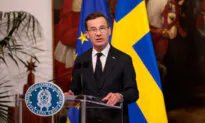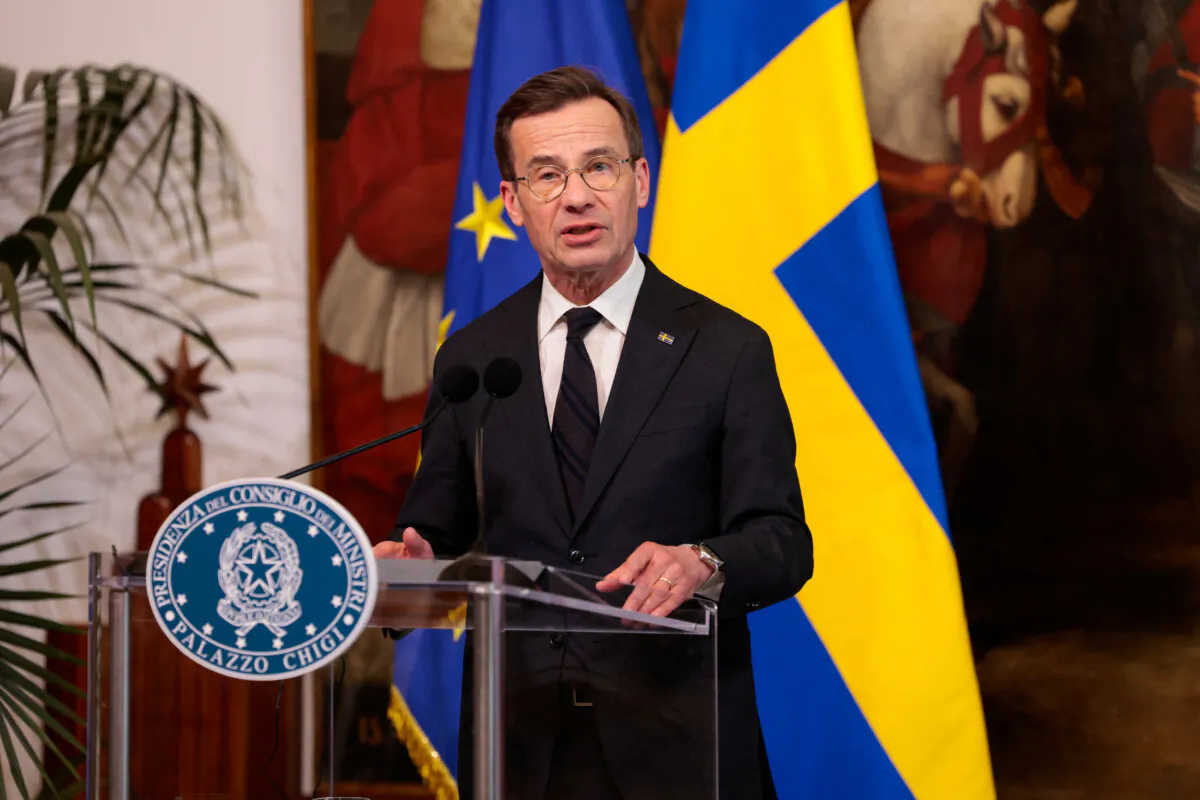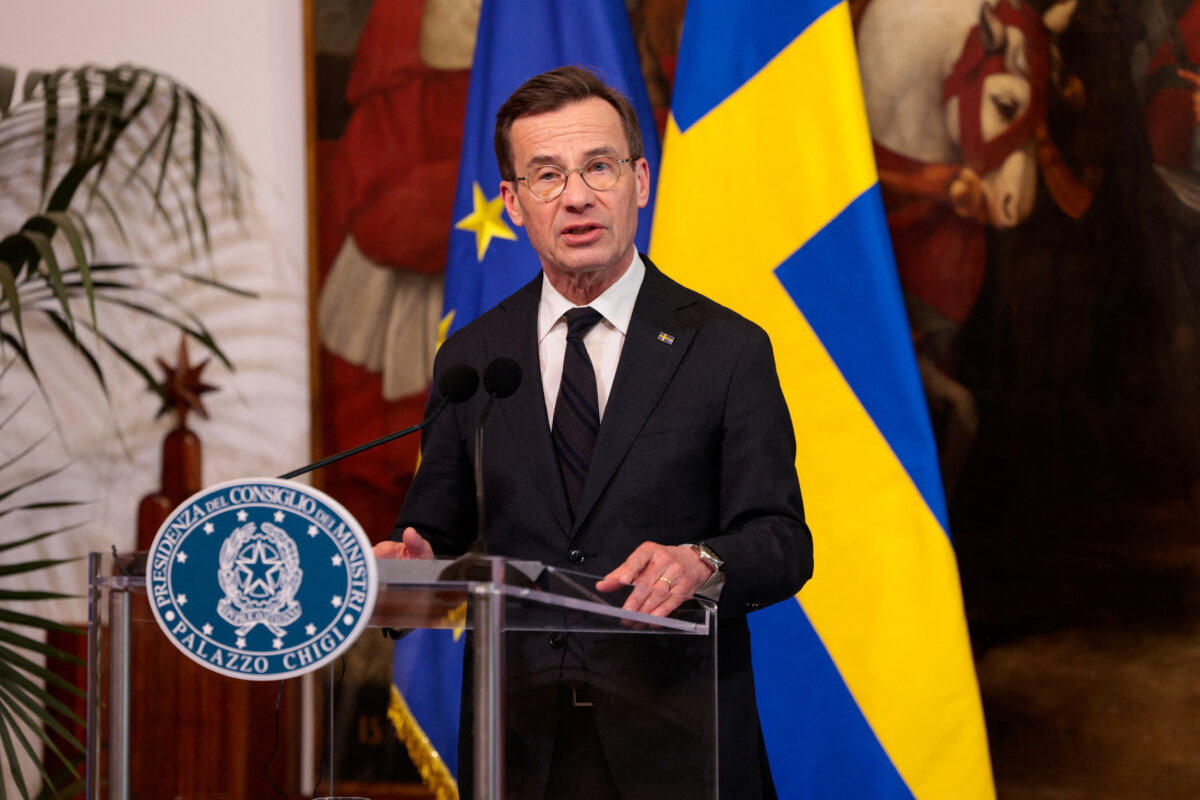

Swedish Prime Minister Ulf Kristersson asked to be relieved of his duties on Sept. 17 after the final count from the Sept. 13 general election gave the left-wing opposition a three-seat majority in the Riksdag.
The Social Democrats, Left Party, Greens, and Center Party secured 176 of parliament’s 349 seats, compared with 173 for the Tido parties of Moderates, Sweden Democrats, Christian Democrats, and Liberals.
The two blocs were separated by about 50,000 votes in a country of 10.6 million people.
In a letter to Speaker Andreas Norlen published on X, Kristersson formally requested to step down, clearing the way for negotiations over the formation of a new government.
He warned that the positions taken by parties before the election “could constitute obstacles to all conceivable government formations and coalitions.”
Kristersson and his ministers will remain in office in a caretaker capacity while the process unfolds.
Norlen is due to begin consultations with the parties on Sept. 18, according to the Riksdag.
The newly elected parliament will convene on Sept. 28 to elect its speaker, and a vote on a new prime minister will be possible from Sept. 29.
Social Democratic leader Magdalena Andersson responded to the result by saying on X that “the Swedish people have voted for a new direction” for the country.
Immigration Debate
The role of immigration and naturalization quickly emerged as one of the most contentious issues in the post-election debate.
SVT’s Election Day exit poll, known as Valu, found that 70 percent of voters with a non-European background supported parties on the left and far-left.
Two days before the election, Sweden Democrats leader Jimmie Akesson had raised the possibility that the country’s changing electorate could prove decisive.
During SVT’s final leaders’ debate, he said it could be “the first election in Sweden where the Muslim immigration [the country has had] decides a parliamentary election.”
Andersson rejected Akesson’s argument, describing it as “conspiracy theories.”
After the opposition moved ahead on election night, Sweden Democrat MP Tobias Andersson similarly pointed to citizenship policy.
He wrote on X that the party’s coalition partners had “refused to stop the rollout of citizenships,” arguing that more than 200,000 newly naturalized citizens had “in turn voted left.”
The Sweden Democrats proposed a temporary freeze on naturalizations in November 2022, but the proposal failed to advance in committee.
Tougher citizenship rules, including an eight-year residency requirement as well as self-sufficiency, language, and civics requirements, did not take effect until June 6.
“The big issue of the last four years under our right-wing government has not been mass immigration but the naturalization of immigrants who had arrived earlier,” Arvid Hallen, a Swedish policy analyst and cofounder of the conservative think tank Oikos, told The Epoch Times.
Hallen argued that had the other Tido parties adopted the Sweden Democrats’ proposal on naturalization at the beginning of the parliamentary term, they “would likely have won this election.”
He nevertheless cautioned against drawing overly pessimistic conclusions from the narrow defeat.
“Of course, the right can flip it back next time,” Hallen said, noting that “majorities in Swedish politics are now so very slim.”
He also pointed to votes cast for smaller right-wing parties outside the Tido bloc as another factor that may have affected the outcome.
Those parties, Hallen said, had been “a drag” on the conservative bloc, drawing away votes that might otherwise have been enough to deny the left-wing parties their narrow parliamentary majority.
Setback for the Sweden Democrats
The Sweden Democrats won 17.5 percent of the vote, down 3.1 percentage points from 2022, and secured 62 seats, 11 fewer than in the previous parliament.
The party slipped to third place behind the Moderates, who climbed to 19.8 percent and 70 seats.
The result marks the first time the Sweden Democrats have lost support in a general election since entering parliament in 2010. Their vote share declined in 285 of Sweden’s 290 municipalities.
Although they have remained outside the Cabinet for the past four years, the Sweden Democrats played a central role in shaping government policy through the Tido Agreement signed in October 2022.
Under the arrangement, the Moderates, Christian Democrats, and Liberals formed the government, while the Sweden Democrats served as a “cooperation party,” with staff in the Government Offices and an equal say over joint projects covering crime, migration, energy, health care, and education.
Going into this election, the party had expected to take the next step and enter government for the first time.
The Liberals dropped their long-standing objection in March, and on April 1, Kristersson appeared alongside Akesson to pledge that, if the Tido parties were to retain their majority, the Sweden Democrats would receive Cabinet posts, including in the areas of migration and integration.
Hallen, however, argued that the Sweden Democrats’ losses were less dramatic than the numbers might initially suggest.
“One conclusion from this election is that the Sweden Democrats have been fully normalized,” he said.
He also said that the result challenged a long-standing argument on the left that “cooperating with the Sweden Democrats would consume you.”
Instead, Hallen said, the Moderates appear to have won back voters who had spent “10 years as tourists” with the Sweden Democrats.
“Over the past four years, by moving very close to the Sweden Democrats’ position on immigration and crime, the Moderates have probably regained the confidence of these voters, who liked them the most but voted for the Sweden Democrats out of intense dislike of the liberal stance on immigration the Moderates used to hold,” he said.
The Tido Legacy
With a change of government now possible, questions are also emerging over how much of the Tido coalition’s policy agenda would survive under a Social Democratic-led administration.
Sweden Democrat MP Ludvig Aspling, the party’s migration spokesman, told The Epoch Times before the final count that he doubted a Social Democratic government would preserve the reforms enacted over the past four years.
He described Andersson’s party as “a machine for power” that says “whatever is popular during a campaign,” and he predicted that the Social Democrats would be willing to make policy concessions to the Left Party and Greens as long as they retained control of government appointments.
Hallen similarly noted that Andersson had campaigned on a tougher approach to crime and immigration than her party had traditionally embraced.
He said that he nevertheless expects her to make at least some concessions to parties on the hard left.
“The question is not whether they will have to go back, but how far,” he said.
“We don’t know, and I’m certainly worried.”
Mattias Karlsson, a Sweden Democrats MP and one of the party’s longtime leading ideological figures, told The Epoch Times before the election that, in his view, the Social Democrats would have little choice but to make concessions to parties on their left if they wanted to form a government.
Those parties have grown “at their expense,” Karlsson said, giving them greater leverage over the Social Democrats.
Aspling was particularly critical of the Left Party, the successor to Sweden’s Communist Party.
He recalled the party had been hit during the campaign by “a series of scandals” involving “Islamism, anti-Semitism, [and] support for terrorism” yet was gaining rather than losing support.
“Their voter base is something completely different from what is normal,” he said.
During the campaign, the Left Party removed 33 candidates from its electoral lists after Swedish media outlets reported social media posts in which they had expressed support for Islamist terrorist groups such as Hamas and Hezbollah.
Despite the controversy, the Left Party recorded the largest gain of any party in the election, rising to 8.4 percent of the vote and securing 30 seats.
A Complicated Government Formation
The opposition’s three-seat majority does not necessarily translate into a straightforward path to forming a government.
The Center Party, which rules out governing with the Sweden Democrats, has also said it will not support a government that includes the Left Party. The Left Party, meanwhile, is demanding Cabinet posts in exchange for its support.
Christian Democrat leader Ebba Busch wrote on X, “At present, there is no one who commands a majority in the parliament.”
Liberal leader Simona Mohamsson similarly said that her “teammates on the right stand ready to continue governing Sweden” if the left fails to reach an agreement.
Sweden’s system of negative parliamentarism means that a candidate nominated by the speaker becomes prime minister unless at least 175 of the Riksdag’s 349 members vote against the nominee.
The speaker has four attempts to secure approval for a prime minister.
If all four fail, an extraordinary election must be held within three months.
Hallen said he sees three possibilities: a left-wing government, the most likely; fresh elections, which he doubts; and a Center Party deal with the right that sidesteps the Sweden Democrats, which he expects would trigger “a huge backlash among Center Party voters.”
 Friends Read Free
Copy
Facebook
Tweet
Friends Read Free
Copy
Facebook
Tweet