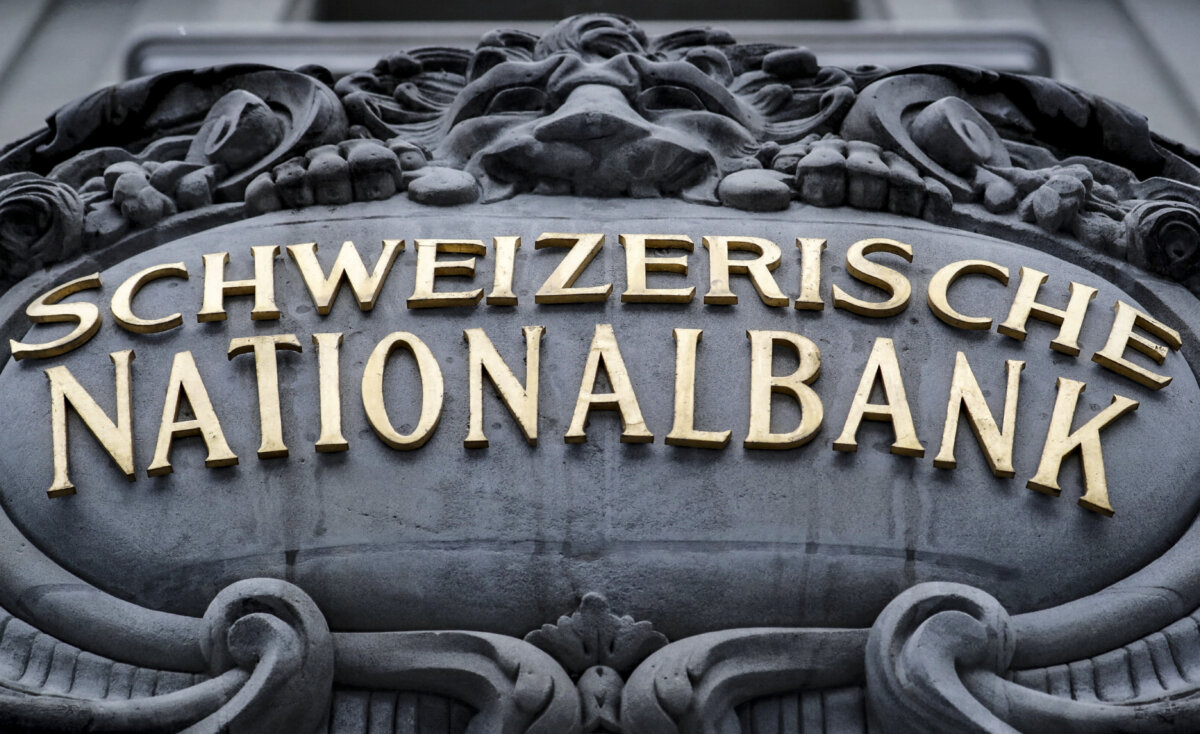

The Swiss National Bank (SNB) has left its benchmark interest rate unchanged at zero percent, saying inflation remains low despite rising energy costs and the uncertainty surrounding the conflict in the Middle East.
The decision keeps borrowing costs at their current level after inflation rose from 0.1 percent in February to 0.6 percent in May.
“This increase was mainly attributable to higher prices for oil products,” the bank said in a June 18 statement. “The other goods and services made little contribution to the rise in inflation.”
The SNB said it is prepared to intervene in foreign exchange markets if necessary to prevent a rapid appreciation of the Swiss franc.
“The SNB thereby counters a rapid and excessive appreciation of the Swiss franc, which would jeopardize price stability in Switzerland,” the central bank said.
Inflation Remains Contained
The SNB said inflation has increased in recent months due to higher energy prices, while price pressures elsewhere in the economy have remained limited.
According to the bank’s latest forecast, inflation is expected to rise slightly over the coming quarters before easing during the first half of 2027 as the impact of higher energy costs fades.
The central bank projected average inflation of 0.6 percent in both 2026 and 2027, rising slightly to 0.7 percent in 2028. Officials said future inflation will depend heavily on developments in global energy markets and the security situation in the Middle East.
“Energy prices will be largely influenced by the further development of the situation in the Middle East,” the SNB said.
The central bank noted that inflation has also increased abroad, which has contributed to a slightly higher near-term forecast than it published in March.
Geopolitical Factor
Swiss government economists also lowered their economic growth forecast on June 18, citing higher energy prices and weaker global demand.
The Federal Government Expert Group on Business Cycles said Switzerland’s economy is now expected to grow by 0.9 percent in 2026 and 1.6 percent in 2027, down slightly from forecasts published in March.
Both the SNB and government economists identified the Middle East conflict as the main risk facing Switzerland’s economy. The SNB said global growth slowed in the first quarter amid rising energy prices following the escalation of tensions in the region.
The central bank warned that a further rise in commodity prices could increase inflation and significantly weaken economic activity.
Economy Shows Resilience
Despite external risks, Swiss officials said the domestic economy has remained relatively resilient. The SNB reported that economic growth was solid during the first quarter, although unemployment has increased somewhat in recent months.
The government forecast unemployment will average 3.1 percent in 2026 before easing slightly to 3 percent in 2027. Officials said stronger economic activity in Europe, particularly in Germany, should help support Swiss exports and investment over the medium term.
The outlook comes days after Swiss voters rejected a proposal to cap the country’s permanent resident population at 10 million people. The June 14 referendum preserved Switzerland’s agreements with the European Union (EU), including the free movement of people.
Opponents of the measure said that disrupting ties with the EU would be risky after a turbulent 2025, when the Trump administration imposed steep tariffs on Swiss exports.
 Friends Read Free
Copy
Facebook
Tweet
Friends Read Free
Copy
Facebook
Tweet