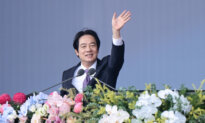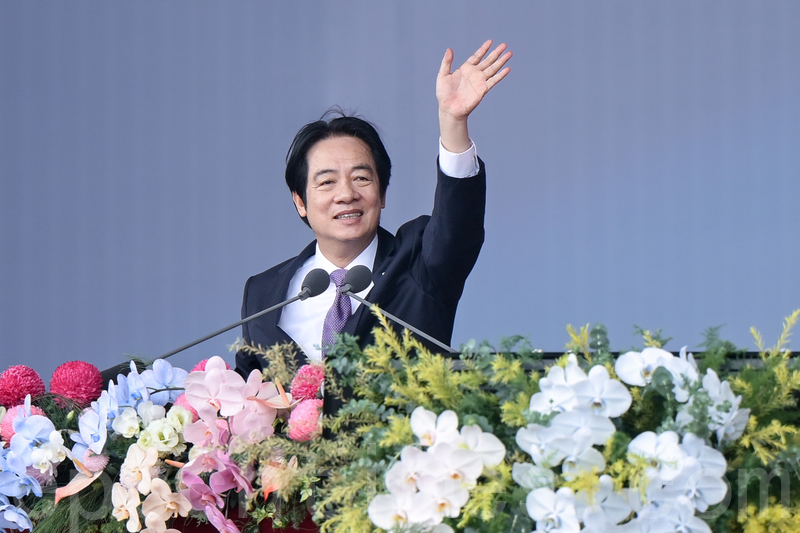

TAIPEI—China’s escalating threats against Taiwan pose a test of the international community’s commitment to the rules-based international order, Taiwanese President Lai Ching-te said in an address on Oct. 10.
Lai delivered the address outside the Presidential Office during Double Ten Day celebrations, marking Taiwan’s National Day and the 115th anniversary of the founding of the Republic of China, Taiwan’s official name.
“China continues to apply pressure through military and gray-zone activities in an attempt to alter the status quo across the Taiwan Strait,” Lai said, according to a translation of his speech from the Presidential Office.
“Taiwan’s resolve is not only a matter of our own survival in the face of such authoritarian expansion; it is about whether the international community still believes that force cannot override rules, and that the powerful cannot strip a people of their right to determine their own future.”
Tensions across the Taiwan Strait have intensified since the Democratic Progressive Party (DPP) regained the presidency in 2016, with Beijing cutting off formal communications with Taipei after Lai’s predecessor, Tsai Ing-wen, became president, and ramping up military activity and gray-zone operations around the island.
Beijing held major military exercises around Taiwan in October 2024, just days after Lai delivered his National Day speech declaring that China had no right to represent the island. Experts said the drills were intended to warn Taipei and its international supporters that Beijing possesses the capability to isolate the island from external support.
The People’s Republic of China, communist China’s official name, claims Taiwan as its territory and has not ruled out using force to bring the island under its control. Taiwan, however, functions as a de facto democratic sovereign nation that governs itself.
Maintaining peace across the Taiwan Strait “cannot rely solely on wishes,” Lai said.
“Taiwan cherishes peace, but we will not give up our freedom. We are open to exchanges, but will not accept subordination,” Lai said. “Taiwan is showing its determination to prevent authoritarianism from eroding democracy and fear from supplanting freedom. Through resolute and responsible actions, we are safeguarding the status quo of peace and stability in the Taiwan Strait and the Indo-Pacific.”
Lai has set a goal of increasing Taiwan’s defense spending to 5 percent of gross domestic product by 2030. In August, he proposed that 2027 spending would reach a record NT 1.1225 trillion (35.2 billion), accounting for more than 3 percent of the island’s projected GDP.
In September, Raymond Greene, director of the American Institute in Taiwan, the de facto U.S. Embassy in Taiwan, warned that a conflict across the Taiwan Strait would inflict a greater economic toll than World War II.
While the United States and Taiwan lack official diplomatic ties, Washington is the island’s biggest arms supplier and most crucial international ally.
“We are strengthening our self-defense not to abandon dialogue, but to ensure that dialogue can take place on the basis of parity and dignity,” Lai said. “There must be respect for the right of the people of Taiwan to exist.”
Lai’s remarks came two weeks after U.S. President Donald Trump hosted Chinese leader Xi Jinping for a state visit at the White House. Despite pressure from Xi during the summit, the U.S. policy toward Taiwan has remained unchanged.
Trump approved an $11.1 billion arms sale to Taiwan in December, but he has yet to sign off on a second $14 billion package despite appeals from a bipartisan group of U.S. lawmakers.
“We welcome the United States and China managing their competition through dialogue and reducing the risk of conflict and war,” Lai said.
Lai called on democratic nations in the Indo-Pacific to join forces to ensure that peace and stability in the region are not undermined.
Last month, foreign ministers and senior representatives of Australia, France, Germany, Japan, New Zealand, Poland, South Korea, and the UK issued a joint statement on the sidelines of the U.N. General Assembly in New York, declaring that they oppose any unilateral attempts to change the status quo across the Taiwan Strait.
Many foreign guests took part in the National Day celebration, including Eswatini King Mswati III and Lieutenant Governor of Indiana Micah Beckwith, according to Lai’s office.
Eswatini stands as Taiwan’s last remaining diplomatic ally in Africa, one of 12 nations globally that continue to formally recognize Taipei over Beijing.
Tennessee Gov. Bill Lee, Sens. Marsha Blackburn (R-Tenn.) and Tommy Tuberville (R-Ala.), and Atlanta Mayor Andre Dickens are among U.S. officials who released videos congratulating Taiwan on its National Day, touting shared democratic values and enduring U.S.-Taiwan ties.
 Friends Read Free
Copy
Facebook
Tweet
Friends Read Free
Copy
Facebook
Tweet