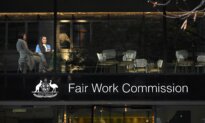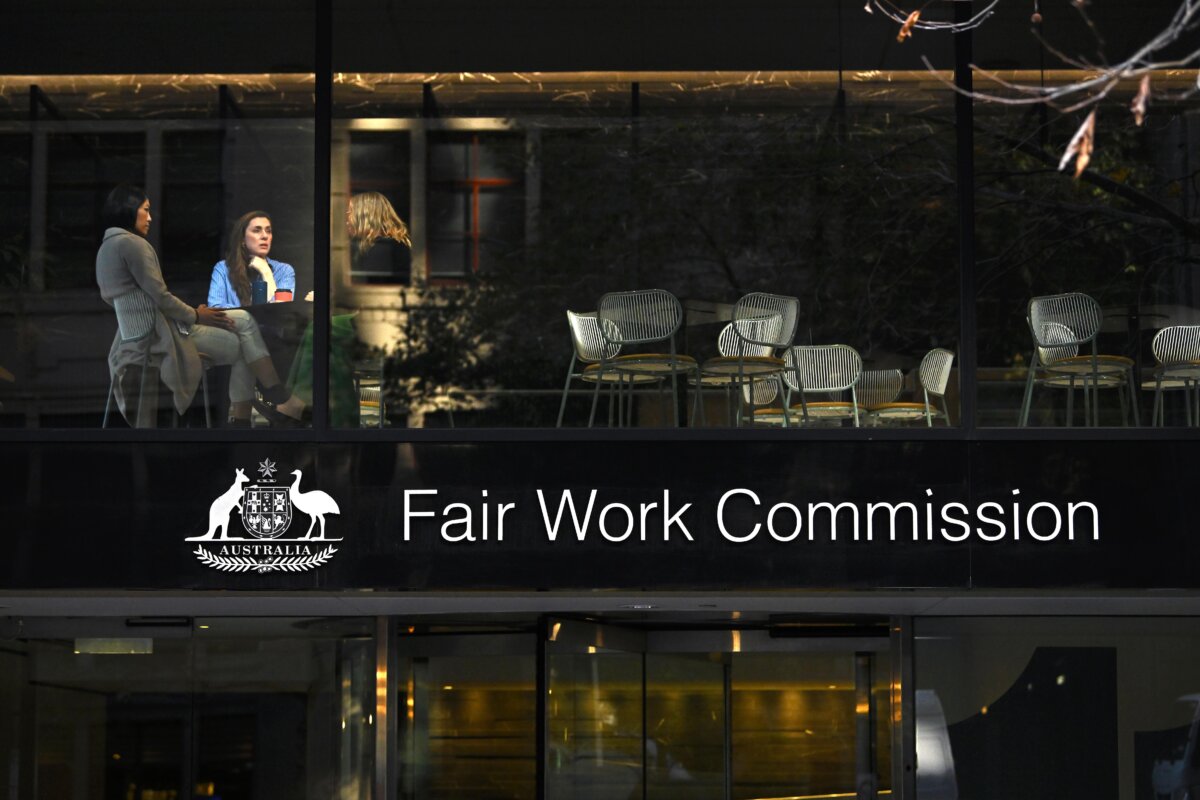

Australia’s Fair Work Commission (FWC) says it is “taking on water” as it scrambles to secure funding needed to continue operations while dealing with a surge in cases driven by artificial intelligence (AI).
A Senate Education and Employment Legislation Committee hearing on the evening of June 2 heard that the bulk of claims being lodged were either unfair dismissal cases or adverse action claims, with about half of them created with the help of AI.
The FWC says funding constraints, coupled with an up to 70 percent increase in cases will likely lead to staff cuts in the coming year.
AI Sends Submissions Soaring
According to the FWC, its operations have been “significantly disrupted” by AI use in claim submissions.
The commission previously shared that cases had moved from around 30,000 a year to a record 40,000 cases in 2023-24, before hitting 44,000 in 2024-25.
It has also predicted the total for 2025-26 will reach 50,000-55,000 matters, representing a possible 70 percent increase in cases over three years.
More people are choosing to self-represent in cases as AI makes it easier to prepare claims. In response, the commission says it is now considering using AI for case processing, as well as AI phone services.
The commission’s own AI tools, which will not replace human decision-making processes, are expected to be introduced by next year.
Zoe Bright, legal executive director for the FWC, told the hearing that almost half of people who had lodged claims had done so with the help of AI.
“And they’re the ones that are telling you that,” Liberal Senator Jane Hume said.
The chamber heard that AI can help with lodgements but can also instil an overly optimistic sense of case outcomes and likely compensation amounts, which could lead to unmeritorious submissions.
Staff Cuts, Financial Shortfalls
FWC executive director of enabling services Jack Lambalk told the hearing the commission had “a lot of work to do” to remain sustainable in the future.
“Effectively, the commission takes into account our approved loss into 25/26. Looking at next year’s budget, we need to reduce our expenditure by about $4 million this year,” he said.
“So that’s why we’re doing a lot of work on our sustainability, meeting our budget obligations, but also meeting our service delivery obligations. We are very grateful that $1.307 million in additional funding received in the May budget helped that situation.”
Senator Hume queried whether the funding was enough to deal with the mounting caseload.
“Obviously that funding will help, but we have to find $4 million next year compared to this year to meet our budget challenges,” Lambalk replied.
When asked whether the FWC had added new staff to deal with workload, Lambalk said staffing had remained steady, with cuts expected next year.
“We’re investing in new technologies and reducing our property profile to meet those challenges, but I don’t think it’s fair to say we’re increasing our staffing levels more effectively,” he said.
“We’re effectively trying to manage both the pressures of funding reductions and growth in lodgements.”
Outcomes Lagging
Greens Senator Barbara Pocock queried the timelines for resolving claims.
“I’ve been contacted by a constituent whose unfair dismissal remains without an outcome after 24 weeks on from the hearing—twice as long as the commission’s benchmark for having those decisions handed down,” she said.
“I’m told this is not a particularly complex matter, and the applicants have been informed the delays are coming from a large volume of cases, which we’ve just been canvassing.”
FWC General Manager Murray Furlong said the case would be “a bit of an outlier,” but stated the commission was struggling to manage the deluge of submissions.
“The phrase that I use internally is that the commission is taking on water at the moment. We are working harder than ever finalising more matters than we’ve ever finalised, but we’re still not keeping up with the increase in the demand,” he said.
Pocock asked whether employers who were in the wrong would go unchecked if cases were not tended to quickly enough. FWC client services executive director Chloe Eaton outlined a range of new processes being introduced to speed up processing times.
Those measures include a new lodgement portal, reviewing all public-facing material, and increasing knowledge of basic eligibility criteria.
 Friends Read Free
Copy
Facebook
Tweet
Friends Read Free
Copy
Facebook
Tweet