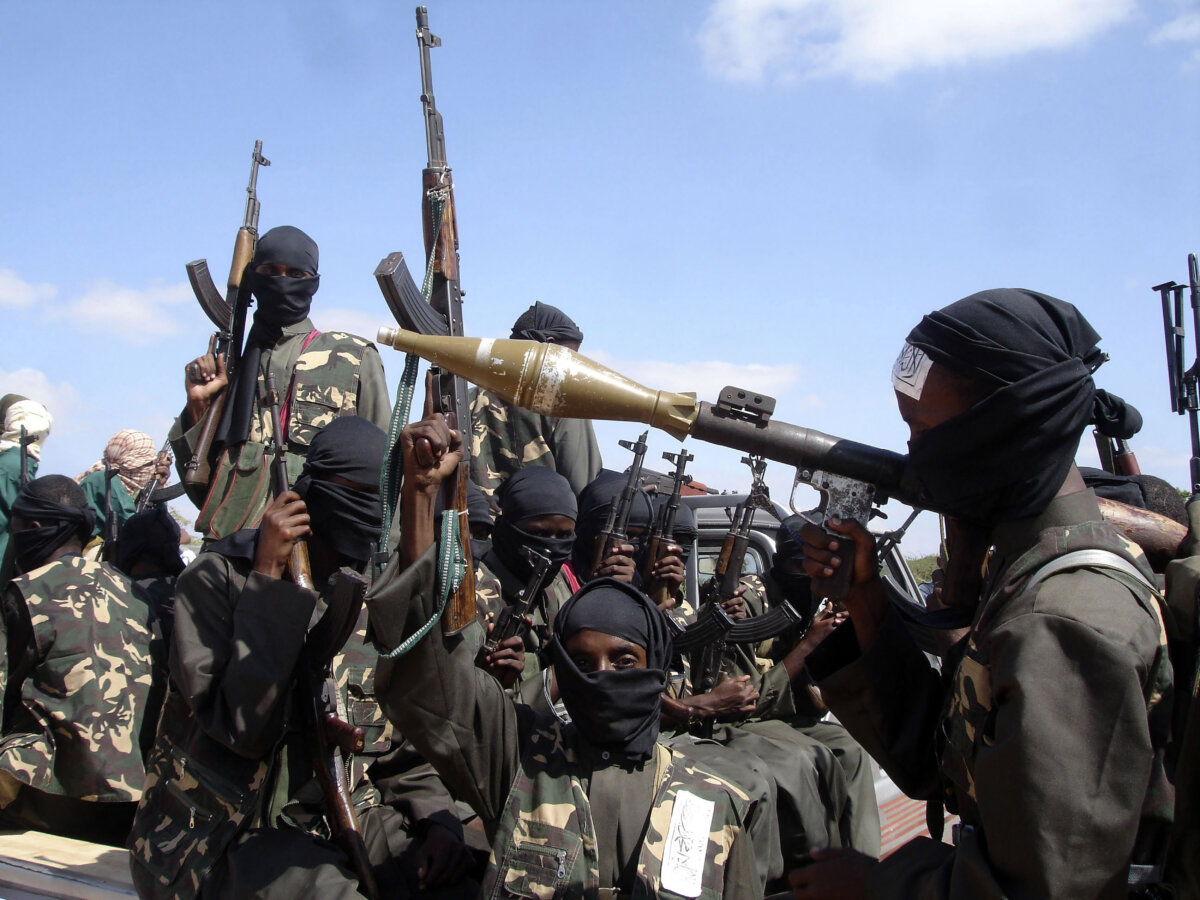

The threat from various offshoots of the terrorist groups ISIS and al-Qaeda is growing in parts of Africa, and they are seizing more territory, according to a July 24 report sent to the U.N. Security Council.
The report by the U.N.’s analytical support and sanctions monitoring team was published as another Islamist terrorist group, al-Shabaab, captured a key town, Mahaas, in Somalia on July 27, according to witnesses.
Al-Shabaab, which is affiliated with al-Qaeda, has been fighting government forces in Somalia for almost 20 years.
The U.N. report, circulated on Wednesday, said al-Shabaab and Jama’at Nasr al-Islam wal-Muslimin (JNIM), an al-Qaeda-affiliated group in western Africa, had both increased the territory under their control.
The team of experts said two groups represented al-Qaeda’s continuing “pivot towards parts of Africa.”
The report said the situation in the Sahel, a semi-arid region south of the Sahara Desert, was “deeply concerning.”
ISIS ‘Seeking to Retrench’
“Although dynamics varied across countries, the overall trend was an expansion of the area of operations of JNIM and a resurgence of activity by the ‘Islamic State’ in the Greater Sahara, particularly along the Niger and Nigeria border, where the group was seeking to entrench itself,” the report said.
JNIM is now operating “with relative freedom” in northern Mali and most of Burkina Faso, according to the report.
“JNIM reached a new level of operational capability to conduct complex attacks with drones, improvised explosive devices and large numbers of fighters against well-defended barracks,” the report said.
The report said that in East Africa, al-Shabaab “maintained its resilience, intensifying operations in southern and central Somalia,” and had close ties with the Iran-backed Houthis across the Red Sea in Yemen.
It said the two groups exchanged weapons and that the Houthis have trained al-Shabaab fighters.
Last year, the Center for Strategic Studies (CSS) at Fort McNair in Washington said that fatalities linked to militant Islamic violence in Africa increased from 19,412 in 2022 to 23,322 in 2023, a rise of 20 percent.
In February 2024, Donna Charles, who monitors Islamic insurgencies in West Africa and the Sahel for the U.S. Institute of Peace in Washington, said, “The evolution of terrorism in sub-Saharan Africa could pose a threat to homeland security and is a growing danger to U.S. interests abroad.”
The U.N. report also looked at the jihadist terrorist threat in other parts of the world.
It said that in the United States, there had been several alleged terrorist attack plots, “largely motivated by the Gaza and Israel conflict” or individuals who were radicalized by ISIS, who are sometimes known as ISIL.
These included Shamsud-Din Jabbar, who drove a truck into a crowd in Bourbon Street, New Orleans, killing 14 people in the early hours of Jan. 1, 2025.
Videos later emerged of him pledging allegiance to the terrorist group.
The report said, “Authorities disrupted attacks, including an ISIL-inspired plot to conduct a mass shooting at a military base in Michigan, and issued warnings of ISIL-K [ISIS-Khorasan] plots targeting Americans, regardless of the limited United States presence in Afghanistan.”
In May, Ammar Abdulmajid-Mohamed Said, 19, was accused of planning to carry out a mass shooting at a military base in Warren, Michigan.
In a statement at the time, the head of the U.S. Department of Justice’s national security division, Sue J. Bai, said the former member of the Michigan Army National Guard “is charged with planning a deadly attack on a U.S. military base here at home for ISIS.”
The U.N. report said ISIS still represents “the most significant threat” to Europe and the Americas, “if only as an inspiration to jihadist lone wolves like Jabbar.”
“The threat throughout Europe remained largely domestic: most individuals implicated in terrorist activity were radicalized locally and motivated by ISIL-K propaganda,” the report said.
“One member state identified four dominant profiles within its domestic threat landscape, namely: individuals under 21, radicalized online, comprising most cases; North Caucasian radicals (although their presence has declined since 2024); convicted terrorists or inmates radicalized while incarcerated; and individuals with psychiatric or psychological disorders.”
The Afghanistan-based ISIS-K is said to be leading the radicalization of young people via social media and encrypted messaging platforms.
But the authors of the report also said: “In contrast to 2024, fallout from the Gaza and Israel conflict had less visible impact.
“While such events still featured prominently in terrorist propaganda, references to them were less frequent in interviews with suspects involved in either completed attacks or foiled plots.”
The Associated Press contributed to this report.
 Friends Read Free
Copy
Facebook
Tweet
Friends Read Free
Copy
Facebook
Tweet