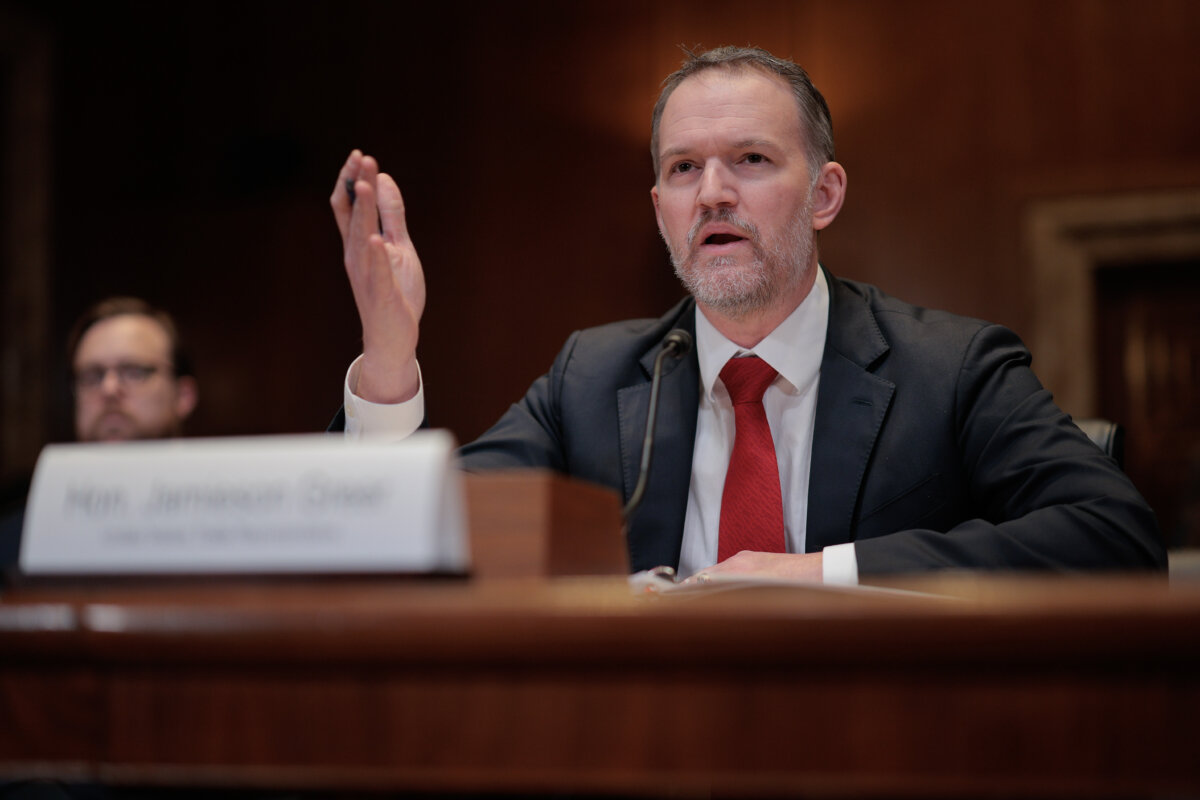

Top American trade negotiator Jamieson Greer said the Trump administration may make separate trade deals with Canada and Mexico instead of renewing the U.S.-Mexico-Canada Agreement (USMCA) next year.
Greer said during a Dec. 10 discussion held by the Atlantic Council think tank that his country might make different deals with the two nations because the American trade relationship with Canada is “very different” than its relationship with Mexico.
“The labour situation’s different. The import-export profile is different. The rule of law is different,” Greer said. “We’re already talking to them separately.”
Greer, who has served as the U.S. trade representative in the Trump cabinet since February of this year, is the lead negotiator for all U.S. trade matters and determines trade policy in coordination with U.S. President Donald Trump.
Canada, the United States, and Mexico have had a free trade agreement for more than three decades, with the USMCA preceded by the North American Free Trade Agreement signed in 1992.
The three nations must each decide whether they want to renew the agreement, renegotiate it, or allow it to expire by July 1, 2026. For his part, Greer is required to inform Congress by Jan. 2 of next year what the Trump administration intends to do with regard to the USMCA.
Although he said all options are “on the table” when it comes to the USMCA, Greer added that he has not yet met jointly this year with representatives from Canada and Mexico together to discuss the future of the agreement.
Greer previously said that the United States is focused on boosting its manufacturing base.
“If the United States does not have a robust manufacturing base and innovation economy, it will have little in the way of hard power to deter conflict and protect Americans,” Greer told the U.S. Senate Finance Committee on Dec. 9. “I am convinced that we have a relatively short window of time to restructure the international trading system to better serve U.S. interests.”
He told senators that he is focused on creating stricter regulations around USMCA’s rules of origin requirements that determine which goods enjoy free trade in all three markets.
Cabinetmakers, truck parts manufacturers, and transport manufacturers have accused Canadian companies of using cheaply produced Chinese materials in Canadian products and then selling them tariff-free in the United States under USMCA provisions. The sectors are now subject to 25 percent U.S. tariffs. The Canadian Kitchen Cabinet Association has rejected the accusations, saying the products are Canadian-made.
Indicating that remaining in USMCA is still a possibility, Greer said Dec. 10 that working out consistent regulations on rules of origin might be best handled in a unified trade agreement, as well as coordinating on trade policy and critical minerals.
The United States is currently applying 35 percent tariffs on most non-USMCA compliant Canadians goods exported stateside, along with a 50 percent sectoral duty on steel, copper, and aluminum, and 25 percent on various furniture and certain auto parts. Canada’s lumber sector is also subject to considerable tariffs and duties.
The Trump administration halted trade discussions with Canada Oct. 23 after Ontario aired an anti-tariff ad in the United States.
 Friends Read Free
Copy
Facebook
Tweet
Friends Read Free
Copy
Facebook
Tweet