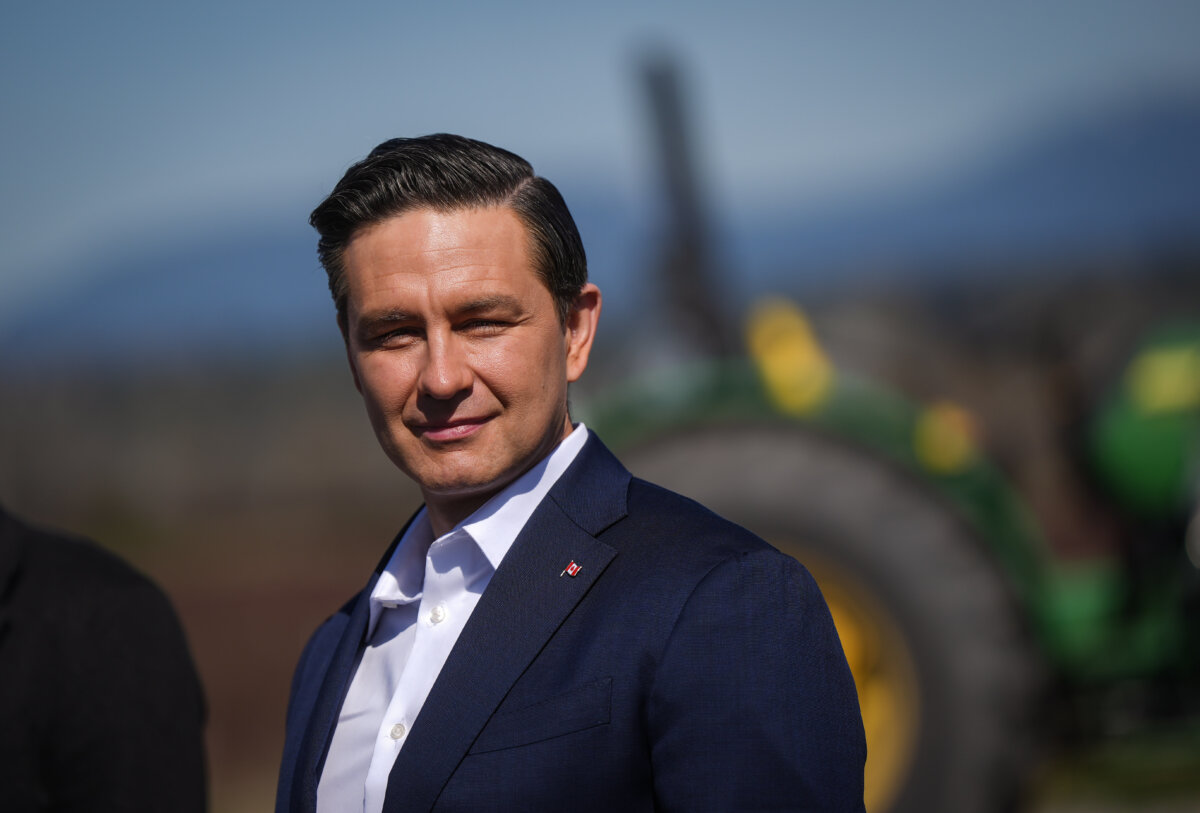
Conservative leader Pierre Poilievre is calling on the Liberal government to support a House of Commons motion that seeks to protect the property rights of landowners in the wake of the Cowichan Tribes decision in B.C.
The symbolic motion calls for the Liberal government to reverse a federal litigation guideline and require federal lawyers to argue that private property rights take priority over other forms of title. The motion will be put to a vote in Parliament on May 25.
The initiative follows a 2025 B.C. Supreme Court decision in Cowichan Tribes v. Canada, which recognized Aboriginal title over portions of land in Richmond, B.C. The ruling said Aboriginal title is a constitutionally protected interest and found that some government-granted land interests were inconsistent with that title. The decision is currently under appeal by the federal and B.C. governments, as well as other affected parties.
B.C. formally adopted the principles of the United Nations Declaration on the Rights of Indigenous Peoples into provincial law in 2019 through the Declaration on the Rights of Indigenous Peoples (DRIPA), committing to work toward aligning provincial laws and policies with the declaration over time and to strengthen consultation and cooperation with indigenous nations on decisions affecting their rights and territories.
Ottawa also signed three agreements with the Musqueam Indian Band in February, which formally recognizes the Band’s Aboriginal rights over its traditional territory encompassing much of Metro Vancouver, and increases its control over fisheries and marine emergency management along parts of B.C.’s south coast.
The federal government and B.C. government have filed an appeal against the Cowichan decision, along with the City of Richmond, Vancouver Fraser Port Authority, Tsawwassen First Nation, and the Musqueam Indian Band.
Prime Minister Carney said on April 29 in the House of Commons that property rights in Canada are “fundamental” and would be protected by the federal government. He said the Liberal government “fundamentally disagrees” with the decision.
Carney added that he’d “always advance viable legal arguments to protect private property.”
B.C. Premier David Eby told reporters on May 4 that he was “encouraged” that Carney also disagreed with the B.C. Supreme Court decision, and that the two were “on the same page.”
Speaking to reporters in Vancouver on May 21, Poilievre said the Cowichan Tribes ruling has impacts across B.C. and said clearer protections are needed as legal disputes involving Aboriginal title continue.
“If this precedent holds up, then all British Columbians may face the loss of their title,” he said.
The Conservative leader said that despite the Cowichan Tribes case being directed at the federal government and not the B.C. government, Carney has kept in place directives that ban federal lawyers from fighting for property rights.
“The Prime Minister is not a passive player, subject to the whims of the courts,” Poilievre said in a release. “It is his government that gives litigation guidelines, negotiates agreements and sets policy on these issues. If he truly believes property rights are ‘fundamental’, he will do what is in his power to protect them.”
Poilievre said the Conservative motion would also require explicit property protections in all future federal agreements with First Nations, “so homeowners and businesses can take comfort in knowing their title is firm.”
The motion would also require Carney to “personally” publish a plan within 30 days to protect Canadians affected by risks to their property rights after the Cowichan decision and Musqueam agreements. A special committee would also be appointed to study the legal and political steps that Parliament could take to protect private property rights.
“These are reasonable steps. They are all within the power of the federal government, and they are urgently needed,” Poilievre said.
 Friends Read Free
Copy
Facebook
Tweet
Friends Read Free
Copy
Facebook
Tweet