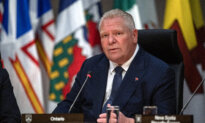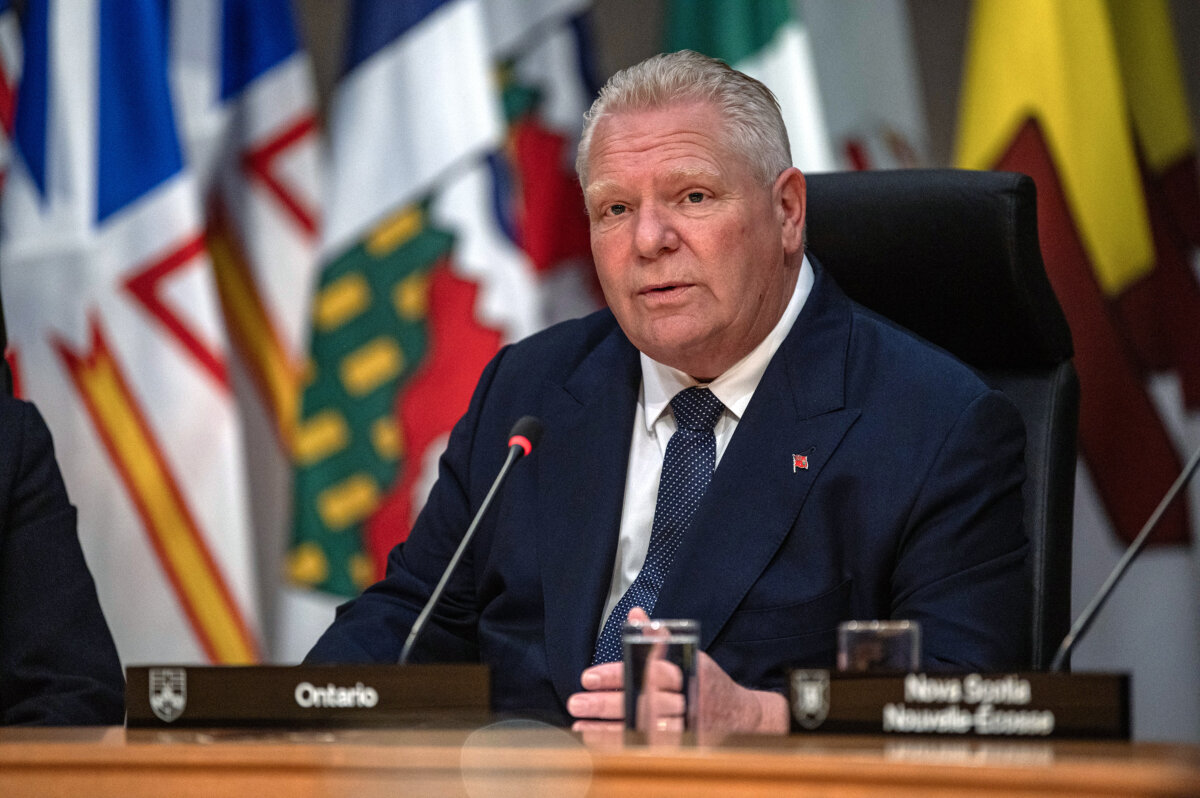

Ontario Premier Doug Ford is predicting U.S. President Donald Trump will call for an early renegotiation of the existing free trade agreement between Canada and the United States, potentially as soon as this fall.
Ford told reporters at an Aug. 6 press briefing at Queen’s Park that U.S. President Donald Trump could “pull the carpet out from underneath us” at any time when it comes to renegotiating the United States-Mexico-Canada Agreement (USMCA).
The free trade agreement is not set to be reviewed until next year, but Ford said he doesn’t think Trump will stick to that, adding that he believes Trump will reopen the deal as early as November.
Canada needs to be prepared for Trump to confront Canada with “double barrels” when it is time to renegotiate the deal, he added.
“Fasten your seatbelts. He is going to come at us with everything he has and we have to make sure that we’re ready,” Ford said.
“We better be ready and throw everything and the kitchen sink at this. This isn’t going to be a church picnic.”
Ford made the comments following the private meeting of the country’s provincial premiers and Prime Minister Mark Carney, which was the first since Trump heightened his trade war by applying a baseline 35 percent tariff on Canada at the beginning of the month. The new tariff applies only to goods not covered by the USMCA.
An Aug. 6 readout from the Prime Minister’s Office said Carney briefed the premiers on the progress of trade negotiations with the United States during the meeting. It emphasized that although Canada is still in discussions with its southern neighbour, “the impacts of tariffs remain present across the Canadian economy.”
Carney and the premiers discussed concrete actions the country could take to support Canadian workers and businesses most impacted by tariffs, the readout said, noting that the group agreed to “accelerate efforts to mobilize capital and investment, diversify supply chains, and strengthen domestic production capacity.”
“They were also unanimous in encouraging Canadian businesses to prioritize and leverage Canadian expertise, where possible, to help alleviate the short-term economic impacts of U.S. tariffs, reduce dependence on vulnerable trade flows, and build Canada’s long-term economic resilience,” it said.
Ford told reporters he has confidence in Ottawa to do what is best for Canada, adding that “no deal is better than a bad deal,” but also noted that the time for action is now.
“We need to move faster, quicker, immediately. That was my message,” Ford said, sharing the thoughts he communicated to Carney in the meeting.
Trade Talks
Ford was asked when the prime minister and the president would next discuss trade between the two countries. The premier said he didn’t know when the next call between Carney and Trump would take place, but he expects that it will be in the coming days.
Carney, who did not make himself available to the media on Aug. 6, told a press conference in B.C. the day before that he has not talked to Trump in recent days but that they would speak “when it makes sense.”
He noted that 85 percent of trade with the U.S. remains tariff-free because of the USMCA, with the exception of sector-specific tariffs such as the 50 percent tax on aluminum, copper, and steel.
Carney said he would consider lifting counter-tariffs on the United States if that helps. “We look at what we can do for our industry that’s most effective,” he said. “In some cases, that will be to remove tariffs.”
Other than China, Canada is the only other country in the world that placed retaliatory tariffs on U.S. goods. Ottawa imposed a 25 percent tariff on select U.S. products in February, but has not escalated its response to the increased 35 percent tariff on Canada.
 Friends Read Free
Copy
Facebook
Tweet
Friends Read Free
Copy
Facebook
Tweet