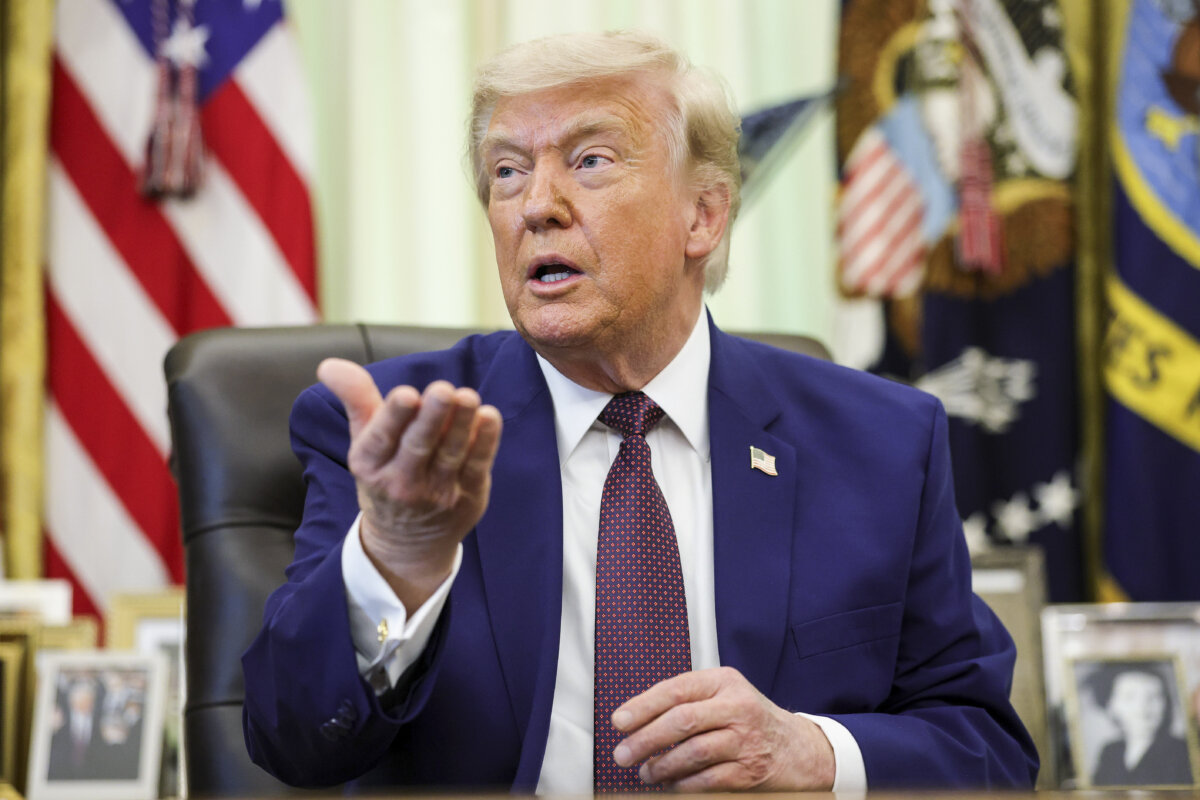

President Donald Trump on Wednesday pushed back against criticism of a memorandum of understanding between the United States and Iran announced by U.S. officials earlier in the day, saying that Tehran must adhere to the agreement.
“If [the Iranian regime doesn’t] honor the agreement, or some things aren’t even mentioned in the agreement, it’s a memorandum of understanding, but we have an understanding of certain things without writing it,” Trump told reporters at the end of the Group of Seven, or G7, summit in France on Wednesday. “If they don’t honor that, we’ll probably go back to bombing them until they honor it.”
The U.S. president cited global economic damage caused by the conflict as a reason for signing the memorandum. Throughout the conflict, Iran shut down the Strait of Hormuz, which has caused the price of oil and gasoline to surge.
Trump said that during the G7 summit, none of the nations that attended asked him to continue the campaign against Iran. Canada, France, Germany, Italy, Japan, and the United Kingdom, as well as the European Union, are part of the group.
“There’s not one nation that came to us and said, ‘Please, sir, keep dropping bombs on them. Please keep dropping bombs,’” he said, adding that the bombing campaign was “expensive.”
“On Sunday, we reached an agreement with Iran that achieves everything we set out to accomplish—everything and much more,” Trump said. “Ending the current conflict, reopening the Strait of Hormuz, and preventing Iran from obtaining a nuclear weapon, that’s what it was all about. That was about 99 percent. Iran cannot have a nuclear weapon.”
His remarks came hours after a U.S. official told The Epoch Times and other media outlets the contours of the memorandum of understanding, which calls for Iran to either remove or dilute its uranium, end its controversial nuclear program, and open the strait, after which the United States will waive sanctions against the regime.
The language of the memorandum was dictated to reporters after it was not released for a few days following an announcement by Trump over the weekend that was later confirmed by Tehran.
The accord would also provide Iran with at least $300 billion, provided by private-sector investments and Gulf-region partners, to rebuild. The mechanism for the implementation of the plan has to be finalized within 60 days, according to the memo.
The United States and Israel launched military operations against Iran on Feb. 28 in part to prevent the terrorism-backing regime from ever getting a nuclear weapon, killing dozens of the country’s top leaders, including Ayatollah Ali Khamenei, in the first week. A ceasefire was announced by Trump in mid-April, allowing for negotiations, while the U.S. military imposed a blockade on the country’s ports.
The deal also said the United States will lift the Iranian port blockade and that the strait will return to its prewar traffic levels in 30 days, while acknowledging Iranian mines may need to be destroyed.
After the agreement was released to the public, a handful of House Democrats said they wanted the Trump administration to brief Congress on the deal and said that any “side agreements,” issues related to Iran’s nuclear program, and the reconstruction fund must be addressed.
Some Republicans, meanwhile, criticized the move.
“Before the war, the strait was open, Iran was being crushed by sanctions, and 13 service members were still alive. Now, 13 Americans are dead, families have paid billions at the pump, sanctions will be lifted, and the bombing has stopped,” outgoing Sen. Bill Cassidy (R-La.), whose Senate primary campaign was effectively killed after Trump endorsed his GOP challenger earlier this year, wrote on social media.
The Associated Press contributed to this report.
 Friends Read Free
Copy
Facebook
Tweet
Friends Read Free
Copy
Facebook
Tweet