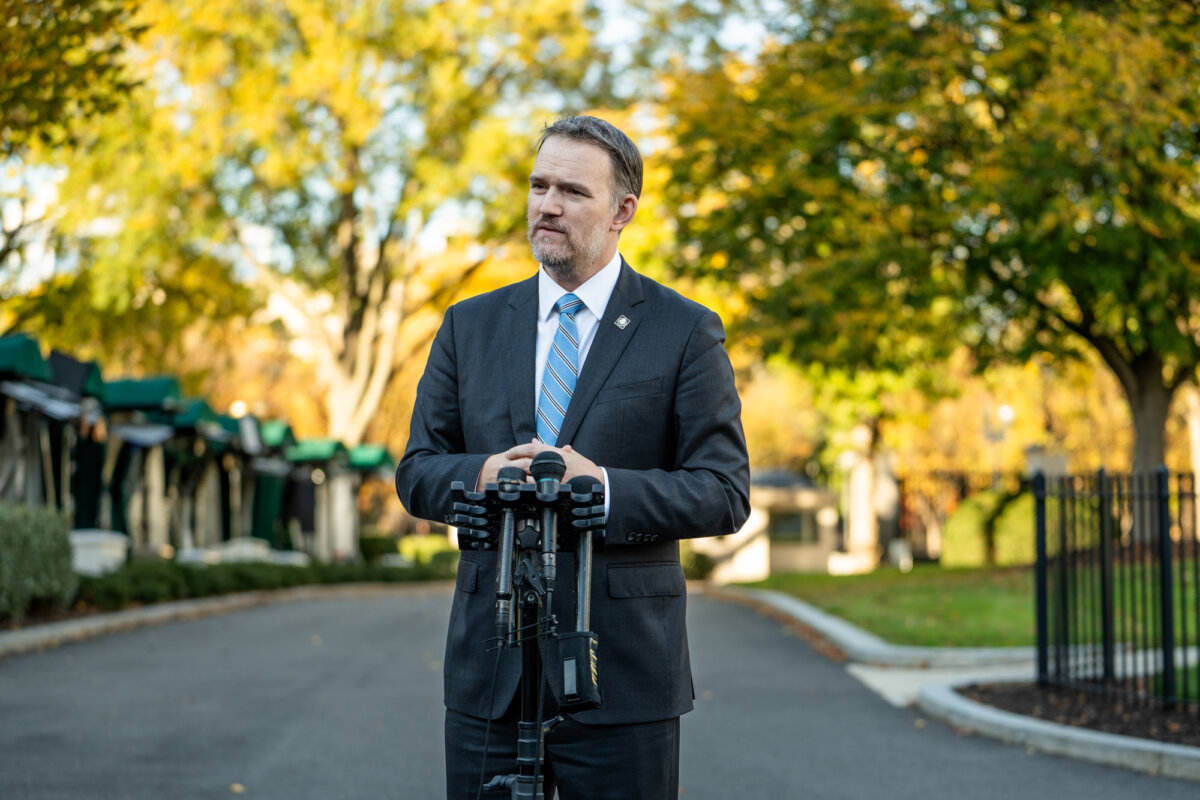

A top trade official in the U.S. administration says Mexico is ahead of Canada in negotiations pertaining to the review of the North American free trade deal.
U.S. Trade Representative Jamieson Greer made the comments to Fox Business on March 18, as formal talks between the American and Mexican sides begin this week.
The White House said last year it would trigger the review process in the United States-Mexico-Canada Agreement (USMCA) on free trade. The review will start this July, and as part of the process all sides have been engaging.
“We’re having talks separately with Canada, but we’ve moved along with Mexico,” Greer said. “Canada is behind on this with Mexico, we’re already at the stage of some formal talks.”
Since U.S. President Donald Trump took office last year and implemented his tariff agenda, Mexico has taken a more low-key approach to the trade disruption than Canada.
Prime Minister Mark Carney was elected on a platform of standing up to Trump. In his January speech at the World Economic Forum in Davos, Switzerland, Carney directed thinly veiled criticism at Trump’s policies.
Before that, Canadian and U.S. officials had been inching closer to a deal on steel, aluminum, and energy. The trade talks were cancelled by Trump in October 2025 when the Ontario government ran an anti-tariff TV ad campaign in the United States.
Carney says Canada currently has the “best” trade deal with the United States, as most goods remain duty-free. Meanwhile, Trump’s sectoral tariffs on steel, aluminum, and autos have significantly impacted local industries.
Focus of Talks
Greer’s office announced on March 5 that the first round of bilateral talks with Mexico on the USMCA review would begin the week of March 16. No similar announcement has been made for Canada.
Greer said the talks with Mexico will focus on the “rules of origin” concept, which relates to the amount of North American content that needs to go into the manufacturing of goods for them to cross borders duty-free.
The White House is concerned about foreign countries using its neighbours as transshipment hubs to benefit from free access to the United States.
“We just don’t want Mexico to become a hub for goods imported from Vietnam or China, somewhere else,” Greer said. “If we’re going to have some kind of a deal, it has to be a deal for Mexico and the United States. And the goods should be made up of content for Mexico or the United States.”
Greer’s office had announced last week the United States was launching a trade investigation into 60 countries, including Canada, in relation to goods made by forced labour.
The investigations could provide the legal grounds for the White House to impose new tariffs, following the U.S. Supreme Court’s decision that Trump had overstepped his authority in using the International Emergency Economic Powers Act (IEEPA) for his tariff agenda.
In commenting on this investigation last week, Carney said the USMCA has provisions on labour standards and that Canadian law has “stronger provisions.”
Informal Talks
While there have been no formal talks launched between Canada and the United States, the two sides held discussions at high levels earlier this month.
Carney had a call with Trump on March 8, and the Prime Minister’s Office said they discussed bilateral trade and the economy.
The leaders’ call took place shortly after Canada-U.S. Trade Minister Dominic LeBlanc visited Washington, D.C., to meet with U.S. Trade Representative Greer.
“We had a constructive and substantive discussion pertaining to the Canada-United States-Mexico Agreement (CUSMA) Joint Review process, and on broader bilateral trade issues,” LeBlanc said on social media after the March 6 meeting.
After that meeting, Carney said Canada and the United States have been holding talks “beneath the surface” over the last year on issues such as unspecified trade irritants and “big structural issues.”
The prime minister also said Canada doesn’t need to be at the table for the bilateral talks between Mexico and the United States, since Ottawa has a different set of issues to iron out with Washington.
Trump and Greer have publicly complained about dairy tariffs imposed by Canada on U.S. farmers, something other U.S. administrations have identified as a trade barrier.
U.S. Vice President JD Vance also spoke on trade with Canada during a stop in Michigan on March 18, in response to a reporter’s question.
“Our hope with Canada, and I think we’ll get there eventually, is we’re going to get to a point where Canada treats our workers fairly, we treat their workers fairly, and they’re going to be a true ally and a true friend, not somebody who’s taking advantage of us, which is what they’ve done for most of my life,” he said.
Vance also criticized Canada for not having a robust military. “Canada pays virtually nothing, at least until a couple of years ago, for their own security, which means we had to foot the bill for that security,” he said.
The comments came the same day that Defence Minister David McGuinty said Canada would reach the NATO spending guideline of 2 percent of GDP by the end of the fiscal year on March 31.
NATO allies, under pressure from Trump, have all increased defence spending in the last year to reach the 2 percent guideline. Most, including Canada, have also agreed to increase spending to 5 percent by 2035.
 Friends Read Free
Copy
Facebook
Tweet
Friends Read Free
Copy
Facebook
Tweet