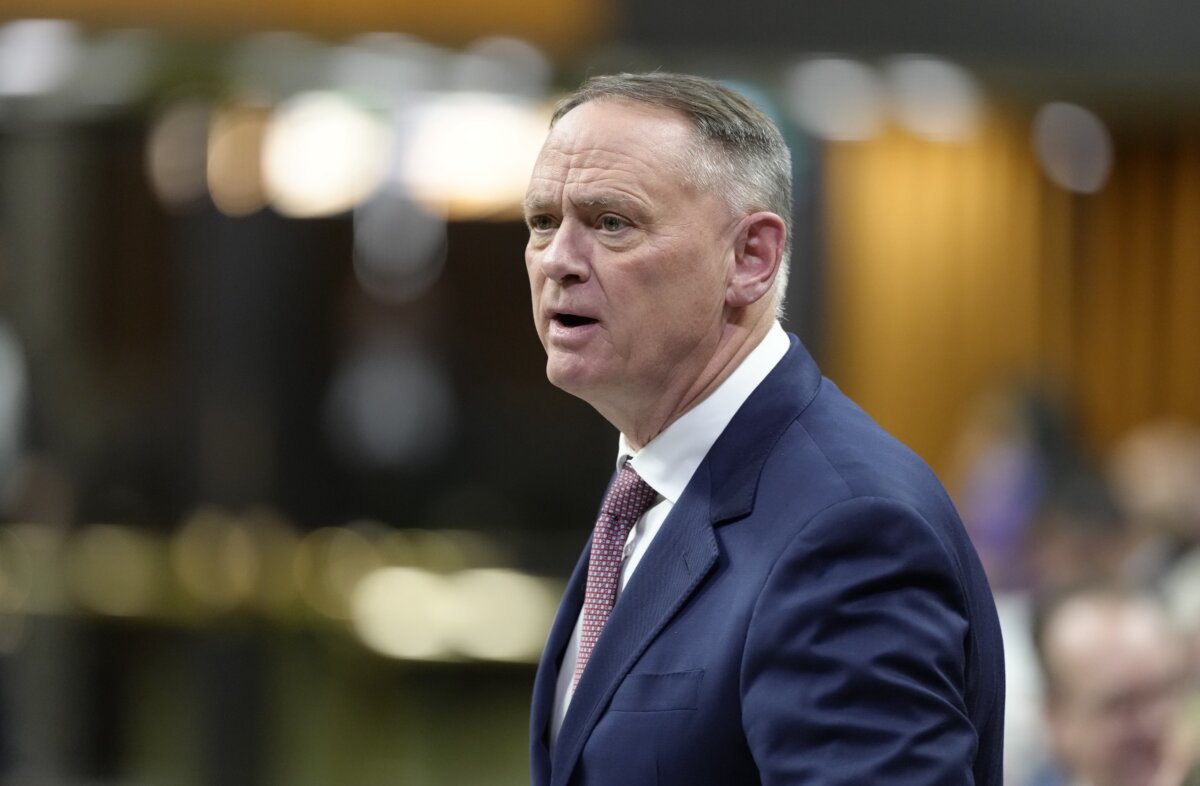

Defence Minister David McGuinty says Ottawa will fulfil its pledge to meet NATO’s defence spending target of 2 percent of GDP by the end of this month.
McGuinty made the remarks during a March 18 press conference announcing increased funding for domestic ammunition production. He was asked by reporters whether Canada might fail to meet the target by the end of the fiscal year, given what a reporter described as an apparent “last-minute spending spree” in the sector.
“No, it’s not possible. We will be achieving our 2 percent spend by March 31,” McGuinty replied.
“This is not about a last-minute spending spree,” he added. “This is a systematic rollout, executing on a plan that was devised some time ago, and we’ll have more to say about this as time rolls on.”
McGuinty said Ottawa is now “laying track” for its plan to achieve its 3.5 percent target by 2029-2030, and its target of 5 percent by 2035.
Ottawa has pledged to invest the equivalent of 2 percent of its GDP in defence this fiscal year, which ends on March 31.
Prime Minister Mark Carney’s government has also said it is committed to increasing its defence spending to 5 percent of GDP by 2035, which other NATO allies also committed to at their summit last year. Canada has not seen that level of defence spending since the Cold War.
As part of the 5 percent pledge, Canada must spend 3.5 percent of GDP on core defence areas, such as investments in the Canadian Armed Forces (CAF), upgrading military equipment and technology, bolstering Canada’s defence industries, and diversifying defence partnerships.
In addition, 1.5 percent must be spent on defence-associated areas, including critical defence and security-related infrastructure such as new airports, ports, telecommunications, emergency preparedness systems, and other dual-use military-civilian initiatives, as well as the procurement of critical minerals needed for defence and advanced technology supply chains.
NATO’s 2 percent benchmark was formally agreed upon in Wales in 2014, but Canada has consistently fallen short of the target.
Carney announced last June that Canada would massively increase military spending to meet the target. He said Ottawa’s plan to boost defence spending is not to please “NATO accountants,” but to protect Canadians against new threats from advanced missile capabilities.
NATO announced last August that all member nations were on track to meet the 2 percent goal. The alliance’s most recent figures estimate Canada’s 2025 defence spending at 2.01 percent of GDP.
Carney’s government also promised in its first budget, released last November, to “put Canada on a pathway” to meet the 5 percent target by 2035. The budget included more than $81 billion in funding over five years to build up the CAF.
Former Parliamentary Budget Officer Jason Jacques said in a Feb. 5 report that meeting NATO’s 5 percent target will add an estimated $63 billion to Canada’s federal budget deficit by 2035. He noted that the government has not disclosed how it intends to fulfil the 5 percent target, but estimated the expenses will total approximately $33.5 billion per year for the next 10 years.
The Department of National Defence has not responded to specific requests about the budget or Canada meeting its NATO targets.
Recent Defence Announcements
Ottawa has made several major defence spending announcements as the fiscal year nears its end.
McGuinty announced on March 18 that Ottawa will spend $1.4 billion to expand Canada’s domestic ammunition production capacity through two new heavy munitions plants in Ingersoll, Ont., and Repentigny, Que.
The defence minister also highlighted Canada’s recent contributions to Ukraine during a March 17 press conference, including a $2 billion support package Carney announced in late February.
The package included a donation of 400 armoured vehicles to Ukraine, with 383 Roshel Senator vehicles made in Canada. This builds on Canada’s previous donations, including 200 Roshel vehicles in 2023, and an initial eight vehicles in 2022.
In addition, McGuinty announced $200 million in funding on March 16 for a Canadian-owned launch pad to send satellites into orbit without the help of other nations or foreign third parties.
Last week, Ottawa announced it is allocating nearly $35 billion to boost its military presence in the Arctic and to improve infrastructure. This is part of a funding package for the modernization of the North American Aerospace Defence Command (NORAD) announced earlier by the previous Liberal government.
Days earlier, Industry Minister Mélanie Joly said Ottawa is allocating more than $900 million in funding to the National Research Council for drone technology and other domestic defence initiatives, including the acquisition of a Bombardier jet for research.
Some of the recent defence announcements have come as part of Ottawa’s new $6.6 billion Defence Industrial Strategy unveiled by Carney last month, which aims to boost Canada’s domestic military manufacturing capability.
Carney said the plan would create more Canadian jobs and strengthen Canadian defence companies. Meanwhile, Conservative Leader Pierre Poilievre said the plan is creating more bureaucracy without adequately speeding up the procurement of military equipment.
Jennifer Cowan, Paul Rowan Brian, and The Canadian Press contributed to this report.
 Friends Read Free
Copy
Facebook
Tweet
Friends Read Free
Copy
Facebook
Tweet