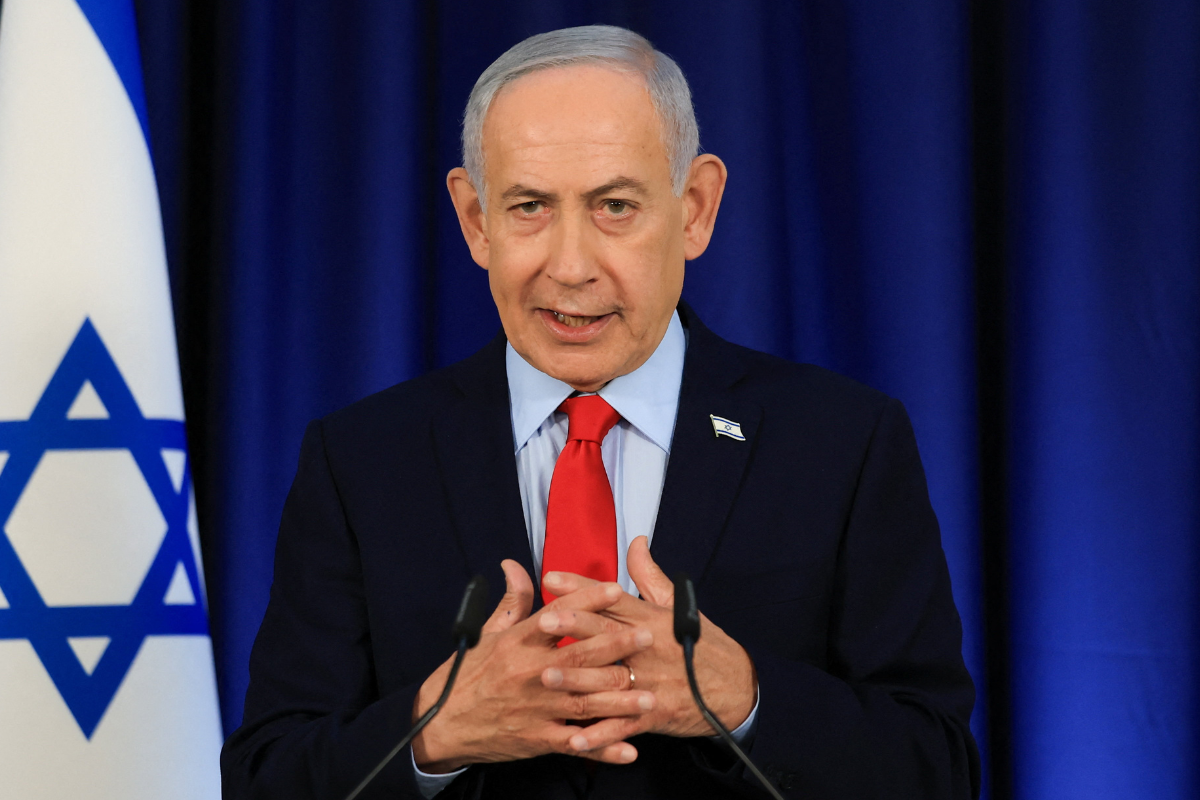

The United Arab Emirates (UAE) has denied Israeli claims that Prime Minister Benjamin Netanyahu “secretly visited” Abu Dhabi during the Iran war, despite Israel’s statement that the trip produced a “historic breakthrough” in relations between the two countries.
In a May 13 post on X, Netanyahu’s office said the Israeli leader met UAE President Mohammed bin Zayed Al Nahyan during “Operation Roaring Lion,” the joint U.S.–Israel military campaign against Iran that began in late February.
But Abu Dhabi said reports of such a visit, or of receiving an Israeli military delegation, were “baseless.”
“In the midst of Operation Roaring Lion, Prime Minister Benjamin Netanyahu secretly visited the United Arab Emirates, where he met with UAE President Sheikh Mohamed bin Zayed,” the post by Netanyahu’s office said.
The gathering “resulted in a historic breakthrough in relations between Israel and the United Arab Emirates,” it said.
However, in a post later the same day on X, the UAE denied that a visit had happened.
“The UAE denies what is being circulated regarding a visit by the Israeli Prime Minister or the reception of an Israeli military delegation,” it said.
In the statement, it said that the UAE “stresses that any claims about unannounced visits or arrangements are baseless unless issued by the official authorities concerned in both countries.”
It called on media outlets “to verify accuracy and not circulate unverified information or use it to create political impressions.”
The UAE said that its relations with Israel are “currently limited to diplomatic channels necessary within the framework of the consular agreement serving the interests of UAE nationals and Emirati entities, and within the context of the ceasefire in Gaza.”
The UAE has recently faced missile and drone attacks during and after the Iran war, despite a ceasefire between Tehran and the United States, which went into effect last month.
Iranian Foreign Minister Abbas Araghchi responded by warning that countries cooperating with Israel against Iran would be “held to account.”
In a May 14 post on X, he said: “Netanyahu has now publicly revealed what Iran’s security services long ago conveyed to our leadership.
“Enmity with the Great People of Iran is a foolish gamble. Collusion with Israel in doing so: unforgivable.
“Those colluding with Israel to sow division will be held to account.”
Israel has deployed Iron Dome missile defense batteries and personnel to the UAE during the Iran war, according to remarks by U.S. Ambassador to Israel Mike Huckabee.
Huckabee made the comments on May 12 during the Tel Aviv Conference hosted by Tel Aviv University and the Kadar Family Foundation.
“I’d like to say a word of appreciation for United Arab Emirates, the first Abraham Accord member,” Huckabee said at the event. “Just look at the benefits. Israel just sent them Iron Dome batteries and personnel to help operate them.”
Huckabee said the deployment reflected what he described as an “extraordinary relationship” between the UAE and Israel under the Abraham Accords.
The remarks came as an Iran war ceasefire continued to hold and as Gulf countries assess regional security arrangements after months of Iranian missile and drone attacks.
The comments also highlighted growing military cooperation between Israel and the UAE, which formally normalized relations under the 2020 Abraham Accords brokered by the United States.
The UAE became the first Gulf Arab state in decades to establish formal diplomatic relations with Israel under the Abraham Accords in 2020. Bahrain, Morocco, and Sudan have also joined as signatories.
Iran sharply criticized the normalization agreement in August 2020, describing it as a betrayal of the Palestinian cause and a threat to regional stability.
Huckabee said he remained “very optimistic” that more countries in the region would eventually join the Abraham Accords and normalize relations with Israel.
Evgenia Filimianova and Jack Phillips contributed to this report.
 Friends Read Free
Copy
Facebook
Tweet
Friends Read Free
Copy
Facebook
Tweet