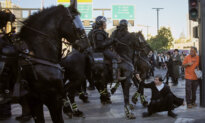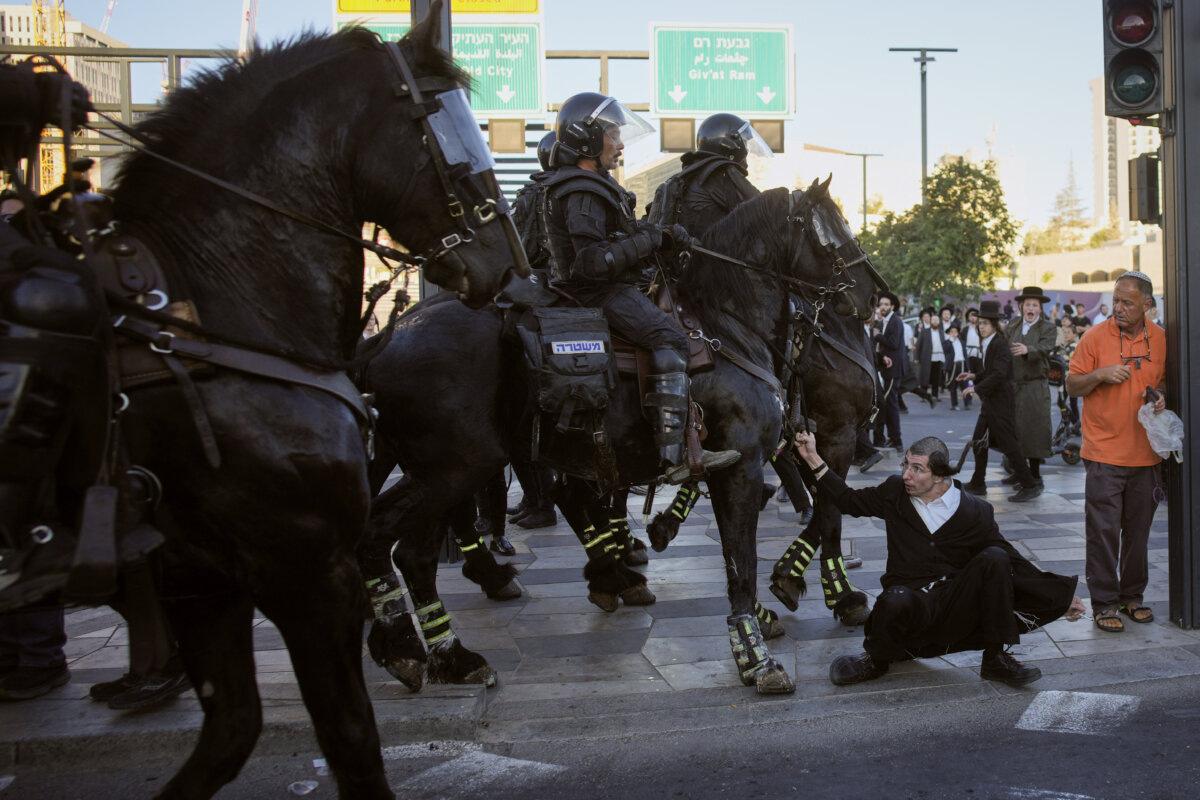
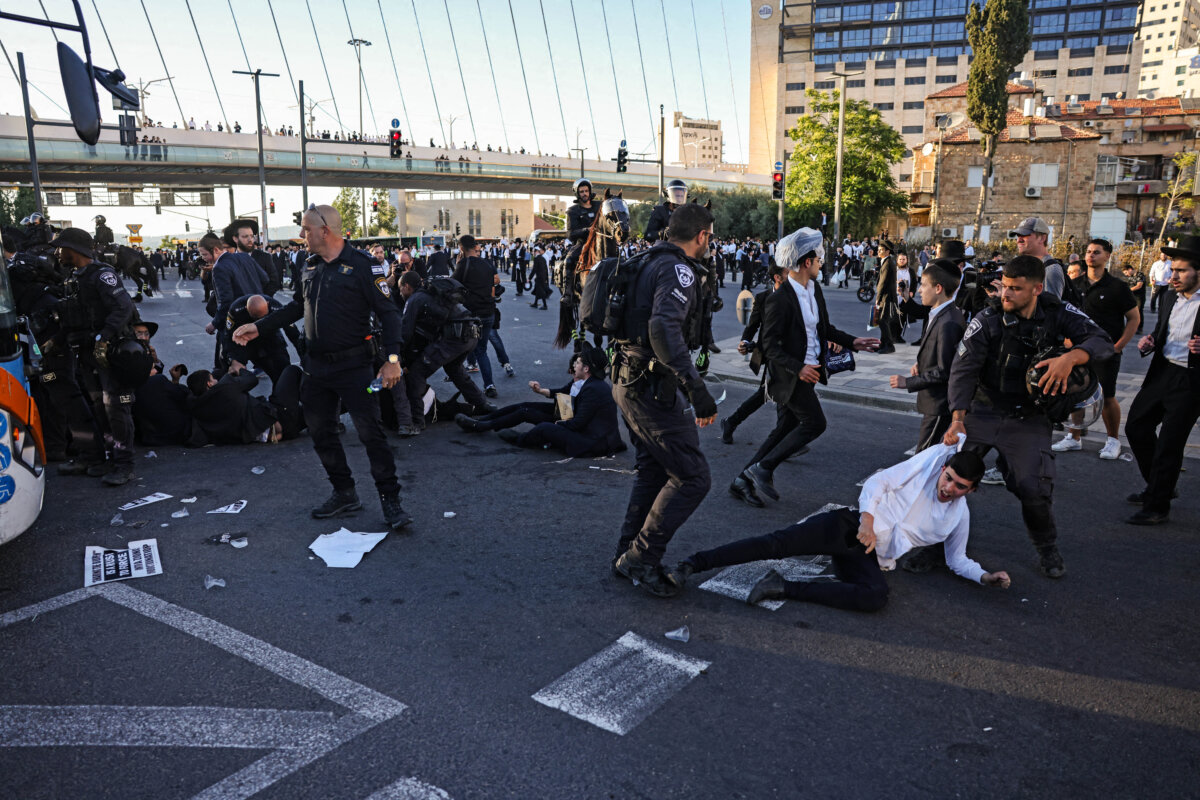
Tens of thousands of ultra-Orthodox Jews blocked roads and set fire to cars on June 1 to protest mandatory enlistment in Israel’s military.
The Israeli police said demonstrators blocked major intersections in both Jerusalem and Tel Aviv and attacked a soldier who got off a bus near a protest. Water cannons and mounted police officers were used to control the demonstrators.
Central Israel was largely paralyzed by the protests, with highways closed and public transportation halted in the metropolitan areas of Jerusalem and Tel Aviv.
Military service is compulsory for most Jewish men and women in Israel, but for decades, ultra-Orthodox Jews, or Haredim, have obtained exemptions from military service and instead use the time to study in religious seminaries.
Each year, fewer than 10 percent of the 13,000 ultra-Orthodox men who reach the conscription age of 18 enlist in the military, according to a Knesset committee.
Some of the demonstrators held signs that read, “We would rather die as Jews than live as Zionists,” and, “We refuse to serve an army for the sake of the Zionist religion.”
In a June 1 post on X, Yair Lapid, leader of the opposition Yesh Atid party, said the government had convinced a community that it is above the law.
“From the moment this government came to power, Netanyahu told the ultra-Orthodox: You are above the law. You are allowed to dodge the draft, you do not have to work, you will not be arrested, and the money will keep flowing,” Lapid wrote. “Now everyone is shocked that there is a group of ultra-Orthodox men rioting and acting violently toward police officers and IDF officers.”
In April, Lapid and Naftali Bennett—who served as Israeli prime minister between June 2021 and June 2022—said they were merging their parties to challenge Netanyahu in an election in October.
‘It’s a War for Our Lives’
One of the demonstrators in Jerusalem, Israel Tropper, said that for ultra-Orthodox Jews, “Going into the Israeli army means giving up religion … we don’t want to give up our religion, so from our perspective it’s a war for our lives.”
Israel’s Supreme Court ruled in 2017 that the exemptions—which date back to the birth of the state in 1948—were unconstitutional. After years of legal battles, Israel’s High Court ruled unanimously in 2024 that the Israel Defense Forces (IDF) must begin drafting all ultra-Orthodox men for compulsory service.
Last year, some of Israeli Prime Minister Benjamin Netanyahu’s political allies, from several ultra-Orthodox parties, proposed a conscription bill that would formalize exemption from service for ultra-Orthodox men.
In June 2025, Netanyahu survived a no-confidence vote in the Knesset over the bill, but the legislation has still not been passed.
The exemption of ultra-Orthodox Jews has become a major political issue, especially since the conflict that began in Gaza after Hamas terrorists crossed the border and murdered 1,200 people on Oct. 7, 2023.
IDF’s Resources Stretched
The IDF is currently occupying almost 70 percent of the Gaza Strip, as well as swaths of southern Lebanon and the south-western corner of Syria, and its air force and anti-drone and missile defenses have been engaged against Iran.
With its manpower stretched, the Israeli military is looking to extend the period of mandatory service.
Most Jewish men are required to serve nearly three years of military service, followed by several years of reserve duty, while Jewish women are required to serve two years.

The military service exemptions and the government stipends that many ultra-Orthodox students at seminaries receive up to the age of 26 are opposed by many non-Orthodox Israelis.
Several ultra-Orthodox parties have withdrawn their support for Netanyahu’s coalition government, forcing him to call elections for this fall.
On May 13, Netanyahu submitted a bill to dissolve parliament, the first step before an election, which must be called by the end of October.
The Associated Press contributed to this report.
 Friends Read Free
Copy
Facebook
Tweet
Friends Read Free
Copy
Facebook
Tweet