
The State Department announced on June 5 nearly $38 million in additional funding to support the U.S. response to an Ebola outbreak in Congo and neighboring Uganda, bringing the State Department’s total contributions for the effort to more than $200 million.
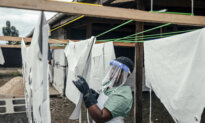
The department said the new money will expand contact tracing, border and airport screening, supplies for health clinics, community education campaigns to counter misinformation, safe and dignified burials, diagnostic capacity, and food assistance for patients and health workers.
Partners on the initiatives include the International Organization for Migration, UNICEF, World Vision, International Medical Corps, and other organizations that are carrying out the effort on the ground.
The announcement came on the same day that the Centers for Disease Control and Prevention (CDC) released scientific reports on the outbreak, including projections showing that limited patient isolation could allow the outbreak to become one of the largest ever recorded.
According to Congo’s health ministry, the country has recorded 452 confirmed cases and 82 deaths as of June 5, with 71 new confirmed cases in the prior 24 hours, with rapid community transmission. Smaller numbers of cases have been confirmed in Uganda.
The outbreak involves the Bundibugyo strain of Ebola, for which no vaccine or specific treatment has been approved.
The State Department emphasized that protecting the health of Americans and preventing the virus from reaching U.S. shores remain its top priorities. It has issued guidance for U.S. citizens in the affected countries, continues to work closely with the CDC and the governments of Congo and Uganda, and maintains strict travel and screening measures.
U.S. embassies are giving updated health and safety information to Americans in the region, and citizens are asked to enroll in the Smart Traveler Enrollment Program.
The United States is the biggest financial contributor to the Ebola response. In addition to the more than $200 million in direct funding, the United States has provided $350 million for Ebola response and other humanitarian assistance in Congo, South Sudan, and Uganda as part of a $1.8 billion contribution to the U.N. Office for the Coordination of Humanitarian Affairs announced on May 14.
Thirteen U.S. treatment centers in a government-funded hospital network remain at the ready to handle Ebola patients as necessary. The CDC maintains about 30 staff in its Congo office and approximately 100 in Uganda, with additional experts deployed in recent weeks.
The current outbreak began in May in Ituri province in northeastern Congo, in areas affected by insecurity, population displacement, mining activity, and frequent cross-border movement. It quickly spread to Uganda. On May 17, the World Health Organization declared the spread of the virus a public health emergency of international concern.
When the outbreak was first confirmed in mid-May, Congolese health authorities reported dozens of deaths and hundreds of suspected cases. Initial figures posited about 80 deaths and more than 200 suspected cases before laboratory confirmation expanded, and the WHO took action.
2014–2016 West Africa Outbreak
The current outbreak represents the 17th Ebola outbreak in Congo since 1976.
On June 5, the CDC issued warnings on the current outbreak based on modeling scenarios.
“Model-based scenario projections of the current BVD outbreak suggest that if large-scale and sustained public health interventions are not rapidly implemented to reduce disease transmission, this outbreak could become as large as the 2014–2016 West Africa Ebola virus disease outbreak,” the CDC stated.
Health officials at the CDC further underscored that rapid isolation, contact tracing, and community engagement are key to preventing the uncontrolled spread that was seen in the 2014–2016 West Africa epidemic, which resulted in more than 28,000 cases and 11,000 deaths.
The CDC and partners continue to publish detailed epidemiological and modeling updates to guide the international response.
The State Department said U.S.-funded efforts are already supporting dozens of health facilities and reaching hundreds of thousands of people through sensitization campaigns and training of community health workers and volunteers.
No Ebola cases linked to this outbreak have been reported in the United States. Officials said the response will remain focused on source containment while maintaining robust domestic preparedness and measures to prevent the virus from crossing U.S. borders.
 Friends Read Free
Copy
Facebook
Tweet
Friends Read Free
Copy
Facebook
Tweet