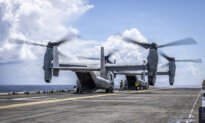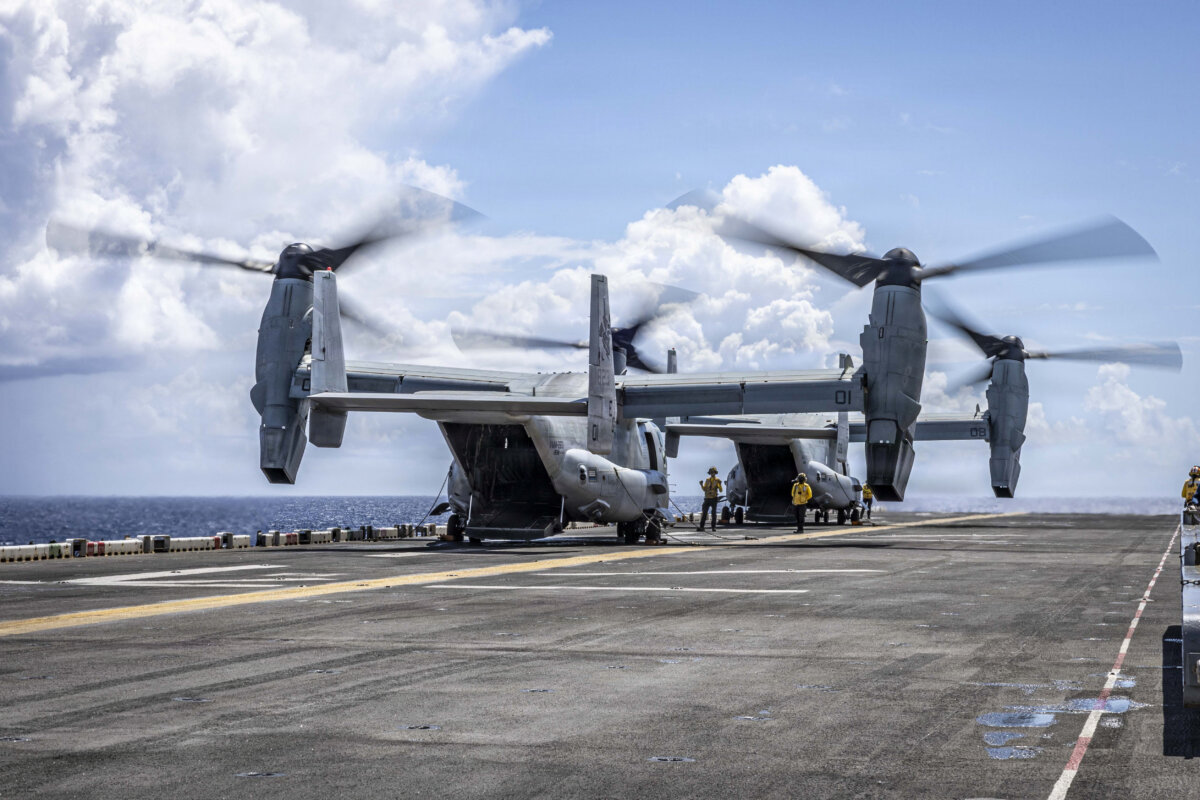

A contingent of U.S. troops conducted a rapid response exercise in the Venezuelan capital city of Caracas on May 23, the first military exercise in the South American nation since U.S. special operations forces raided the city and captured former Venezuelan leader Nicolás Maduro and his wife, Cilia Flores, on Jan. 3.
The troops flew in aboard a pair of U.S. Marine Corps MV-22B Osprey tiltrotor aircraft. Also aboard the aircraft was Marine Gen. Francis L. Donovan, the commander of the U.S. Southern Command.
It was Donovan’s second official visit to Venezuela. He used the opportunity to meet with leaders and staff of the recently reopened U.S. Embassy and with Venezuela’s interim leadership.
Venezuela’s state-run Telesur news agency reported that Venezuela’s interim leaders authorized the U.S. military drills, with coordination through the country’s foreign ministry and its air traffic control network.
Since ordering the nighttime assault to capture Maduro and his wife, U.S. President Donald Trump has allowed Maduro’s deputy, Venezuelan Vice President Delcy Rodríguez, to serve as the country’s acting president through a transitional phase.
Maduro and his wife are currently facing criminal prosecution in the United States on drug trafficking and terrorism-related charges. Last month, the U.S. government agreed to relax sanctions to permit the Venezuelan interim government to fund the couple’s legal defense.
The Trump administration has described a three-phase plan for Venezuela’s post-Maduro transition period, including an initial stabilization effort, gradual reconciliation for Maduro’s political opposition, and eventual elections.
“We remain committed to ensuring the implementation of [the president’s] three-phase plan — particularly the stabilization of Venezuela — and the importance of shared security across the Western Hemisphere,” the U.S. Southern Command wrote in an X post addressing the military exercise in Caracas on May 23.
The post-Maduro transition has also involved efforts to make Venezuela more accessible to international business.
In January, the U.S. Treasury Department began granting some licensing for international investors—except those linked to Russia, China, North Korea, Iran, and Cuba—to participate in Venezuela’s oil industry.
In March, the United States began granting similar licenses for investors to participate in Venezuela’s broader mineral resource extraction industry. These licenses also stipulated continuing restrictions on people located in Russia, China, North Korea, Iran, and Cuba or in connection with entities owned or associated with those countries.
The U.S. government has also eased sanctions on Venezuelan state-owned oil and gas enterprises to help counteract supply disruptions in the Middle East brought on by recent fighting with Iran.
 Friends Read Free
Copy
Facebook
Tweet
Friends Read Free
Copy
Facebook
Tweet