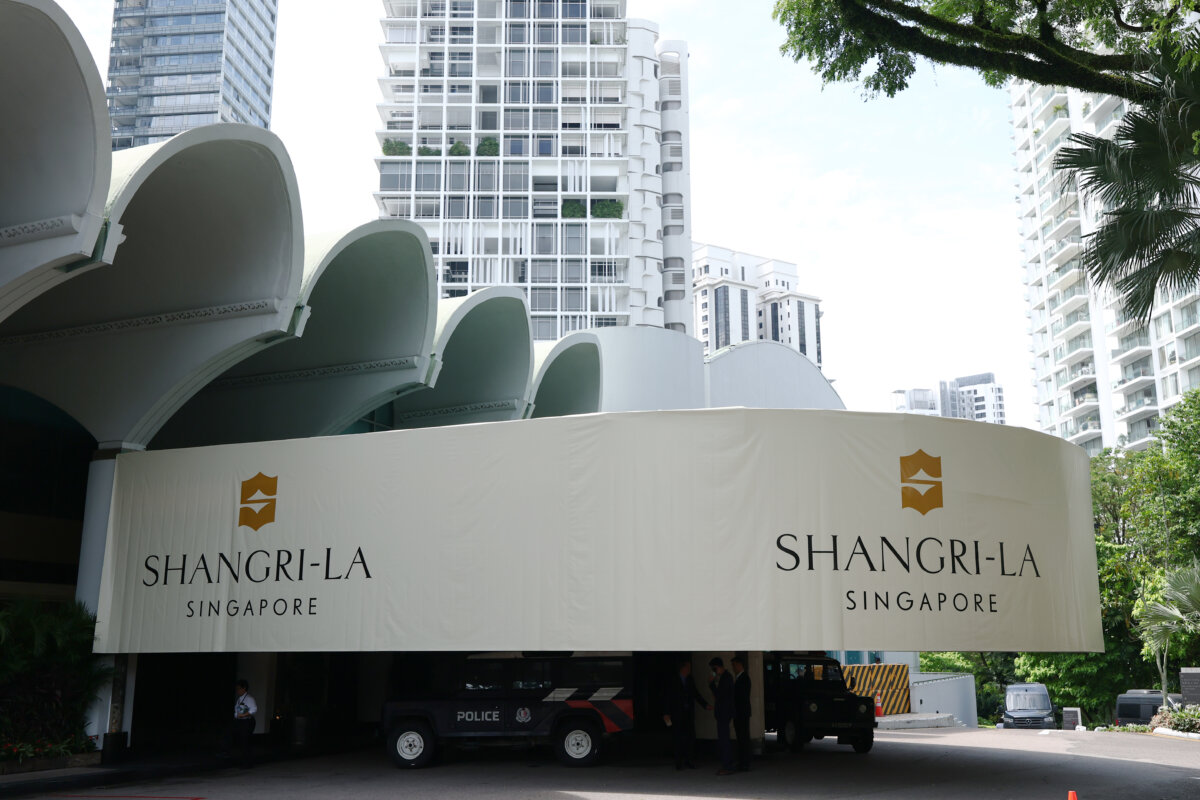

Asia’s top annual defense forum opens in Singapore this weekend, with the United States, Japan, and Taiwan each placing deterrence at the center of their Indo-Pacific security posture.
Secretary of War Pete Hegseth is scheduled to address the Shangri-La Dialogue on the morning of May 30 in a session titled “United States’ Strategy for Peace in the Indo-Pacific.” Japanese Defense Minister Shinjiro Koizumi is scheduled to speak on Sunday on “Managing Regional Tensions Amid Global Competition.”
Taiwan is not formally represented at the forum, but President Lai Ching-te has framed Taiwan’s security policy in similar terms.
In a May 20 address marking his second anniversary in office, Lai said Taiwan would maintain the status quo of peace and stability across the Taiwan Strait while strengthening national defense, asymmetric capabilities, and whole-of-society defense resilience.
“True peace can only be secured through strength,” Lai said. “We are increasing investment in defense because we are alert to threats that are greater than ever before—this is not to provoke, but to prevent war.”
A new assessment by the International Institute for Strategic Studies (IISS) warns that military doctrines and nuclear-risk concerns are converging in the region.
The assessment, released before the forum, said military doctrine, geography, and technology are reshaping regional security and described the Asia-Pacific as no longer fully at peace. Its first published chapter examines the military doctrines of the United States, China, and India as each prepares for possible wars in the region.
A separate IISS analysis depicted the world as “on the cusp” of a new nuclear arms competition, with the Asia-Pacific at its core, as nuclear and non-nuclear capabilities increasingly interact.
Washington’s Indo-Pacific Strategy
The 2026 U.S. National Defense Strategy says the Department of War will deter China in the Indo-Pacific “through strength, not confrontation.” It says Washington will build a “strong denial defense” along the First Island Chain and urge regional allies and partners to do more for collective defense.
The document says the goal is not to dominate China, but to prevent China from dominating the United States or its allies and to establish “a balance of power in the Indo-Pacific” that allows what it calls “a decent peace.”
The strategy also says Washington will seek military-to-military communications with the Chinese People’s Liberation Army to support strategic stability, deconfliction, and de-escalation.
The strategy does not mention Taiwan by name. The First Island Chain runs from Japan through Taiwan and the Philippines, placing Taiwan at the center of the area Washington says it intends to defend.
Hegseth’s Saturday address is the first plenary session of the summit.
Japan Moves Defense Posture Southwest
Japan is approaching the forum with a language of managing tensions and its own expansion of defense capability.
Japan’s fiscal 2026 budget includes 9.0353 trillion yen (about $58 billion) in defense-related expenditures, according to the Ministry of Defense. The budget supports seven priority areas, including standoff defense, integrated air and missile defense, unmanned defense, command-and-control and intelligence functions, and facility resilience.
Japan’s 2025 defense white paper describes China’s military activities and external posture as an “unprecedented and the greatest strategic challenge” to Japan’s security. The white paper says Beijing has been rapidly improving nuclear, missile, naval, and air capabilities while increasing activities around Japan and Taiwan.
Tokyo has also been shifting more attention toward its southwestern islands. Yonaguni, Japan’s westernmost inhabited island, lies about 68 miles from Taiwan.
At a Nov. 23, 2025, press conference at Camp Yonaguni, Koizumi said preparations were “steadily progressing” for the planned deployment of a medium-range surface-to-air missile unit on the island. He said the unit was intended to defend Yonaguni and reduce the possibility of an armed attack against Japan.
Koizumi is scheduled to speak on Sunday in the Shangri-La session on managing regional tensions.
Taiwan Frames Defense as Prevention
Taiwan’s government has made deterrence and resilience central to its cross-strait policy.
Lai said on May 20 that maintaining peace and stability across the Taiwan Strait and preventing external forces from changing the status quo are Taiwan’s national strategic goals.
He added that Taiwan is willing to engage in “healthy and orderly exchanges” with China under the principles of parity and dignity, but rejects any attempts to package unification as peace.
The same speech tied Taiwan’s defense reforms to asymmetric capabilities, whole-of-society resilience, homeland security, logistics, training, and defense-industry self-sufficiency. Lai said Taiwan is investing more in defense “not to provoke, but to prevent war.”
Taiwan’s legislature passed a 780 billion New Taiwan dollars ($24.8 billion) supplementary defense budget on May 8 to support military procurement from 2026 to 2033. The package was smaller than Lai’s original proposal but gave Taiwan a new multi-year defense funding line.
Lai also linked Taiwan’s security to its relationship with the United States at a May 27 reception hosted by the American Institute in Taiwan to mark the coming 250th anniversary of American independence.
He said Taiwan and the United States should continue deepening cooperation in trade, semiconductors, artificial intelligence, and regional security.
IISS Raises Nuclear-Risk Concern
The IISS nuclear risk analysis does not predict that a regional conflict will escalate to nuclear levels. It points to a specific danger in how modern militaries fight.
Militaries increasingly rely on command, control, communications, computers, intelligence, surveillance, and reconnaissance systems—known as C4ISR—to identify targets, direct forces, and coordinate operations. Some of those networks can also support nuclear command and control.
In a major crisis, a conventional strike meant to disrupt an adversary’s military operations could be read as a threat to nuclear forces if it disables overlapping command networks. IISS said the interaction of nuclear forces, long-range conventional strike systems, missile defense, space assets, and emerging technologies is complicating strategic stability in the Asia-Pacific.
The IISS assessment also comes as regional defense spending continues to rise. The institute projected that Asian defense spending will increase 3.4 percent in real terms in 2026 and reach about $630 billion in aggregate, even as governments face fiscal constraints.
China’s Ministry of National Defense stated in March that Beijing’s 2026 central government defense expenditure would rise 7 percent to 1.91 trillion yuan (about $263 billion).
The Department of War said in its 2025 annual report to Congress that China’s actual defense spending in 2024 was probably between $304 billion and $377 billion, or 32 percent to 63 percent higher than Beijing’s announced budget that year.
Asked about the IISS assessment at a May 28 press conference, Chinese Foreign Ministry spokesperson Mao Ning said Taiwan is China’s internal affair and that the United States should exercise “extra caution” in handling Taiwan.
Taiwan rejects Beijing’s sovereignty claims. Beijing has never ruled out using force to bring Taiwan under its control.
The Chinese defense minister is also absent from the Shangri-La Dialogue for the second straight year, with Beijing represented instead by a PLA delegation led by Maj. Gen. Meng Xiangqing of the National Defense University, according to China’s Ministry of National Defense.
 Friends Read Free
Copy
Facebook
Tweet
Friends Read Free
Copy
Facebook
Tweet