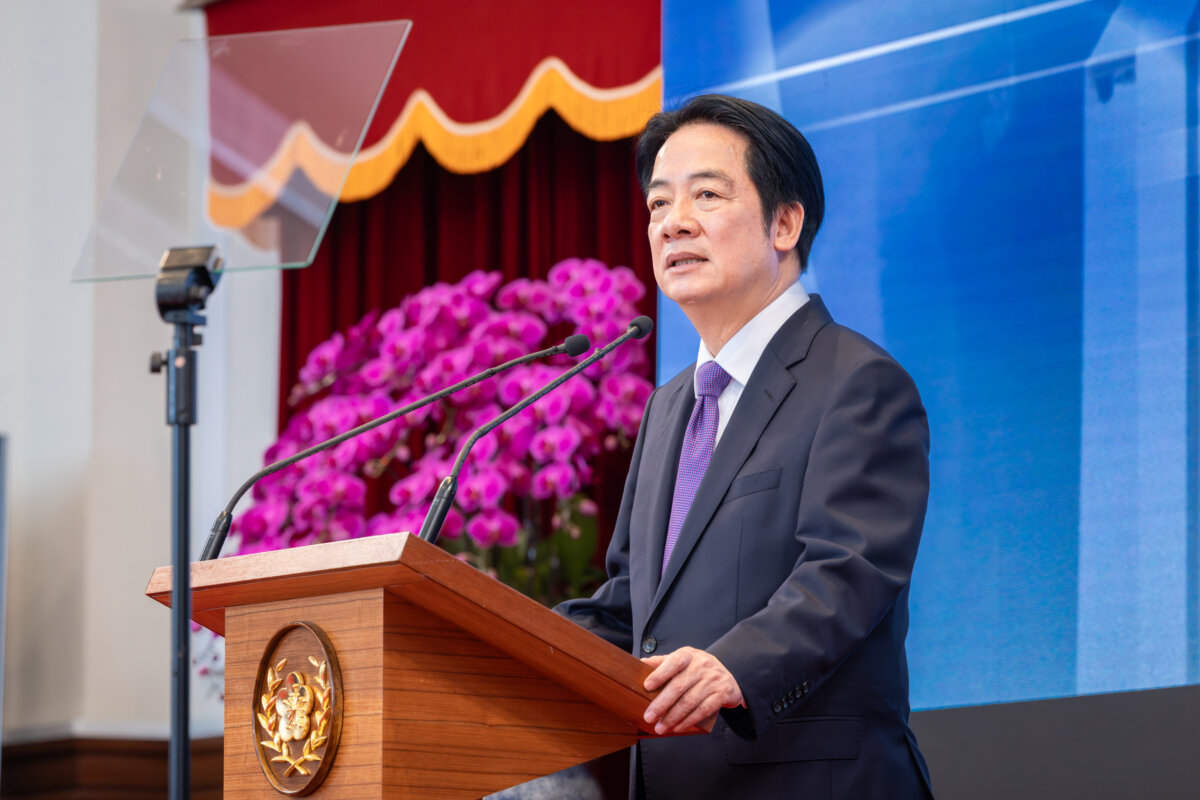
Taiwan President Lai Ching-te on May 20 said peace across the Taiwan Strait must be secured through strength, in an address delivered on his second anniversary since taking office.
Lai said Taiwan’s future “cannot be decided by forces outside our borders” and must be determined by Taiwan’s 23 million people. He said Taiwan is willing to engage China under principles of “parity and dignity,” but rejected what he called the Chinese regime’s united front tactics that “package unification as peace.”
“True peace can only be secured through strength,” Lai said, adding that Taiwan is increasing defense investment “not to provoke, but to prevent war.”
The address came days after U.S. President Donald Trump met Chinese leader Xi Jinping in Beijing, where Taiwan again drew attention as a key topic in U.S.–China relations.
Trump said on May 20 that he would speak with Lai about a pending U.S. weapons sale to Taiwan, which Beijing opposed, while a call had not yet been scheduled. Taiwan’s government welcomed dialogue with Trump and stressed its commitment to maintaining the status quo across the Taiwan Strait.
Lai Sharpens Status Quo Message Around Deterrence
Lai’s speech presented “maintaining the status quo” as more than preventing immediate conflict. He linked it to Taiwan’s democratic system, military deterrence, economic competitiveness, and whole-of-society resilience.
“Taiwan is a responsible member of the international community—not a destabilizer,” Lai said. “We are willing to engage in dialogue, but will not accept subordination. We pursue stability, but will not sacrifice our sovereignty or our democratic way of life.”
Lai said his government has spent the past two years advancing defense reforms, strengthening asymmetric capabilities, enhancing whole-of-society defense resilience, and building a broader homeland security network. He said defense reform involves not only weapons, but also personnel, training, logistics, institutions, and social support.
He also cited Taiwan’s first indigenous submarine, Narwhal, as a symbol of defense self-sufficiency, saying the vessel reflects Taiwan’s determination to build “a more secure home for future generations.”
In response to Lai’s remarks, Chinese Foreign Ministry spokesman Guo Jiakun accused the Taiwanese leader of “separatism” and repeated Beijing’s opposition to U.S. arms sales to Taiwan.
Lai Administration Moves to Fill Defense Funding Gaps
Lai said the Taiwanese legislature’s failure to pass the defense package in full on May 8 would affect peace and stability across the Taiwan Strait, but his administration is already moving to fund the approved portions while seeking other channels for items left out.
The Executive Yuan said its original eight-year NT$1.25 trillion, or about $39.6 billion, special defense proposal was reduced by the legislature to a NT$780 billion, or about $24.7 billion, ceiling focused on U.S. arms procurement, excluding commercial procurement and commissioned projects tied to the Taiwan Shield, an artificial intelligence-enabled kill chain, drones, and domestic defense production.
On May 20, the Executive Yuan approved the first special budget proposal under the newly passed act and sent it to the legislature. Premier Cho Jung-tai said the first U.S. procurement package totals about NT$294.99 billion, or about $9.34 billion, with an initial fiscal 2026 request of about NT$8.8 billion, or about $279 million, funded through borrowing. The first package covers five urgent U.S. procurement items: M109A7 self-propelled howitzers, HIMARS rocket systems, anti-armor loitering-munition systems, Javelin missiles, and TOW 2B missiles.
For the projects excluded from the narrowed special act, Lai said the government would seek an alternative special act, additional budgets, annual defense budget increases, commercial procurement, commissioned projects, international cooperation, and domestic production of unmanned ground, maritime, and aerial systems.
Scholars Say Lai Was Reassuring Washington While Warning Beijing
Taiwan-based scholars at a May 21 seminar hosted by Taipei University of Marine Technology said Lai’s speech should be read against the backdrop of Trump’s remarks on Taiwan after meeting Xi.
Wang Chih-sheng, an assistant professor at Central Police University, said Lai’s address functioned as a “stabilizing statement” and “strategic recalibration.” Wang said Lai sent messages to three audiences: to China, that Taiwan will not accept unification framed as peace; to the United States, that Taiwan is not a provocateur or bargaining chip but a democratic partner willing to defend itself and maintain the status quo; and to Taiwan’s domestic audience, that national security should not be held hostage by partisan competition.
Chen Fang-yu, an associate professor in Soochow University’s political science department, said Trump’s Taiwan-related comments departed from some past conventions but did not amount to a change in overall U.S. policy toward Taiwan and China. Chen said U.S. foreign policy is shaped by the broader bureaucracy and Congress, giving it long-term stability, and said Taiwan should continue to deepen ties with Washington.
Wu Se-chih, an assistant professor at Taipei University of Marine Technology’s general education center, said Lai had reinterpreted “maintaining the status quo” as more than avoiding conflict. Wu said Lai’s speech defined the status quo as including Taiwan’s democratic way of life and the sovereignty reality of the Republic of China, Taiwan’s official name.
Tan Wei-en, a professor at National Chung Hsing University’s Graduate Institute of International Politics, said Trump’s comments should not be read as a concession to Beijing, but as an effort by a major power to manage a dangerous geopolitical flashpoint. Tan said sovereignty is Taiwan’s ultimate shield because “without sovereignty, there is no democracy.”
Why It Matters to Washington
Lai’s speech touched several U.S. concerns: whether Taiwan is increasing its own defense burden, whether Beijing will view U.S. arms sales as a test after the Trump-Xi summit, and whether Taiwan can remain a stable partner in advanced technology supply chains.
The Taiwan Relations Act states that U.S. policy is to provide Taiwan with defense articles and services necessary for Taiwan to maintain a sufficient self-defense capability. It also says any effort to determine Taiwan’s future by non-peaceful means would be considered a threat to peace and security in the Western Pacific and of grave concern to the United States.
Lai’s speech aligned Taiwan’s own defense buildup with that U.S. policy framework. The Taiwanese leader also said Taiwan is working with like-minded partners “not to oppose anyone,” but to uphold peace and stability across the Taiwan Strait and the Indo-Pacific.
Lai Links Taiwan’s Security to Resilient Economy, Society
Lai also connected Taiwan’s security to its economy. He said Taiwan holds key positions in global supply chains for semiconductors, artificial intelligence, defense industries, security and surveillance, and next-generation communications, and is becoming “a crucial and trustworthy partner in the democratic technology alliance.”
He said Taiwan’s economy grew 8.68 percent last year and 13.69 percent in the first quarter of this year, which he called the island’s highest single-quarter growth in 39 years. He said full-year output is projected to exceed NT$32 trillion, or about $1.01 trillion.
Lai said he would propose a NT$100 billion, or about $3.16 billion, plan to help micro-, small, and medium-sized enterprises and traditional industries upgrade, and would introduce a population strategy that includes a monthly NT$5,000, or about $158, child allowance from birth through age 18.
Lai said those domestic policies are part of a wider national resilience agenda. He said modern security extends beyond military bases and includes hospitals, schools, banks, factories, ports, power grids, internet networks, food security, cybersecurity, transportation, healthcare, civil defense training, and local communities.
Lai closed by returning to Taiwan’s democratic identity.
“Taiwan’s strength is not in the size of its population, but in the people’s free will,” he said. “It is not in the volume of our voices, but in the clarity of our values. It is not in the size of our territory, but in our unwavering commitment to walking the path forward.”
 Friends Read Free
Copy
Facebook
Tweet
Friends Read Free
Copy
Facebook
Tweet