
The United States has reaffirmed its support for Japan and South Korea, with all three nations stressing their backing for Taiwan and the preservation of a “free and open” Indo-Pacific region.
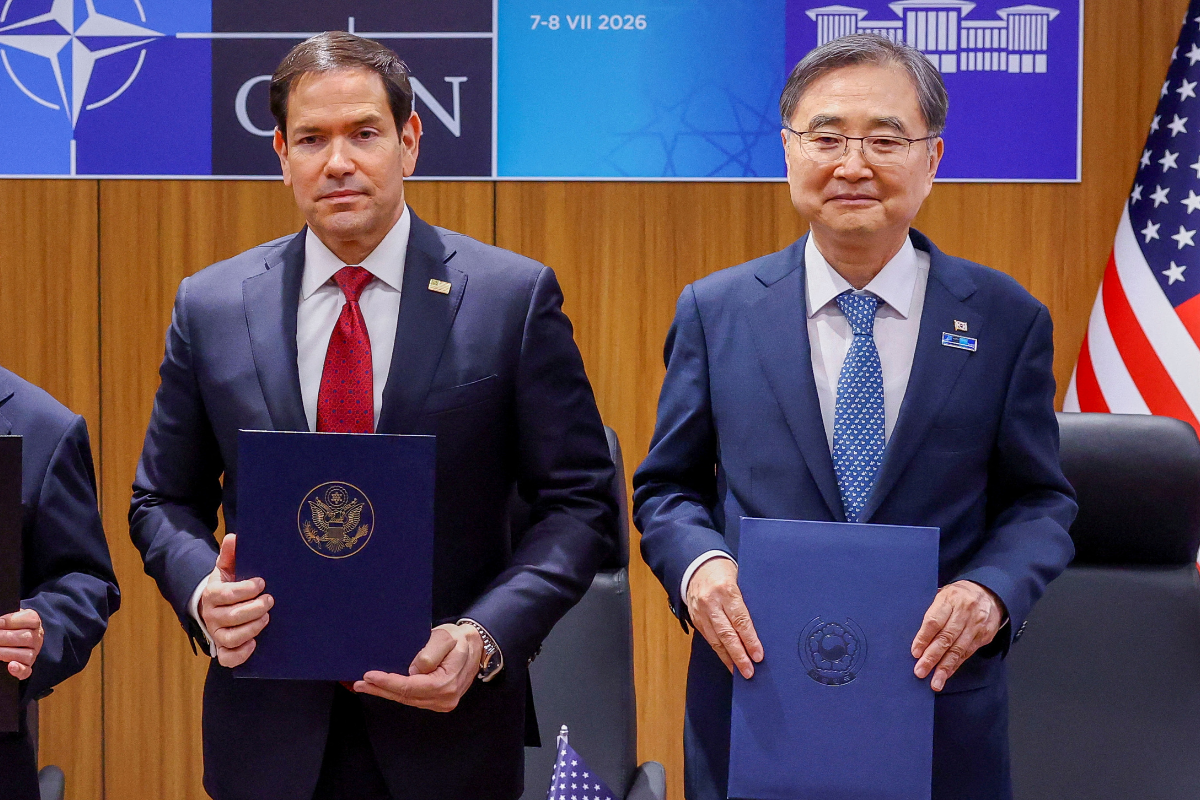
U.S. Secretary of State Marco Rubio met with Japanese Foreign Minister Motegi Toshimitsu and South Korean Foreign Minister Cho Hyun on the sidelines of the U.N. General Assembly in New York on Monday.
A joint statement released by the State Department on Sept. 21 said the United States “reiterated its ironclad commitments to the defense of Japan and the ROK, backed by America’s unmatched military strength, including its nuclear capabilities, and reaffirmed its extended deterrence commitments to Japan and the ROK,” using the initials for the Republic of Korea, South Korea’s official name.
Rubio and the foreign ministers also stressed the importance of maintaining stability in the Taiwan Strait and encouraged the peaceful resolution of any issues in the region. They emphasized that they “opposed any attempts to unilaterally change the status quo,” and support Taiwan’s participation in international organizations.
Taipei welcomed the comments, with its foreign ministry saying the support for maintaining peace and stability shows that security in the strait has become a “strong consensus of the international community.”
Free, Open Indo-Pacific
In veiled criticisms directed at the Chinese regime’s aggressive actions in the region, the three representatives “underscored progress in trilateral cooperation that promotes peace, stability, and economic prosperity to realize a free and open Indo-Pacific, while upholding shared principles including the rule of law,” the Sept. 21 State Department statement said.
The joint remarks were released ahead of a summit that U.S. President Donald Trump is hosting with Chinese leader Xi Jinping at the White House in Washington on Sept. 24 and 25.
The Chinese Communist Party considers Taiwan its territory and has not ruled out the use of force to take control of the island. Taipei rejects Beijing’s territorial claim.
Tokyo has also faced strained diplomatic relations with Beijing, after Japanese Prime Minister Sanae Takaichi said in November 2025, in response to a question in parliament, that an attack on Taiwan would be an existential threat to her country.
North Korea
The statement covered wide-ranging security issues, including in relation to North Korea.
Rubio, Toshimitsu, and Cho said that they reaffirmed their commitment to denuclearizing the Democratic People’s Republic of Korea (DPRK)—North Korea’s official name—and for peace on the Korean Peninsula.
They also continue to back the prohibition of support for revenue generation for the DPRK’s nuclear and ballistic missile programs, in accordance with U.N. Security Council resolutions. They said that the opportunity for dialogue with Pyongyang remains open.
Tensions have flared on the Korean Peninsula in recent weeks after the militaries of South Korea and its allies finished a number of annual security drills, which North Korea views as demonstrating a confrontational stance in the region. Pyongyang has responded with its own drills and missile launches.
Recently, the United States, Japan, and South Korea wrapped up their five-day trilateral Freedom Edge 26 exercise. The earlier U.S.–South Korean Ulchi Freedom Shield exercises were scaled back on Trump’s orders, with the U.S. president saying that they gave the wrong message to North Korean leader Kim Jong Un and were costly to the American taxpayer.
Reuters contributed to this report.
 Friends Read Free
Copy
Facebook
Tweet
Friends Read Free
Copy
Facebook
Tweet