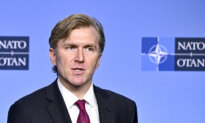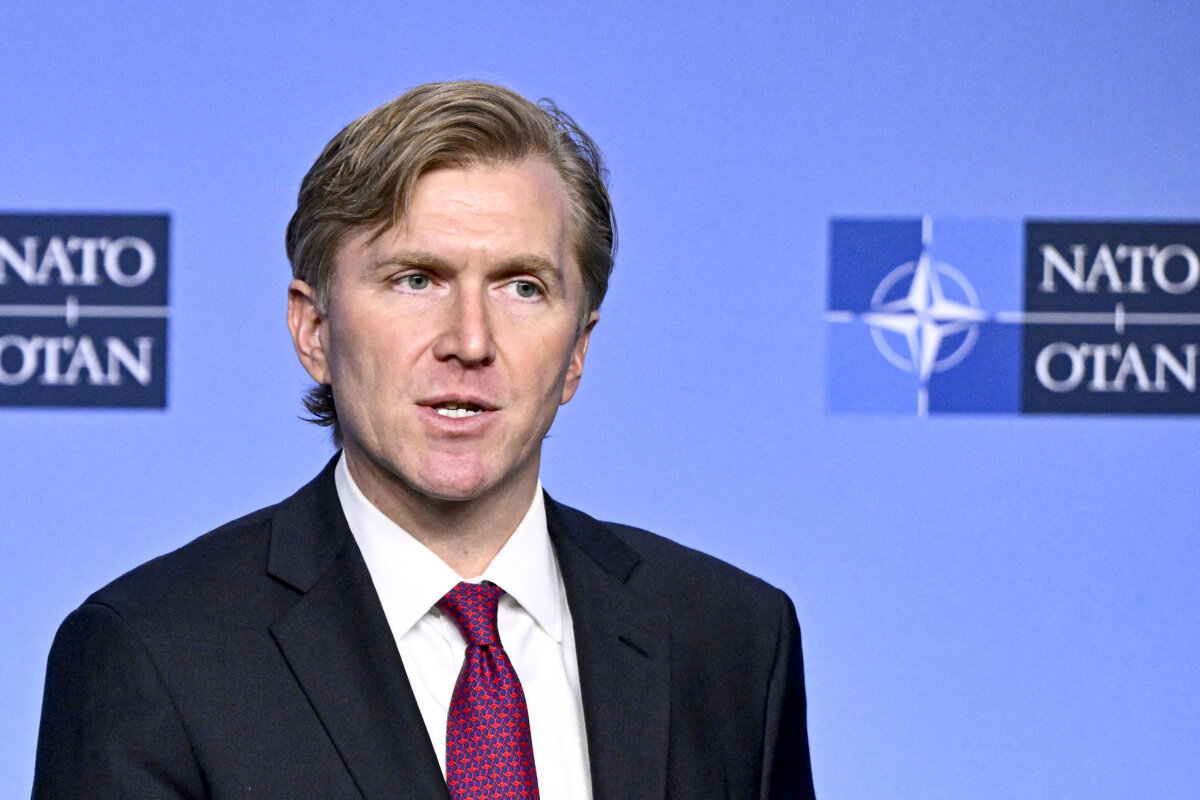

Under Secretary of War Elbridge Colby on Aug. 27 praised some European NATO allies for upping their defense spending during a trip to Brussels to meet with NATO Secretary General Mark Rutte.
Colby’s visit to Belgium comes as the United States continues to reassess its presence on the continent as part of Washington’s Europe Posture Review, following announcements of troop drawdowns and a general reorientation of its defense priorities.
While in the Belgian capital, he will also participate in a meeting of the North Atlantic Council, which acts as the alliance’s main political decision-making body.
In brief remarks to the press before Colby and Rutte went to lunch, the pair amicably laid out what would be happening during the meetings.
Colby thanked the secretary general for being a “great friend” to the American government as the Trump administration pursues its goals with respect to NATO, describing the alliance as being in “quite a different place” than a couple of years ago.
He said that Europe is a “very wealthy continent” that “can and is taking primary responsibility for its own conventional defense,” stressing that Washington remains committed to NATO but praising Europeans for taking the lead in supporting Ukraine.
Colby specifically commended Poland, Germany, and the Netherlands, the last of which Rutte was prime minister of before taking his role at the head of NATO, for stepping up defense spending, along with many others calling the progress made in this regard “extraordinary.”
Addressing the review, and what U.S. Secretary of War Pete Hegseth has dubbed NATO 3.0, the Pentagon representative said it had been initiated to “accelerate what’s happening, and then to look at the strategic posture at a high level of U.S. forces in Europe.”
He added that Europe remained a critical interest of Washington’s, even as it “prioritizes the Western Hemisphere and the First Island chain,” indicating the administration’s pivot away from the Atlantic and towards the Pacific.
Rutte described NATO 3.0 as “a stronger Europe and a strong Canada in a stronger NATO,” adding that the plan is now unfolding.
“When you look at the moment in 2025, $139 billion extra spent on defense by the Canadians and the Europeans compared to the years before, and it is still continuing,” he said, stressing that there is “still much more to be done” but adding that “we will get there.”
The day before meeting with Rutte, on Aug. 26, Colby met with U.S. Air Force General Alexus Grynkewich, who serves as NATO’s Supreme Allied Commander Europe (SACEUR), in what he described as a “superb session” in a post on X, during which they discussed the Europe Posture Review.
In a follow-up post, he further outlined the purpose of the review, saying it is “designed to ensure our strategic posture in Europe advances and accelerates the NATO 3.0 of an alliance rededicated to strains, clarity, rigor, and readiness.”
The review was announced by Hegseth in July, when he warned NATO allies failing to meet defense spending commitments could face consequences as Washington pushes the alliance toward what he called a new era of burden-sharing.
Speaking at a meeting of NATO defense ministers in Brussels, Hegseth said the review would examine America’s military footprint in Europe and help ensure that European allies assume primary responsibility for the continent’s conventional defense.
Hegseth described the review as part of a broader transformation of the alliance, a return to what he characterized as NATO’s original mission as a hard-edged military alliance focused on deterrence and warfighting.
Although he did not question the U.S. commitment to NATO’s Article 5 collective defense clause, he indicated that allies failing to meet spending targets could see reductions in U.S. contributions.
“Going forward, our annual NATO dues will be contingent on other countries meeting their defense spending targets,” he said.
“Where other allies do not spend with urgency, our dues contributions will go down. It’s a review that some countries will fail, and others will pass with flying colors.”
Hegseth announced the review a week after President Donald Trump sharply criticized NATO ally Spain’s commitment to the alliance, labelling Madrid a “wasted cause” and a “terrible partner.”
Tensions have been particularly high between Washington and Madrid since Spanish Prime Minister Pedro Sánchez publicly criticized the United States’ conflict with Iran, actively blocked the U.S. military from using its domestic airspace, and denied access to joint military bases.
Tom Ozimek contributed to this report.
 Friends Read Free
Copy
Facebook
Tweet
Friends Read Free
Copy
Facebook
Tweet