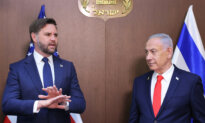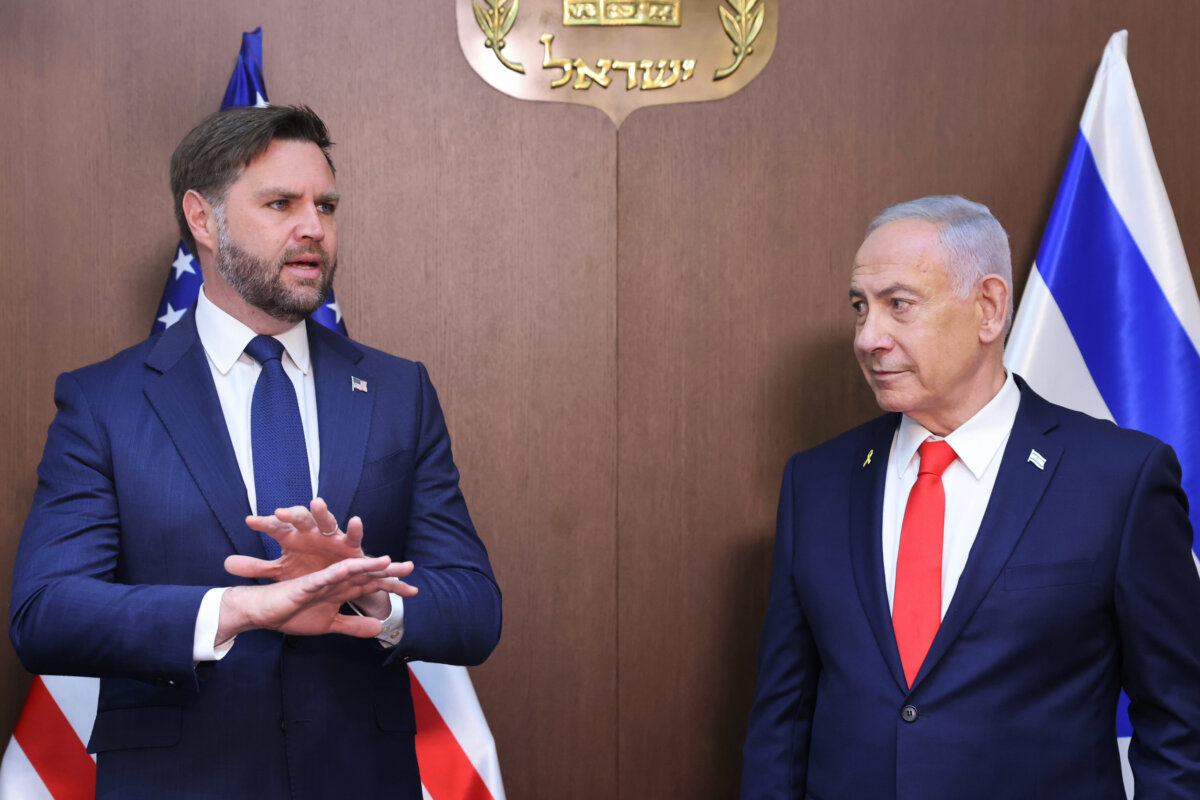

Israeli Prime Minister Benjamin Netanyahu said on Oct. 22 that he and U.S. Vice President JD Vance discussed the Gaza Strip’s future, including governance and security plans in the enclave.
Speaking to reporters in Israel, where Vance arrived on Oct. 21 for an official visit, Netanyahu said the talks focused on shared regional decisions and Israel’s long-term security.
“We discussed this idea of the day after,” he said. “We’re just creating an unbelievable day after with a completely new vision of how to have the civil government, how to have the security there, who could provide that security there, again, with Israel taking care of a role in security always.”
Both Vance and Netanyahu recognized the difficulty of advancing the Gaza peace plan, yet Vance expressed optimism about the current stage of discussions.
“We have a very, very tough task ahead of us, which is to disarm Hamas but rebuild Gaza, to make life better for the people of Gaza, but also to ensure that [the] Hamas [terrorist group] is no longer [a] threat to our friends in Israel,” Vance said. “That is not easy. I feel very optimistic about where we are.”
When asked whether Turkish security personnel would be allowed inside the Gaza Strip, Netanyahu said he has “very strong opinions about that.”
A day earlier, Vance announced the creation of a Civil-Military Cooperation Center, a joint initiative between the United States and Israel to support Middle East peace efforts.
He suggested that foreign troops, including those from Turkey and Indonesia, could take part in peacekeeping operations, although he emphasized that the final decision rests with Israel.
Cease-Fire Developments
The first phase of the cease-fire plan brokered by U.S. President Donald Trump between Israel and the Hamas terrorist group calls for the return of all Israeli hostages held in the Gaza Strip since the Oct. 7, 2023, attack on Israel, as well as the disarmament of Hamas.
On Oct. 21, the Israel Defense Forces confirmed that Hamas had handed over the bodies of two deceased hostages, identified as Aryeh Zalmanovich, 85, and Master Sgt. (Res.) Tamir Adar, 38.
Thirteen of 28 bodies of Israeli hostages are still in the Gaza Strip. Earlier in October, all 20 living hostages were released after the agreement to the first phase of the peace plan.
The cease-fire deal, mediated by Egypt, Qatar, and Turkey, has been welcomed by Arab states and leaders around the world.
Netanyahu told reporters on Oct. 22 that the Israeli military was able to “put the knife up to Hamas’s throat,” while the United States led efforts to “isolate Hamas in the Arab and Muslim world.”
According to Netanyahu, that combination of military pressure and diplomatic isolation has pushed Hamas to release Israeli hostages.
His remarks came after an interview with CBS’s “60 Minutes” that aired on Oct. 19, in which Jared Kushner—Trump’s son-in-law and one of the key cease-fire negotiators—said that winning the endorsement of Arab states for the peace deal “changed the entire global dynamic,” isolating Hamas instead of Israel.
Trump said in a Truth Social post on Oct. 21 that U.S. allies in the Middle East and around the region informed him that they would welcome the opportunity “to go into GAZA with a heavy force and ‘straighten [out] Hamas’” if the group were to violate the cease-fire agreement.
Trump noted that he had told Israel and other countries to wait, expressing hope that Hamas would act responsibly, but warned that its end would be swift and “brutal” if it did not.
US–Israel Alliance and Abraham Accords
Commenting on the U.S.–Israel relationship, Vance said that Washington seeks a partnership and an alliance with Jerusalem.
“The president believes very strongly that Israel, honestly, with our welfare of allies, can play a very positive leadership role in this region,” he told reporters on Oct. 22.
According to Vance, the United States sees the peace deal as a “critical piece” in unlocking the Abraham Accords, a series of U.S.-brokered agreements aimed at normalizing relations between Israel and its predominantly Muslim neighbors.
“What it could allow is an alliance structure in the Middle East that perseveres, that endures, and that allows the good people in this region, the world, to step up and take ownership of their own backyard,” he said. “That’s in the United States’ best interest. I happen to think it’s [in] Israel’s best interest.”
Signatories to the Abraham Accords include Israel, the United Arab Emirates, Bahrain, Sudan, and Morocco.
Speaking in the Israeli Parliament on Oct. 13, Trump expressed hope that the accords would be expanded to include more countries.
 Friends Read Free
Copy
Facebook
Tweet
Friends Read Free
Copy
Facebook
Tweet