
Vice President JD Vance on Thursday said that the Trump administration has everything “on the table” to prevent Iran from firing on commercial ships traveling through the crucial Strait of Hormuz waterway.
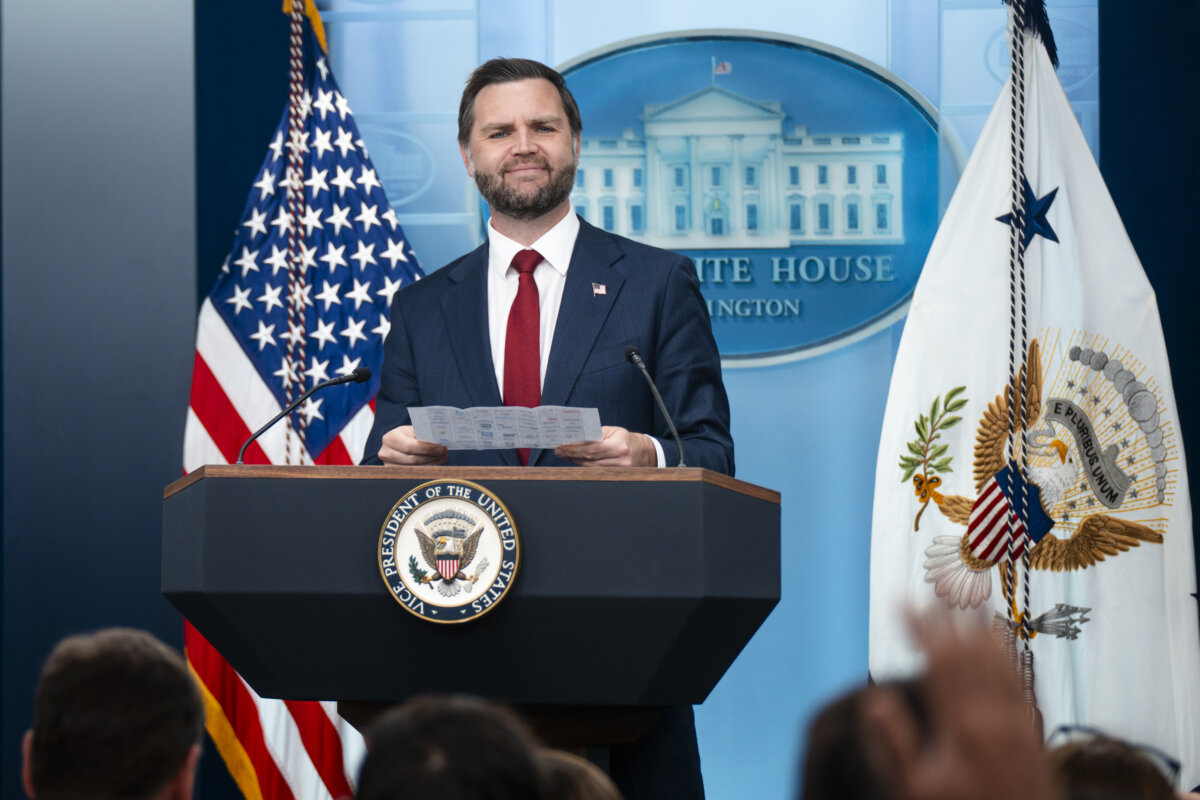
Coming days after fresh U.S. strikes against Iran, Vance told reporters during a White House press conference: “There are a lot of things that we’re doing … to try to apply pressure on the Iranians to get them to stop shooting at commercial shipping.”
He added: “Accepting that they’re still going to try to shoot at commercial shipping.”
Vance said that U.S. military action in the region has prevented “a worldwide energy crisis” and that “we would have had an energy crisis because the Iranians refused to stop acting like terrorists in the Strait of Hormuz.”
Since the start of the U.S. conflict with Iran, Tehran has frequently attacked oil vessels traveling in the strait, a key waterway that connects the Persian Gulf with the broader Indian Ocean.
The strait allows for the passage of roughly 20 percent of the world’s traded oil in peacetime.
Recent U.S. military strikes targeting Iran have been meant to reduce the country’s ability to threaten ships, the U.S. Central Command (CENTCOM) said in a Sept. 2 update.
“There are a lot of, of course, additional tools that we have at our disposal, some of those the president will use and some of them he won’t,” Vance said.
“But I’m not going to advertise exactly how we’re going to engage with the Iranians in the months and years to come, because it frankly would take away the president’s decision space.”
With regard to forcing Iran to stop the attacks, the U.S. vice president added, “everything that could happen is on the table,” including “economic pressure, military pressure, diplomatic pressure, covert pressure.”
When asked about the nature of the conflict, Vance said that he wouldn’t describe it as “a war” and that “there is no active shooting” at present.
Vance’s assertion came as Iran said it fired missiles and drones at U.S. Gulf ally Kuwait and the United Arab Emirates on Thursday in retaliation for recent U.S. strikes on Iran earlier in the week, reported state-run Tasnim News, quoting Iran’s military.
A day before that, Tasnim carried a statement from Iran’s army saying that it launched drone attacks against the United Arab Emirates and Bahrain, also U.S. allies in the region.
This week, President Donald Trump and other administration officials have said that more oil is passing through the Strait of Hormuz, with Trump stating in a Truth Social post that 18 million barrels of oil were recently removed from the region.
Energy Secretary Chris Wright told CNBC on Wednesday that 18 million barrels were moved out of the Gulf on Monday.
On Friday, Brent crude oil prices dipped more than 1 percent to $93 per barrel, while West Texas Intermediate crude dropped nearly 2 percentage points to $89 per barrel.
Gas prices remained the same at $4.14 per gallon of regular gasoline, on average, across the United States, according to the American Automobile Association.
Diesel reached $5.85 per gallon on Friday, or the highest in AAA’s history.
 Friends Read Free
Copy
Facebook
Tweet
Friends Read Free
Copy
Facebook
Tweet