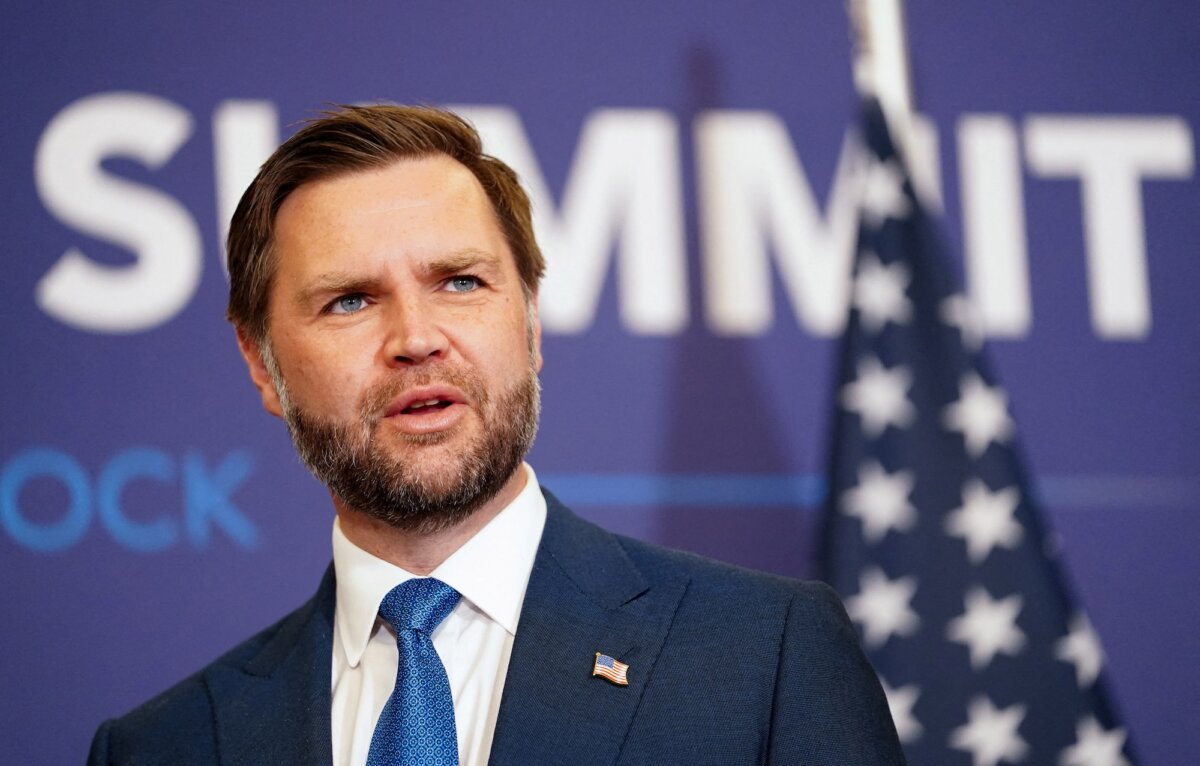

U.S. Vice President JD Vance said on June 22 that Iran had agreed to allow international nuclear inspectors back into the country, calling it a major breakthrough from the first round of U.S.–Iran talks in Switzerland and saying negotiators had laid “a very good foundation” for a final agreement to end the war.
Speaking at the Bürgenstock resort near Lake Lucerne in Switzerland on June 22 after marathon negotiations that stretched into the early hours of the day, Vance said the talks achieved a number of key U.S. objectives. These include mechanisms to keep the Strait of Hormuz open, efforts to reinforce a fragile ceasefire in Lebanon, and progress on Iran’s nuclear program. Vance said movement on the nuclear issue is probably what the U.S. side is “most excited about.”
“The Iranians have agreed to invite [International Atomic Energy Agency] inspectors back into their country,” Vance told reporters at a briefing. “That is a major milestone for the American people and the first step in permanently denuclearizing or permanently ending a nuclear weapons program in Iran.”
Vance said technical teams from the United States, Iran, Qatar, and Pakistan would continue negotiations in Switzerland in the coming days as part of a roadmap aimed at reaching a final agreement within 60 days.
“We laid a very good foundation for a successful final deal,” Vance said. “The final deal is the house. We set the foundation. We haven’t built the house, but we’ve laid a successful foundation to get to a good place for the American people.”
The comments came a day after mediators Qatar and Pakistan announced what they described as “encouraging progress” at the first high-level talks held under the framework of a June 17 memorandum of understanding between Washington and Tehran that halted direct hostilities and cleared the way for the Strait of Hormuz to reopen.
“I think it’s important for all of us to appreciate how much was done, but honestly, there is still a lot to do as we continue to make progress on the nuclear talks, on the economic talks, as we continue to demine the straits and ensure that that flow of traffic continues to pick back up,” Vance said, referring to operations to remove Iranian naval mines from the Strait of Hormuz, the key maritime choke point whose blockade has triggered a global energy crisis.
“A lot of progress, but still some work to do, and we’re very committed to doing exactly that.”
Vance said he would be returning to Washington while a technical team would remain in Switzerland to continue negotiations with the Iranian side on what could be a lasting peace.
Technical Talks Continue
In a joint statement issued early on June 22, Qatar and Pakistan said the parties agreed to establish a high-level committee to oversee political negotiations and specialized working groups focused on the nuclear issue, sanctions relief, and resolution of other disputes.
The mediators said a roadmap had been agreed upon to reach a final accord within 60 days and that technical negotiations would begin immediately.
Iranian foreign ministry spokesman Esmail Baghaei confirmed in a social media statement that discussions had continued into the early hours of June 22 and said expert-level talks would continue while the senior Iranian delegation would return to Iran.
“The basis of the work is ‘commitment for commitment,'” Baghaei said, adding that the technical talks would focus on implementing the provisions of the memorandum of understanding, which he referred to as a preliminary “war-termination agreement.”
Baghaei said the memorandum would pave the way for a broader, final peace deal if its key points—including the cessation of Israeli military operations in Lebanon—are implemented, and he said that Iran will “utilize all its levers to ensure the fulfillment of those commitments.”
The effort comes amid continuing disputes over the ceasefire.
Israeli Defense Minister Israel Katz said on June 21 that Israel would not withdraw from what he called a security zone in southern Lebanon, and Lebanese President Joseph Aoun’s office said on June 22 that Vance, White House adviser Jared Kushner, and Qatari Prime Minister Mohammed bin Abdulrahman Al Thani discussed steps to consolidate the ceasefire and halt Israeli military escalation.
Senior Israeli officials told Epoch Magazine Israel that they believe Iran has been encouraging the Hezbollah terror group to violate the Lebanon ceasefire in a bid to provoke Israeli retaliation, create friction between Washington and Jerusalem, and undermine the U.S.–Iran memorandum of understanding.
The officials said Israel has assured the Trump administration that it is committed to the ceasefire and that recent Israeli military actions in Lebanon were taken in self-defense following Hezbollah attacks.
Vance was asked by reporters about the role Lebanon played in the talks, whether he was surprised that Iran had made it into such a central issue, and whether the matter was moving closer to a resolution. He replied by saying that negotiators over the weekend made “very good progress” on mechanisms aimed at preventing clashes between Israel and Hezbollah from escalating into a wider conflict.
“We want Israel’s security to be protected, and we also want Lebanon’s sovereignty to be protected,” Vance said. “We do believe, of course, it’s going to require a lot of hard work that we can get to a place where Lebanon’s territorial integrity and sovereignty is protected, Israel’s security is protected.”
The vice president said that the issue of Lebanon would require coordination between the Lebanese armed forces and that “it’s going to require the Iranians to rein in Hezbollah,” referring to the sway Tehran has over Hezbollah, widely viewed as an Iranian proxy.
 Friends Read Free
Copy
Facebook
Tweet
Friends Read Free
Copy
Facebook
Tweet