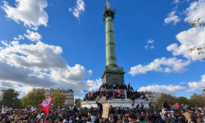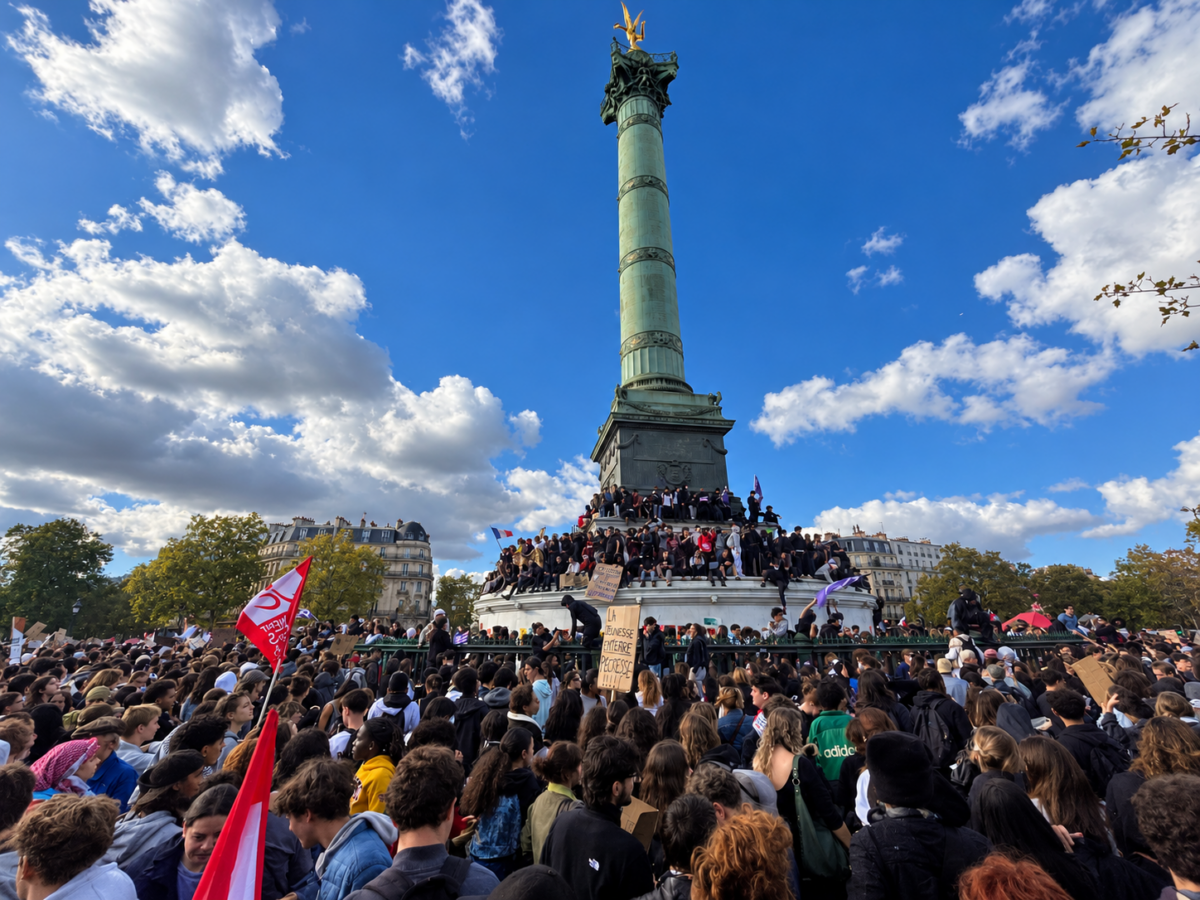

PARIS—“We took the Bastille!” protesters shouted on Oct. 8 as thousands poured into Place de la Bastille, the Paris square where the storming of a royal prison in 1789 set the French Revolution in motion.
Many communist and Palestinian flags waved above the crowd, while a number of banners and placards called for a new revolution on Oct. 13, when organizers have scheduled another nationwide day of demonstrations.
Some protesters invoked the Bolshevik Revolution of 1917, which brought the communists to power in Russia, with signs reading “October Revolution.”
Others referred to France’s revolutionary history.
One placard declared, “1789–2026, let’s retake the Bastille,” while another read, “All I remember from the French national anthem is ‘To arms, citizens!’” A third stated, “Robespierre would have been proud.” Yet another proclaimed, “Long live the Commune!”
The slogans echoed those heard at previous demonstrations, with protesters chanting “Down with the state, the cops, and the fascists,” “Everyone hates the police,” and “To arms!”
The war in Gaza also featured prominently, as demonstrators sang, “We are all children of Gaza.”
Many of the protesters appeared to be much older than high school or university students.
By mid-afternoon, the square had become the scene of a confrontation between protesters and riot police.
Police vans were stationed around the area by 3 p.m., and shortly after 4:20 p.m., officers came under attack from paving stones and firework mortars. Police responded with tear gas and water cannons.
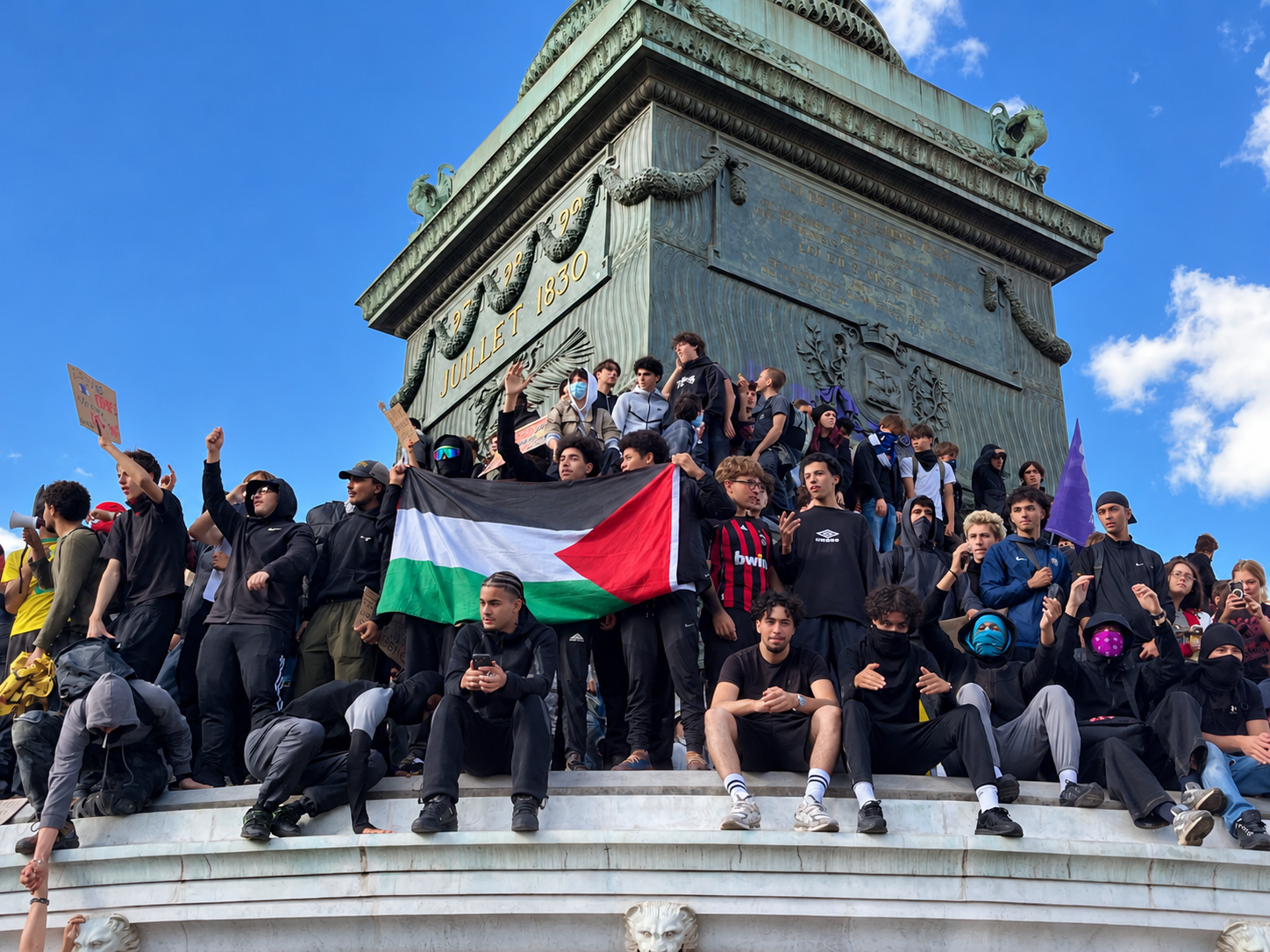 Protesters, some wearing masks, gather at the base of the July Column at Place de la Bastille in Paris, holding a Palestinian flag during a high school protest in Paris on Oct. 8, 2026. (Etienne Fauchaire/The Epoch Times)
Police eventually cleared the square in the early evening, leaving behind walls defaced with graffiti. Among the messages were insults directed at police, calls to destroy the French state, pro-Palestinian slogans, and a large inscription calling for President Emmanuel Macron to be beheaded.
The clashes at the Bastille were part of another day of nationwide demonstrations that have disrupted French high schools and universities for several weeks.
According to the Interior Ministry, 71,500 people participated in marches and rallies across France, including 24,500 in Paris, while another 55,000 took part in actions outside schools.
Authorities reported 504 arrests and 48 police officers and gendarmes injured.
Interior Minister Laurent Nuñez strongly condemned the violence, praising police officers for having “systematically thwarted” attacks against them.
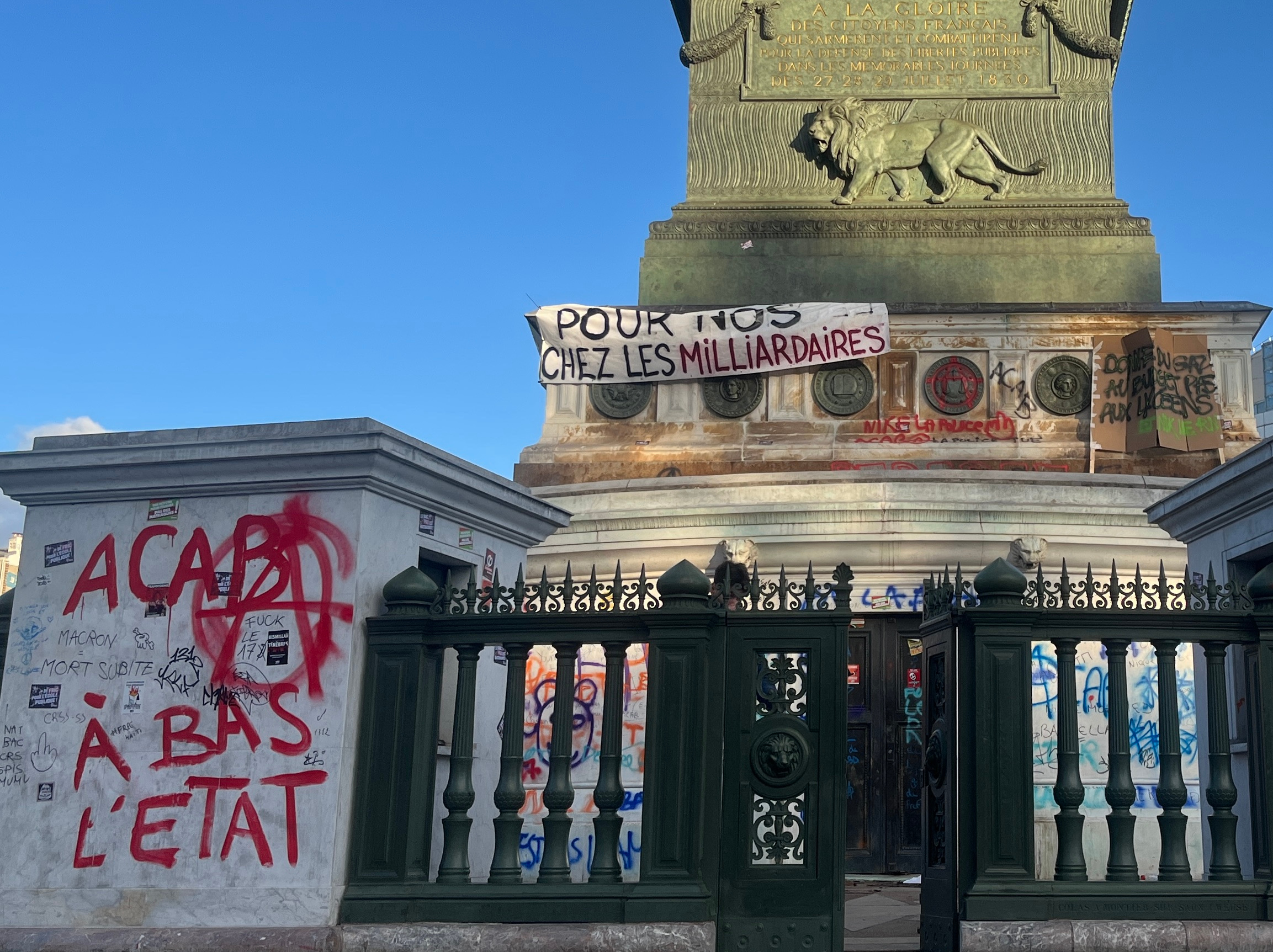 The base of the July Column at Place de la Bastille is defaced with graffiti following a high school protest in Paris on Oct. 8, 2026. Graffiti text included the phrases “ACAB,” a derogatory anti-police slogan, and “Down with the State.” (Etienne Fauchaire/The Epoch Times)
The Education Ministry reported that 375 of France’s approximately 3,700 high schools had suspended classes entirely or partially, a 30 percent decrease from the previous day. Fewer than 1 percent of teachers participated in the strike.
‘Not Even Co-optation’
According to Prime Minister Sébastien Lecornu’s office, French intelligence services have identified Jean-Luc Mélenchon’s hard-left France Unbowed party (LFI) and what officials describe as its “ultra-left proxies” as playing a role in fueling the protests.
For Rubens Strachan, a national delegate of UNI, France’s leading right-leaning student union, the political character of the demonstrations is hardly surprising.
“It’s not even co-optation, since the far left is at the origin of this movement,” he told The Epoch Times.
“On the blockades, we see slogans going from Gaza to New Caledonia. In the end, nobody really knows anymore what the demands of the day are.”
Mélenchon, a politician who has repeatedly spoken favorably of socialist governments such as those of Cuba, Venezuela, and China, hailed the demonstration at the Bastille.
“The Bastille is retaken,” he wrote on X on Oct. 8. “Immense pride. See you Tuesday, Oct. 13.”
The movement has also spread to universities, where such protests have traditionally been uncommon.
On Oct. 8, blockades reached the Catholic Institute of Paris, where such actions have historically been rare, as well as Paris-Panthéon-Assas University, best known for its law programs and long regarded as having a more conservative student body.
Strachan said UNI members at both institutions had reported that the overwhelming majority of those participating in the blockades were not enrolled there.
“The day we see that many people dressed in black with antifa slogans at Assas, it will be known,” he said, questioning whether the demonstrations reflected the views of the institutions’ students.
The Epoch Times observed that some of the protesters present at the Catholic Institute of Paris blockades had also been at those near Sciences Po the day before.
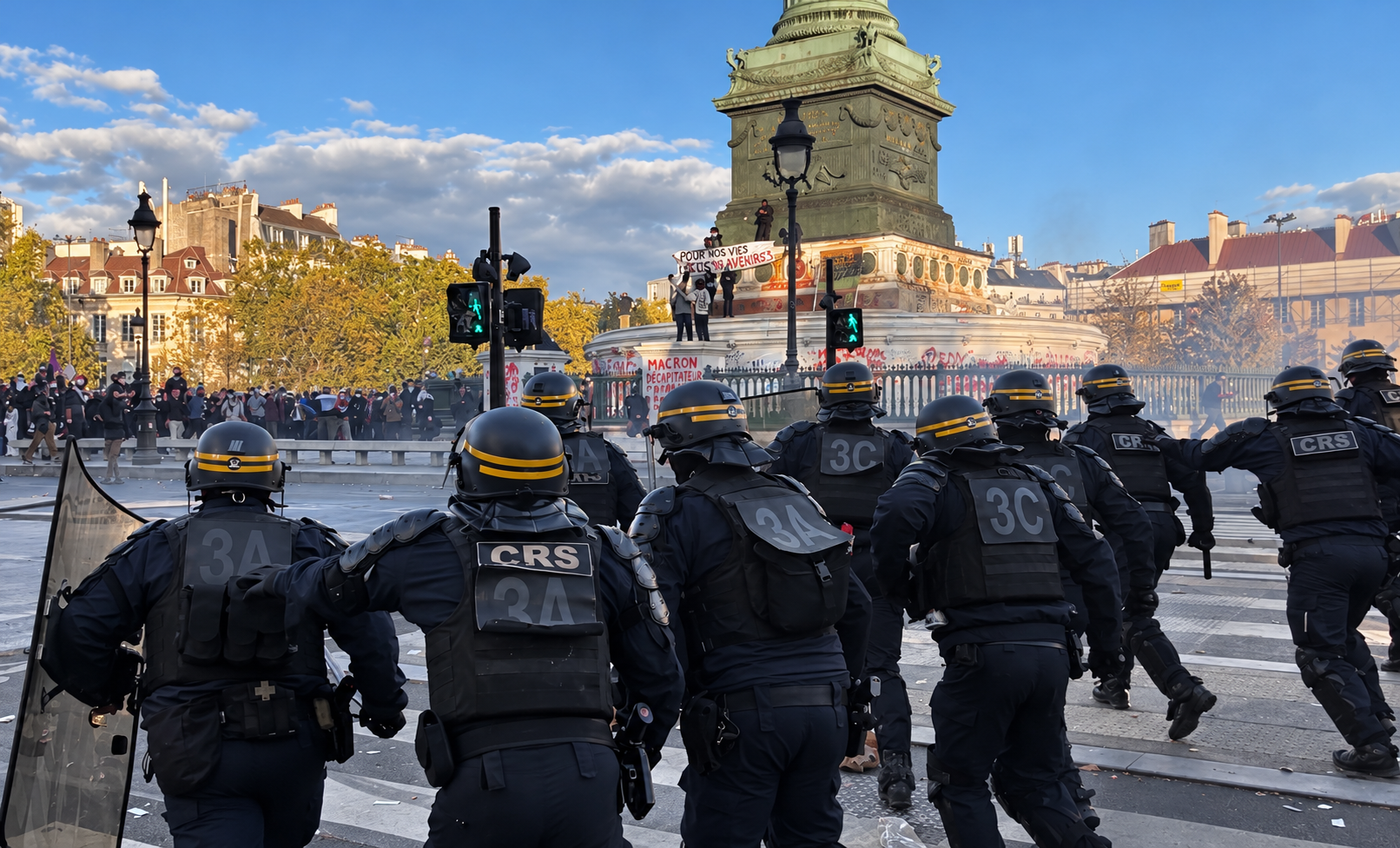 French riot police advance toward protesters amid tear gas at Place de la Bastille during a high school protest in Paris on Oct. 8, 2026. (Etienne Fauchaire/The Epoch Times)
Government Responses
The government has sought to address the educational grievances that initially brought students into the streets.
In a televised address on Oct. 7, Lecornu pledged to announce the first measures by the end of October, although he offered no additional funding beyond the 1.2 billion euro increase already included in the 2027 education budget.
He also criticized political figures who, he said, were exploiting students’ frustrations for their own electoral purposes.
The following day, Education Minister Édouard Geffray announced that 3,000 replacement teachers who had not yet been assigned would be deployed “in the coming hours and days” to 114 high schools identified as facing particularly severe teacher shortages.
For Strachan, the government’s response will encourage further disruption without addressing the underlying problems.
“By tossing out crumbs, the government will not fix the situation,” he said. “The far left won’t settle for it and will carry on. And it shows that violence works.”
He accused Macron’s government of doing little to improve French schools and universities over the past decade and of being complacent toward far-left groups.
“I would like to point out that far-left organizations receive enormous amounts of government funding at universities, and that this money is then used to buy equipment for demonstrations against the very government that funds them,” he said.
“The situation is absolutely absurd.”
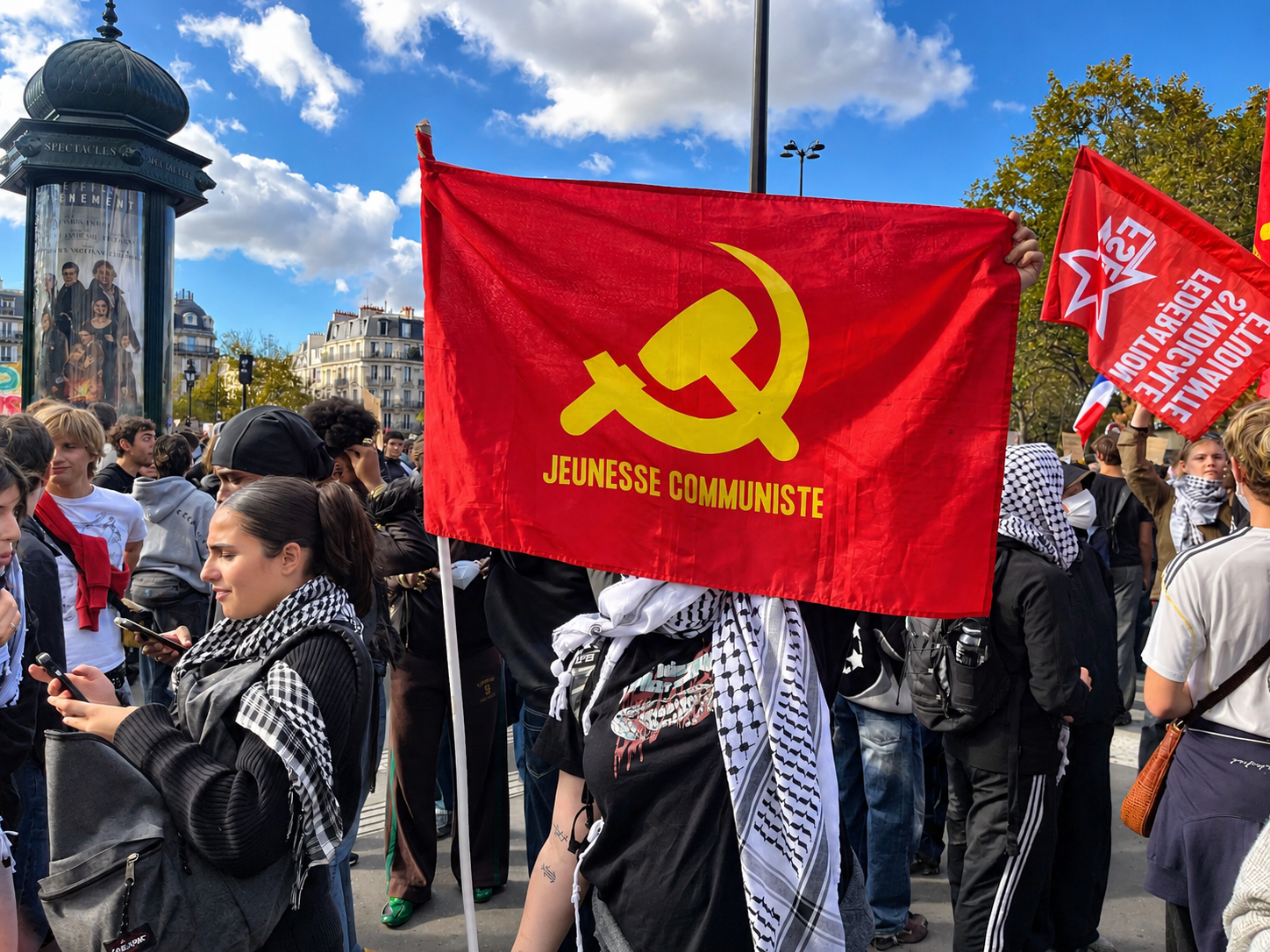 A protester holds a red flag bearing the hammer and sickle emblem of the French Young Communist Movement during a high school protest at Place de la Bastille in Paris on Oct. 8, 2026. (Etienne Fauchaire/The Epoch Times)
“There is a silent majority who is opposed to this,” he said. “Our message is: Let us study in peace.”
 Friends Read Free
Copy
Facebook
Tweet
Friends Read Free
Copy
Facebook
Tweet