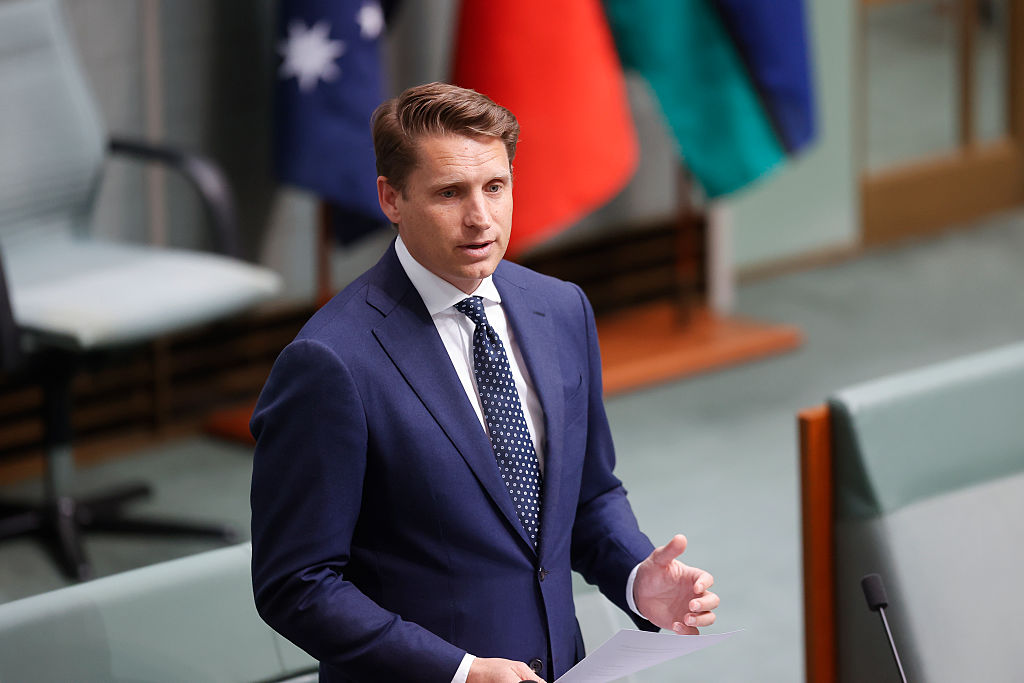

Shadow Sovereign Capability Minister Andrew Hastie has warned Australia would be “sitting ducks” without the support of the United States in a conflict, arguing for a rebuild of the nation’s industrial and defence capability.
During an Anzac Day speech at the Robert Menzies Institute, Andrew Hastie said Australia “forgot the hard lessons of war” and outsourced its security to the United States at the expense of its own hard power.
He tied this view to current events, including tensions with Iran, fuel supply risks and drone and missile threats in the Ukraine and the Middle East.
“Our Royal Australian Navy frigates are not deployable to the Strait of Hormuz because we have not kept pace with developing drone and missile technology used in Ukraine and the Middle East,” Hastie said.
“Even if we send young Australians into harm’s way, we’d be sitting ducks without the intimate support of the U.S. navy.
“What’s worse, we’d probably be a soft target for an Iranian drone or missile strike. The Iranians could send a stern message the same way they have weaponised energy against American allies.”
Hastie, a former Special Air Service Regiment (SASR) officer, reflected on the Australia and United States relationship under the ANZUS treaty in the past decades, arguing that post-Cold War decisions had led to the country’s over-reliance on the United States.
“Our industrial base was once a beast—we could build our own light bombers, cars, whitegoods and cargo ships, and pay workers well for it,” he said.
“But after the Cold War, we embraced globalisation and bet long on the dominance of the United States.
“Deindustrialisation swiftly followed. Our advanced manufacturing sector collapsed, along with our defence industry and refining capacity. We stopped making complex things of value at scale. We lost our industrial teeth.”
The ANZUS alliance is a 1951 security treaty between Australia, the United States and New Zealand, though in practice it is now centered on the Australia-US defence relationship.
‘We Must Grow Our Industrial Might’: Hastie
Hastie did not criticise Australia’s alliance with the United States, instead saying the country must rebalance by rebuilding its domestic capability.
He argued if the ANZUS was to endure for another seventy-five years, Australia needed to invest heavily in its industrial base and defence force.
“For the last 30 years, we have neglected our commitment in Article II to develop our means of ‘continuous and effective self-help’ so that we can defend ourselves and our partners,” Hastie said.
“We must grow our industrial might and hard power. We must be able to make things of value. We must drill, dig and refine oil here in Australia.”
The shadow minister also argued that Australia should attract investment from U.S. AI hyperscalers and chipmakers to build domestically, ensuring sovereign control over critical infrastructure.
“We can’t sit idle at the end of our submarine cables, and hope powerful oligarchs in Silicon Valley will do the right thing by the Australian people,” he said.
“We need sovereign data centres built on our red dirt.”
Hastie noted that these policies are necessary as the United States is prioritising its strategic interests over the international rules-based order under the Trump administration.
“President Trump confirms this reality almost every day with his robust messaging about America’s traditional allies. That means Australia needs to get serious about our own national security,” he said.
U.S. Alliance Remains Fundamental to Australia’s Defence: Marles
Meanwhile, Defence Minister Richard Marles recently said the U.S. alliance remained fundamental to the nation’s defence.
He pointed out that Australia is entering a more dangerous strategic environment, requiring increased defence spending and greater capability.
“The current strategic environment is challenging old assumptions. Both the cost and requirement of defence will grow, and as a nation we will need to invest greater resources in our defence than we historically have,” Marles said during an address to the National Press Club.
“Middle powers that don’t take on more responsibility for their own security will be more exposed to coercion and face greater limits on their sovereignty.”
However, the minister made it clear that self-reliance and building Australia’s own capability did not mean going it alone.
“A greater focus on Australian self-reliance should not be confused with military self-sufficiency. This is not about jettisoning alliance relationships,” he said.
“To the contrary, alliances, especially with the United States, will always be fundamental to Australia’s defence”
 Friends Read Free
Copy
Facebook
Tweet
Friends Read Free
Copy
Facebook
Tweet