
News Analysis
While Canada and the United States saw their unemployment rates reach near-record lows toward the end of the COVID-19 pandemic, Canada has since seen its unemployment rise by a larger percentage than its southern neighbour.
Both Canada and the United States saw their unemployment rates shoot up to over 13 percent during the height of the pandemic in 2020, if the same methodology is used to calculate the figures for both, as the two countries use different definitions. By late 2022, both countries had returned to their pre-pandemic averages of around 5 percent and 3.5 percent respectively.
However, Canada’s unemployment rate has since risen to hit 6.9 percent in June, while the United States has seen that metric rise to just 4.1 percent.
According to several economists, this discrepancy is due to factors like Canada’s comparatively high immigration rates and the strength of the U.S. economy.
Jack Mintz, president’s fellow of the School of Public Policy at the University of Calgary, said Canada’s “very large immigration inflow” since 2023 has pushed unemployment higher, particularly among young Canadians.
Mintz also said imports represent a smaller percentage of the American gross domestic product (GDP) than they do for Canada, which makes the country less economically vulnerable to the recent trade turbulence, while a stronger Canadian loonie has made its exports less competitive and contributed to higher unemployment.
Eric Miller, trade analyst and president of Rideau Potomac Strategy Group, said there has historically been stronger job creation in the United States as well as higher “job destruction,” allowing it to adjust faster to economic changes and recover from recessions.
Livio Di Matteo, an economics professor at Lakehead University in Thunder Bay, Ont., said Canada’s average monthly unemployment rate has been 7.2 percent between 1955 and 2025, while in the United States it has been around 5.2 percent. He said American workers are typically more mobile and the U.S. labour market has historically been more competitive than Canada’s, allowing for fuller employment.
Unemployment Definition, Immigration
Canada and the United States calculate unemployment rates differently. Canada’s working-age population starts at 15, while in the United States it begins at age 16, which makes Canada’s employment rate seem lower since teens are less likely to be employed.
Canada also considers those looking for work by merely browsing job ads as unemployed, while the United States only includes in its statistics those who are “actively” looking for work—such as by answering job ads, visiting employment agencies, or sending out applications.
 People attend a job and continuing education fair in Montreal, on Oct. 5, 2023. (The Canadian Press/Christinne Muschi)
But when using data from the Organisation for Economic Co-operation and Development (OECD), which has a more uniform definition of unemployment across countries and accounts for these discrepancies, Canada’s unemployment rate is still higher than that of the United States over the last few years.
In 2019, Canada had an unemployment rate of 5.7 percent according to OECD data, while the U.S. unemployment rate was 3.7 percent. But when the COVID-19 pandemic resulted in both countries implementing lockdowns to slow the spread of the virus, unemployment shot up to 13.5 percent in Canada and 13 percent in the United States by the second quarter of 2020.

While the Canadian and U.S. governments provided economic stimulus to those out of work during the pandemic, the unemployment rate fell as people returned to their jobs, and by the final quarter of 2022, Canada had an unemployment rate of 5 percent and the U.S. had a 3.6 percent unemployment rate.
Both countries faced issues with not having enough workers to fill key positions, which was due in part to the “Great Resignation” of workers that began in 2021 following the reopening of economies after lockdowns, and was fuelled by employees seeking better work-life balance, higher pay, and more opportunities for advancement.
Canada responded to this problem by loosening its immigration policies and allowing more temporary and permanent residents and lifting the 20-hour-per-week cap on the number of hours that international students can work off-campus while class is in session.
Canada’s population increased from nearly 39 million in July 2022 to nearly 42 million in July 2025. Meanwhile, its unemployment rate went from 6.5 percent in January 2022 and 5.0 percent in January 2023 to 5.7 percent in January 2024 and 6.6 percent in January 2025. The latest data show 6.9 percent in June 2025.
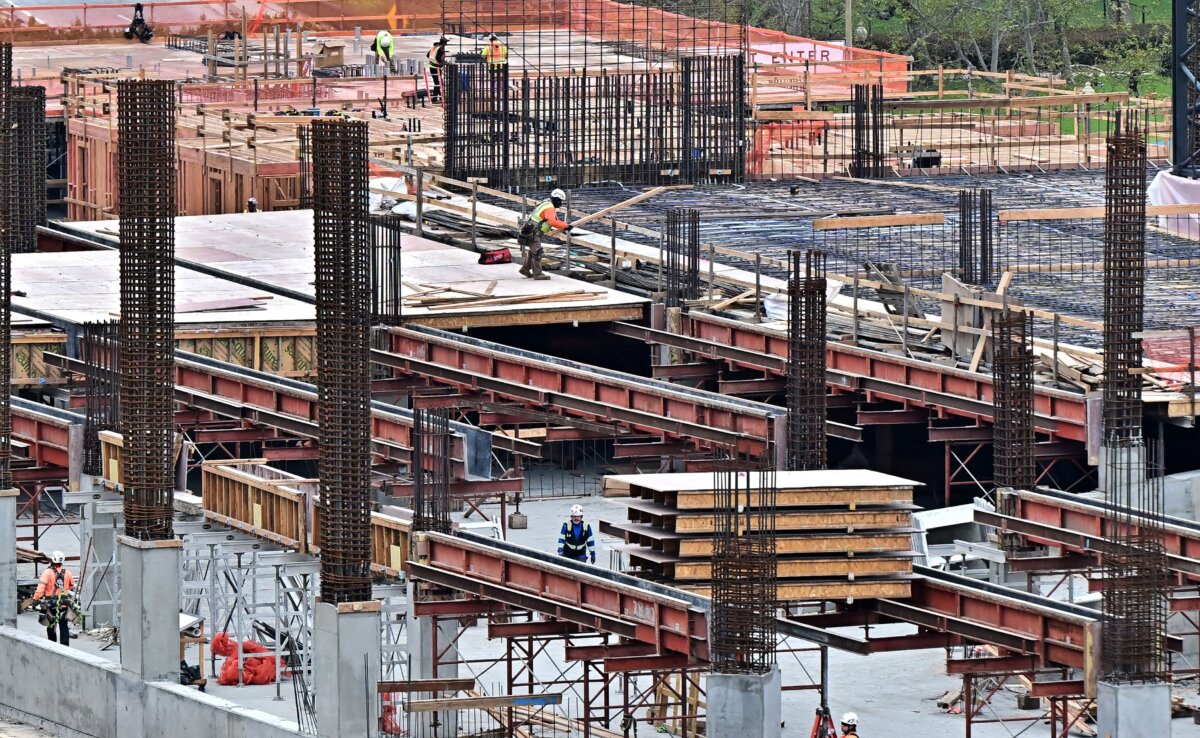
 A general view of the Honda CRV production line at a Honda manufacturing plant in Alliston, Ont., April 5, 2023. (The Canadian Press/Cole Burston)
According to Mintz, Canada’s immigration rates have had a large impact on its unemployment levels, particularly among younger Canadians aged 15 to 24. He noted that according to government data, the unemployment rate for non-student youth in that age group has risen from 7.3 percent in 2023 to 11.2 percent by 2025, which is the highest rate outside of the COVID-19 pandemic since the mid-1990s.
Di Matteo says Canada’s unemployment rate has risen faster than that of the United States since 2022 because its labour force has been growing faster than its employment, which is due to faster population growth through immigration relative to the United States.
However, the Canadian government took steps to reduce immigration rates starting in 2024. As a result, there was virtually no population growth in Canada from January to April 2025.
US Tariffs
While Canada’s tightening immigration policies have likely reduced pressure on the country’s unemployment rates, U.S. President Donald Trump’s tariffs have impacted Canada’s economy and decreased employment.
Trump has put a series of tariffs on Canada since the beginning of 2025, including 25 percent tariffs on all goods not covered under the United States-Mexico-Canada free-trade agreement, which he said on July 10 would increase to 35 percent effective Aug. 1.
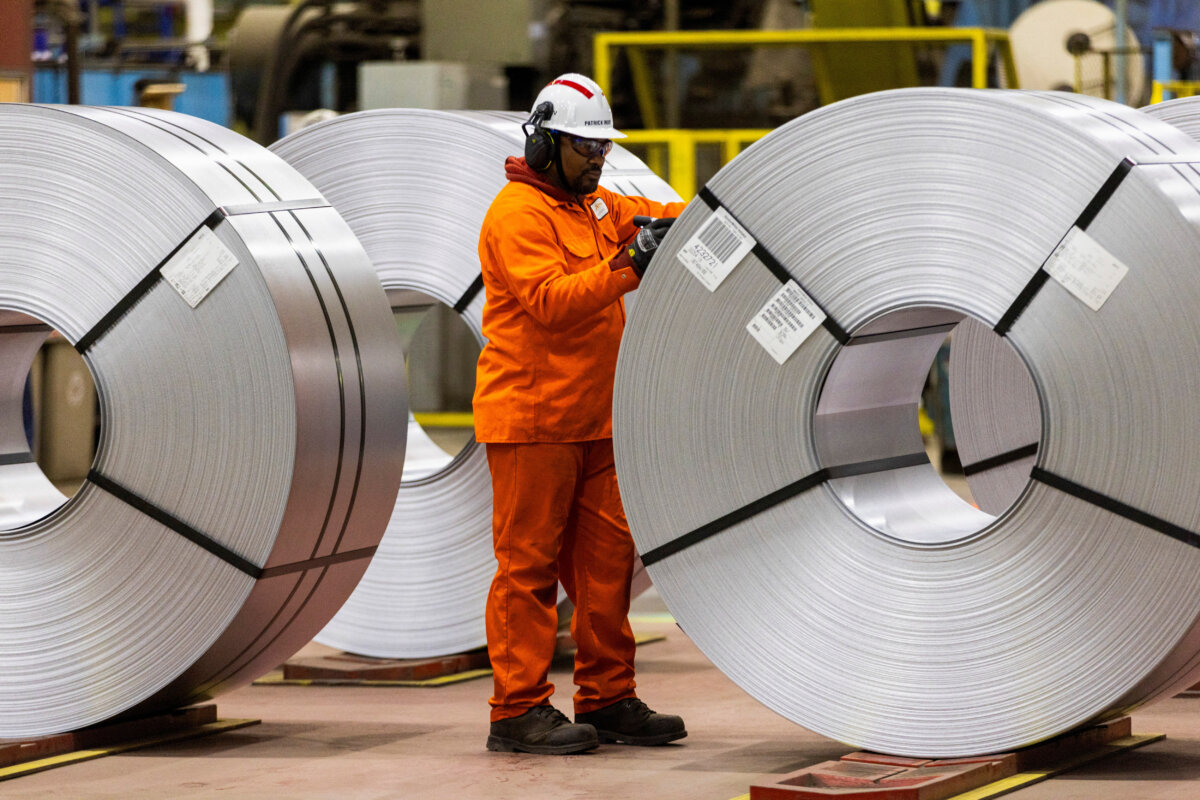
Trump has also put 50 percent tariffs on steel and aluminum, 25 percent tariffs on cars and auto parts, and 10 percent tariffs on energy products and potash.
Canada has over 600,000 workers in the automotive industry and related sectors who are vulnerable to tariffs, and over 200,000 workers in the oil and gas industry. The Canadian aluminum industry accounts for more than 9,500 direct jobs and 20,000 indirect jobs in the country. And Canadian steel producers directly employ 23,000 steel workers while the industry also indirectly generates over 100,000 jobs in supporting industries
The Bank of Canada noted in June that several Ontario auto parts and assembly plants have announced layoffs and production cuts, and manufacturing jobs across Canada are down 55,000 since January.
The United States, which has imposed steep tariffs on other countries with the aim of bringing back domestic manufacturing, has not been as vulnerable to job losses.
Mintz noted that imports of goods and services only make up around 14 percent of the U.S. GDP, while they represent around 33 percent of Canadian GDP, according to 2024 data compiled by the World Bank. This means Canadian counter-tariffs won’t have as much of an impact on the U.S. economy or its employment numbers.
Mintz also said that since the U.S. tariffs have decreased the value of the U.S. dollar relative to the Canadian dollar, Canada’s exports are less competitive, which he said “could be one of the things that’s contributing to higher unemployment.” The value of Canada’s dollar has risen from around 69 cents to the U.S. dollar at the beginning of 2025 to around 73 cents to the dollar in June.
 Friends Read Free
Copy
Facebook
Tweet
Friends Read Free
Copy
Facebook
Tweet