
“What do you think they’re going to do when they find us?” a witness, known only as Dina, said to her husband as they drove past protesters chanting, “Where are the Jews?” during a pro-Palestinian march in Sydney on Oct. 9, 2025.
Just over two months later, on Dec. 14, two gunmen—a father and son—shot and killed 15 people attending a Hanukkah celebration at the iconic Bondi Beach.
Her story is just one of many that are being told to the Royal Commission on Anti-Semitism and Social Cohesion during its first phase, where it looks at the lived experiences of anti-Semitism and its impact on Jewish Australians.
Dina’s father was a Holocaust survivor whose own father was killed in the camps. The family came to Australia and settled in Bondi—her “happy place” growing up.
With three primary-school-aged children of her own now, her family is a frequent visitor to the beach.
“We’ve raised them going to Bondi like many Aussie kids are raised at the beach—surfing, building sandcastles, [and having] takeaway dinners. It’s always had a sense of peace, safety, [and] I would say belonging. Everyone belongs there,” she told the commission.
Referring to the events of Oct. 9, she said, “When you hear angry, violent protesters burning an Israeli flag and shouting, ‘Where are the Jews?’ encircled by police who are not interfering, as a Jew, you feel scared. I said to my husband, I think we should take the mezuzah off our [front] door.”
A mezuzah refers to a small case containing a handwritten parchment scroll with Torah verses, which signifies the home is Jewish.
She recalled that when she went to her Jewish school, children would sit on the grass outside at the end of the day, waiting to be collected by the bus or by their parents.
For her children, the experience is very different.
“Now my children go to school with concrete bollards lining the walkway so that they don’t get rammed by a car. High security fences, security guards, volunteer security guards, and often police.
“I feel comforted that they’re there because I acknowledge that they’re needed, and I feel a level of safety knowing that they’re there. [But] I can’t tell you how many times I’ve dropped my children off and left and cried, because this is not how they should be going to school.
“But then you drive past other schools … I went to another school the other day, and I just walked in. It felt surreal. I literally just opened the door and walked in. That is such an unfamiliar experience for a Jewish parent who sends their child to a Jewish Day School, and it’s not fair.”
She told of taking her children to their friend’s Bat Mitzvah and noticed there were employed security guards.
“A Bat Mitzvah is just a party, a celebration for 12-year-olds, where they just dance and eat ice cream and celebrate … We’ve got daughters who are coming up to having their Bat Mitzvah … We will probably get security guards too,” Dina said.
She said that in this current environment, children couldn’t go through normal life without internalising anti-Semitism.
“They hear anti-Semitism around them all the time. They hear it being spoken about. They see it on the news. They see the stickers, they see the graffiti. They know about Bondi. It’s become part of their psyche.”
Prejudice They Didn’t Expect in Australia: Jewish Group
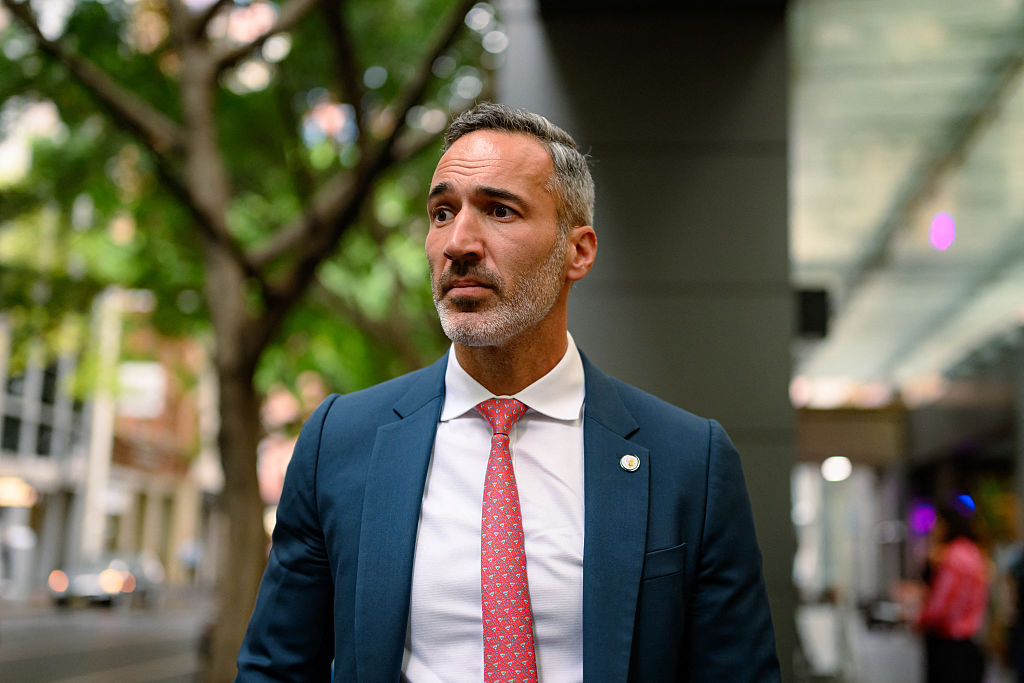
The Commission also heard from Alexander Ryvchin, a Ukrainian-born Australian author and co-chief executive of the Executive Council of Australian Jewry (ECAJ).
He spoke of his parents’ experience as migrants from the Soviet Union and how—with the exception of one neighbour growing up—his family hadn’t encountered prejudice in Australia.
But that changed on Oct. 7, 2025, when Hamas attacked southern Israel, killing almost 1,200 people.
“Seeing the terror return to my parents’ eyes in that moment, it showed me that no matter how far they sought to flee from the Soviet Union, that experience would always be with them,” Ryvchin said.
His work with ECAJ brought him into contact with a wide range of Jewish people, he told the commission. Since Oct. 7, that had meant dealing with “exclusion from cultural institutions, street abuse, and the violence directed towards them,” he said.
This includes students fearing identification from their school uniform, and business owners who have lost everything after facing intense abuse and threats online.
“My family fled the Soviet Union to be as far as possible from [anti-Semitism] but the things that we’ve seen in this country replicate what happened there: the rampant street abuse, the violence, the denigration, and the sheer relish with which it’s inflicted on the Jewish people so often, I think there are clear parallels,” Ryvchin said.
 Friends Read Free
Copy
Facebook
Tweet
Friends Read Free
Copy
Facebook
Tweet