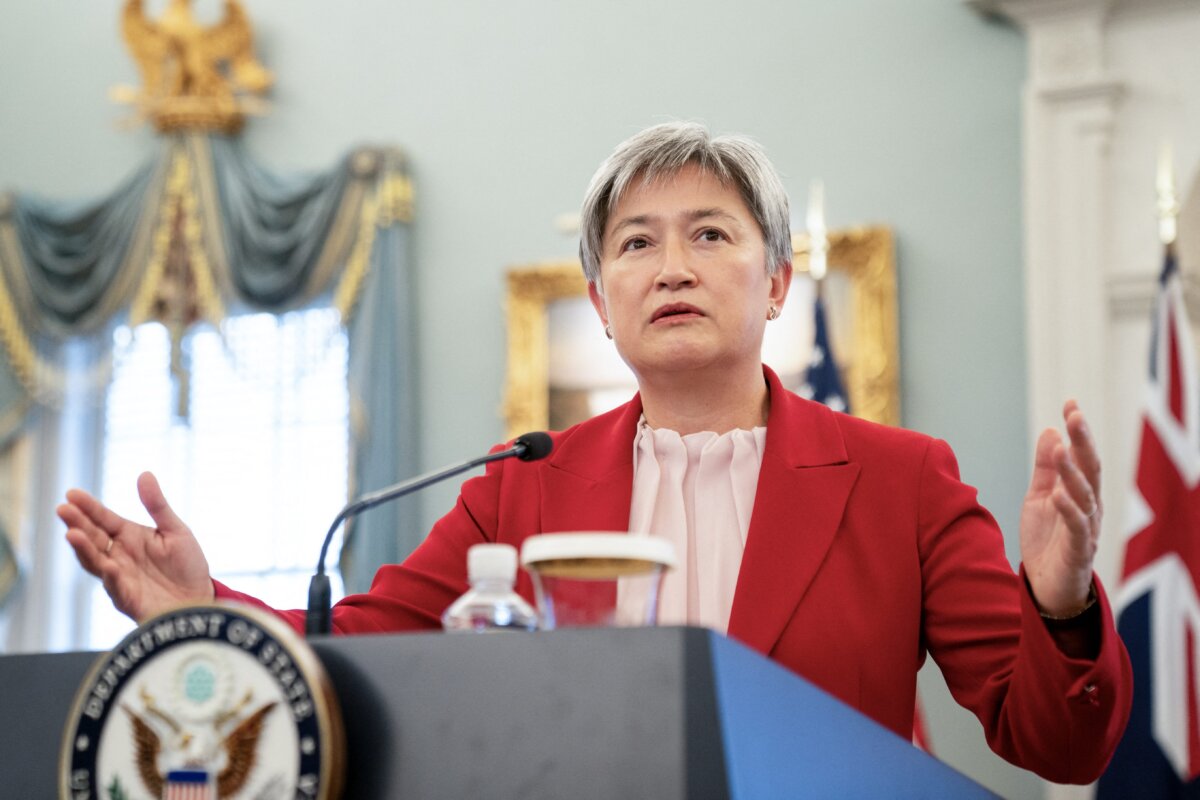

Australia’s Foreign Minister Penny Wong has left on a week-long trip to Asia, which will include a meeting with her Chinese Communist Party (CCP) counterpart Wang Yi as part of annual talks.
She will also visit Japan and South Korea, aiming to secure fuel supply agreements with them. Two-way trade will also be on the agenda.
Last year, trade with all three countries fell: China by $23.7 billion (11.2 percent) to $188.7 billion; Japan by $10.9 billion (13.5 percent) to $69.7 billion; and South Korea by $1.1 billion (2.5 percent) to $41.3 billion.
However, China remained the main trading partner, well ahead of the second-placed United States, which which rose $16.7 billion (44.0 percent) to $54.6 billion.
Wong will likely be looking to reverse the downward trends when speaking with leaders of the three Asian countries.
“The Middle East conflict and closure of the Strait of Hormuz continue to disrupt global energy markets, with Asian refineries and the Indo-Pacific region disproportionately affected,” Wong said in a statement.
“Direct, in-person engagement with counterparts across our region will help ensure we are coordinating effectively as these disruptions continue to unfold.
Wong also spoke of securing fuel supply from the region.
“The Republic of Korea is one of Australia’s most important sources of refined fuels, including diesel, automotive gasoline and aviation fuel. Australia will continue working with international partners to help secure the supplies we need—including diesel, petrol, and fertiliser—and ensure Australia is prioritised as a reliable energy partner.
The trip follows Prime Minister Anthony Albanese’s recent visits to Southeast Asian nations to shore up fuel supplies.
On holding the 8th Foreign and Strategic Dialogue with China, Wong said Australia “remains committed to a stable and constructive relationship with China, which is in the interests of both our countries.
“Dialogue between our countries enables us to progress the full range of our interests and manage our differences,” she said.
Last year China’s global trade surplus reached $1 trillion, and it recently granted additional export licences to Australian beef producers, despite imposing a quota in January.
All imports of Australian beef into China after the quota is met will have a 55 percent tariff imposed, which attracted considerable criticism from meat producers and forced exporters to look for alternative markets.
On Japan Trade
The value of two-way trade with Japan makes it Australia’s third-largest trading partner and second-largest export destination.
Wong says she will discuss energy markets with Japanese Foreign Minister Motegi Toshimitsu during meetings in Tokyo, ahead of her China visit.
“Australia and Japan are special strategic partners and close friends, with a relationship built on trust, aligned values, and mutual interests,” she said. “Together, we support a free and open Indo-Pacific that is inclusive and resilient.”
Her Asian trip will finish in Seoul, where she will meet with South Korean Foreign Minister Cho Hyu.
South Korea is one of Australia’s primary sources of refined fuels, including petrol, diesel and aviation fuel.
Australia’s major gas export markets are South Korea, China, and Japan. Canberra has been eager to bolster the country’s reputation as a reliable supplier, in return seeking greater certainty about liquid fuel supplies.
 Friends Read Free
Copy
Facebook
Tweet
Friends Read Free
Copy
Facebook
Tweet