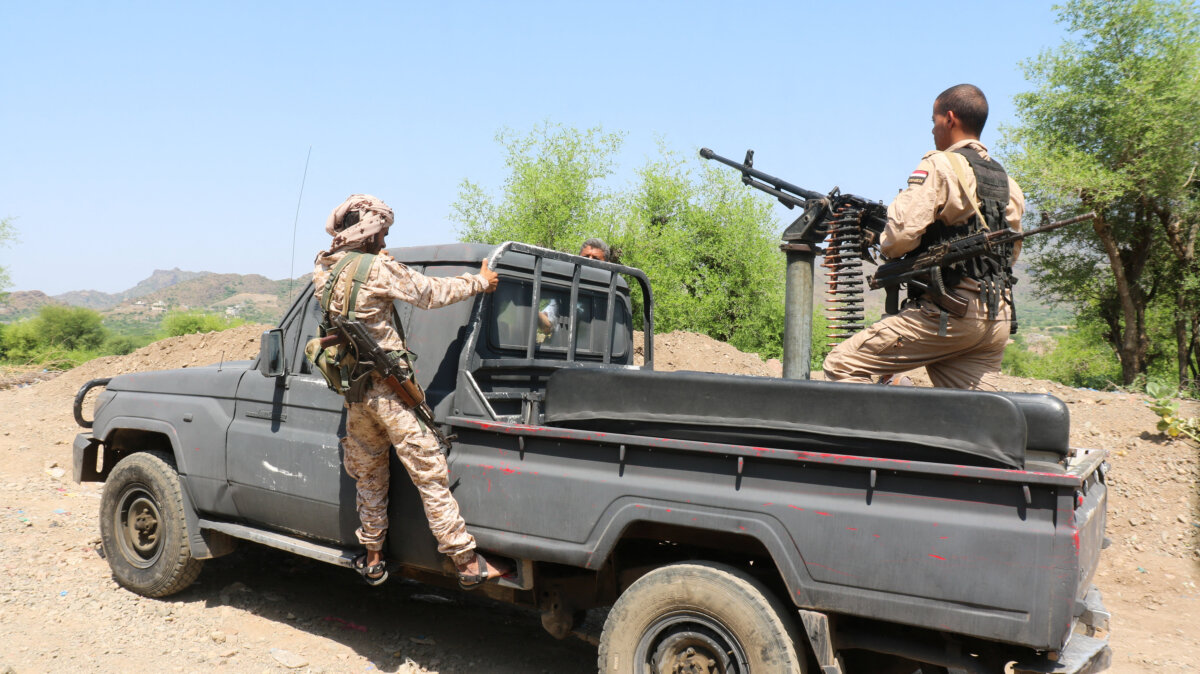

Yemeni government forces have regained effective control of the Bab al-Mandeb Strait from the Houthis, a government minister said on Monday.
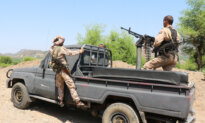
Yemen’s information minister Moammar al-Eryani said government forces, which launched an offensive on Sunday, had made a rapid advance with Saudi air support and seized key positions in Dhubab, next to the key international waterway.
Eryani said the armed forces had regained an airstrip at Dhubab, which is just inland, and cut off Houthi forces in the area, but fighting is still continuing.
About 12 percent of the world’s goods are shipped through the strait, en route to or from Europe and Asia.
U.S. Secretary of State Marco Rubio welcomed reports of the Yemeni government offensive.
“The Yemeni forces are going to try to retake territory that they were ousted from,” Rubio said.
When the Houthis took Mokha on Sept. 10, after a surprise offensive of their own, they threatened the Bab al-Mandeb Strait, which is 50 miles south of Mokha and is a key waterway connecting the Red Sea with the Gulf of Aden and the Indian Ocean.
Two days later, they captured Perim Island, a strategic island in the Bab al-Mandeb Strait.
The fighting close to the Bab al-Mandeb strait comes as Iran maintains its threat to shipping in the Strait of Hormuz, a strategy Tehran adopted after U.S. and Israeli forces began attacking Iran on Feb. 28.
Earlier, the Houthis said reports of government gains were “completely untrue” and threatened to shoot down Saudi planes operating in the area.
Last month the Houthis captured the key port of Mokha on Yemen’s Red Sea coast, their biggest territorial gain since a 2022 ceasefire between the Iran-aligned terrorist group and the Yemeni government.
In a televised address on Sunday, Yemeni President Rashad al-Alimi said the government’s armed forces would press the offensive “until the country is liberated from the grip of the terrorist militia.”
He said the decision to launch the counteroffensive came after attempts at de-escalating the conflict had been exhausted.
The Houthis responded by saying they had launched ballistic missiles and drones at oil sites owned by the Saudi government-owned Aramco, in the capital Riyadh, and in the Khurais oilfield in eastern Saudi Arabia.
The Houthis, who are officially known as Ansar Allah and are designated as a foreign terrorist organization by the United States, seized control over the Yemeni capital city of Sanaa in late 2014.
They then consolidated power over an area of northwest Yemen representing about 80 percent of the country’s population.
The government, which is politically and militarily backed by Saudi Arabia, is based in Aden, on Yemen’s south coast, and controls most of the south and east of the country.
In a Monday post on X, Yemeni military spokesman, Col. Majed Al-Nuzaili, called the offensive Operation “Dawn of Yemen.”
“The Giants Forces and National Shield succeeded in controlling Bab al-Mandab,” a reference to two pro-government militias.
Houthis Escape By Boats
Al-Nuzaili said Yemeni forces cut off the road between Dhu Bab and Al-Makha [Mokha] and tightened fire control over it.
Hundreds of Houthis were besieged in the Dhu Bab area; some Houthi militia elements escaped on boats.
“Free Yemen From Iran,” Rep. Joe Wilson (R-S.C.), who serves on the House Committee on Foreign Affairs, posted on X on Monday.
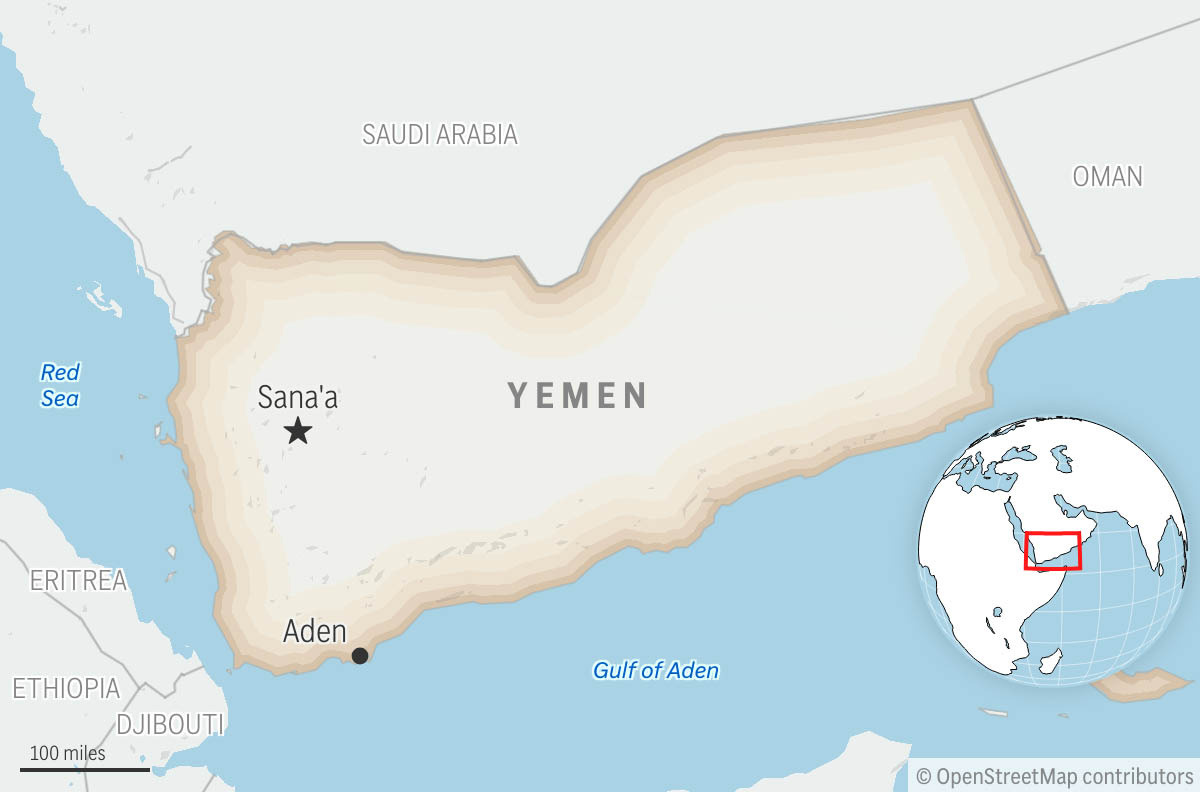 A map of Yemen with its capital, Sanaa. (AP Photo)
“The Southern Giants Forces highly commend the role of the Sabiha tribes, whose sons joined the forces to engage in the battle against the Houthi enemy, amid high morale and full readiness and preparedness to counter any Houthi movement,” they wrote.
In August, X shut down the account of Houthi spokesman Yahya Saree for violating the social media company’s rules.
Reuters contributed to this report.
 Friends Read Free
Copy
Facebook
Tweet
Friends Read Free
Copy
Facebook
Tweet