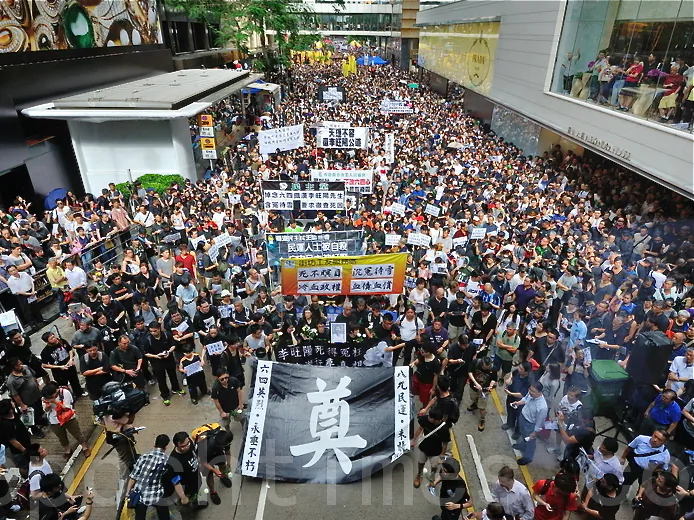

More than 25,000 protesters gathered in front of the Chinese regime’s liaison office in Hong Kong on Sunday, June 10, demanding Beijing investigate the death of Li Wangyang, a Chinese dissident imprisoned for more than 20 years for his activism on behalf of the rights of workers.
Participants dressed in black prepared flowers to mourn Li’s death. Demonstrators started near Pedder Street, passed by Queen’s Road Central, Queen’s Road West, and eventually arrived at the Chinese regime’s liaison office. Along the way, many Hong Kong residents joined the march. In front of the office, they sang mourning songs and read a statement urging the regime to investigate Li’s recent mysterious death.
Li Wangyang was found dead, apparently having hung himself, on June 6. Three days later his body was cremated by the government of Shaoyang City, Hunan Province without notifying his family. A few days before his death, Li was interviewed by Hong Kong’s i-Cable Television, where he revealed the persecution he suffered and his ongoing determination to fight for human rights in China. Critics suspect the government staged Li’s suicide because of his outspokenness. Li was in extremely poor health before his death, and his family raised questions over whether he had the strength to climb out of his hospital bed and hang himself near the window.
“He is only a normal Chinese who spoke out for democracy. If I don’t stand out, the next person might be me,” said 24-year-old protester A-Hai. “If we do nothing, then the truth will really be buried.”
Li Wangyang was a glass factory worker in 1989 when the nationwide pro-democracy movement broke out. Li later founded a labor union, and openly mourned victims of the Tiananmen Square massacre. For these acts, Li was charged with “counterrevolutionary crimes” and sentenced to 13 years in prison. After his release in 2000, he again called out against the Chinese regime and was sentenced to another 10 years in 2001. When he was released last year, he had gone blind and deaf due to torture.
“We really feel that Mr. Li suffered a lot in the past 20–30 years and that he would not have committed suicide; if he did commit suicide, then the local government should have allowed a fair, unbiased, and open autopsy,” a participant in Sunday’s march said.
In a tweet, dissident Guo Baoluo pointed to three Zhaoyang City officials he thinks may have had a hand in Li’s death. Guo named Li Xiaokui, head of the Public Security Bureau in Zhaoyang; Zhao Luxiang, head of the National Security Team under the Public Security Bureau; and Zhou Benshun, secretary of the Political and Legislative Affairs Committee, who is a native of Zhaoyang City. The Political and Legislative Affairs Committee is responsible for suppressing dissidents. Zhao Luxiang was involved in suppressing student protesters during the 1989 democracy movement and personally oversaw Li’s sentencing.
Shi Zangshan, an expert on China’s political issues residing in Washington, D.C., said amid the intense internal struggle among top Communist Party leaders, there is fierce competition over who will preside over the vindication of the 1989 student movement.
“Because none of the top leaders who initiated the violent crackdown are in power—Deng Xiaoping is dead, and Jiang Zemin is out—Zhou Yongkang and Zeng Qinghong are the only forces against the vindication,” Shi said.
Read the original Chinese article.
Click www.ept.ms/ccp-crisis to read about the most recent developments in the ongoing crisis within the Chinese communist regime. In this special topic, we provide readers with the necessary context to understand the situation. Get the RSS feed. Get the new interactive Timeline of Events. Who are the Major Players? 
The Epoch Times publishes in 35 countries and in 19 languages. Subscribe to our e-newsletter.
 Friends Read Free
Copy
Facebook
Tweet
Friends Read Free
Copy
Facebook
Tweet