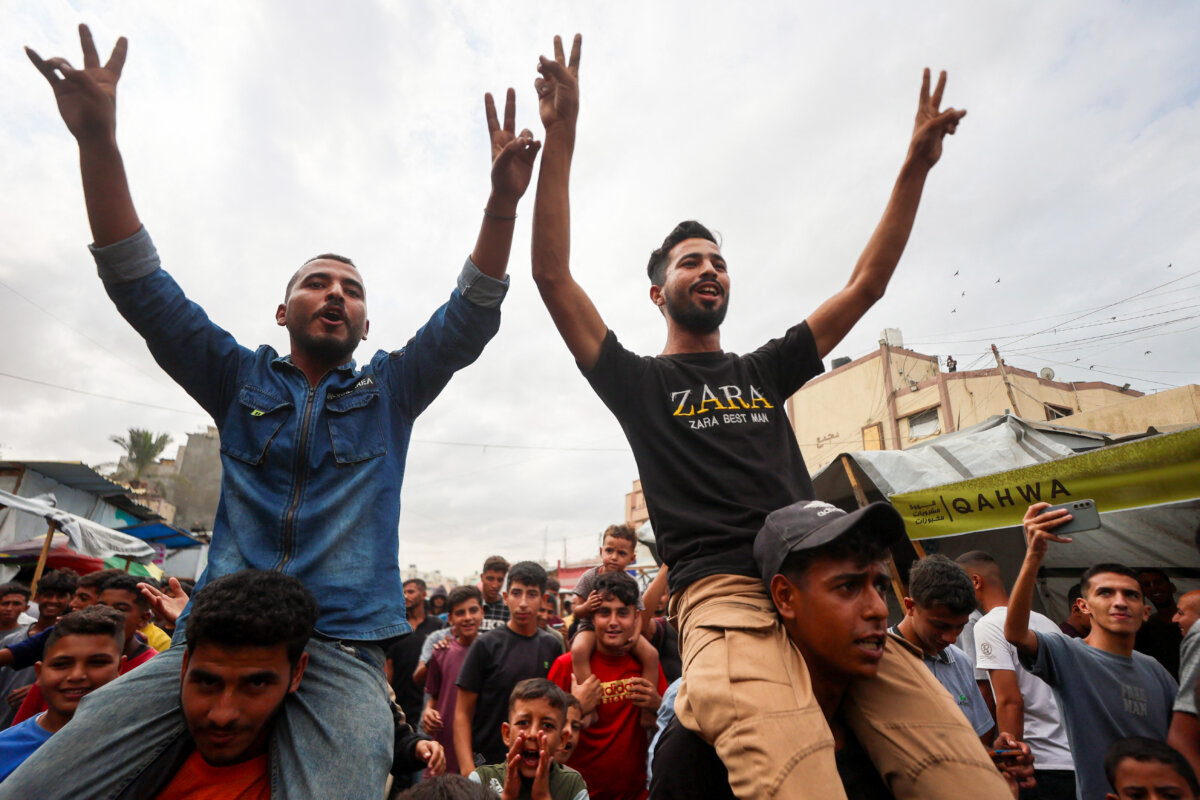

WASHINGTON—President Donald Trump successfully brokered a cease-fire deal between Israel and Hamas, seen by many observers as a groundbreaking chance to end the two-year conflict and establish lasting peace in the Middle East.
Following days of negotiations in the Egyptian city of Sharm el-Sheikh, Hamas signed an agreement on Oct. 9 to release all 48 hostages held in Gaza, both the living and the bodies of the dead. It is estimated that nearly 20 hostages remain alive.
Trump hailed the agreement as a “momentous breakthrough.”
“It’s something that nobody thought was possible, and we’re going to end up having peace in the Middle East,” he said on Oct. 9 during a Cabinet meeting at the White House.
He announced that the hostages will be released early next week—likely on Monday or Tuesday.
“That’ll be a day of joy,” Trump remarked, noting he plans to visit Egypt to attend the official signing of the cease-fire.
World leaders on Thursday issued a wave of statements praising Trump.
The United Kingdom’s Prime Minister Keir Starmer said the deal “would not have happened” without the U.S. president’s leadership.
Former NATO Secretary General Anders Fogh Rasmussen said Trump’s peace plan could be used as a blueprint to solve other conflicts.
“Trump deserves credit for brokering this Middle East deal, and I think the same approach should be used to create a peace process in Ukraine,” he told Sky News on Thursday.
While many are hopeful, skepticism persists among experts about Gaza’s future and the successful implementation of the second phase of Trump’s 20-point peace plan.
Building Trust in the Middle East
Trump’s first step was a visit to the Gulf nations in May, where he prioritized building personal bonds with the leaders of Saudi Arabia, Qatar, and the United Arab Emirates.
In an unprecedented move, he also signed an executive order on Sept. 29 aimed at protecting Qatar. The commitment came after Israel’s Sept. 9 military strike on Qatar to target Hamas leaders, which triggered a major escalation in the Middle East.
“The United States shall regard any armed attack on the territory, sovereignty, or critical infrastructure of the State of Qatar as a threat to the peace and security of the United States,” the executive order stated.
Netanyahu’s Stunning Reversal
While gaining the backing of Arab and Muslim nations was crucial, Trump’s pivotal achievement came on Sept. 29, when Israeli Prime Minister Benjamin Netanyahu endorsed his peace plan during a White House visit.
The agreement stipulated that Israel would refrain from annexing Gaza and commit to Palestinian statehood once specific conditions were met.
Just a week prior, Netanyahu had sharply criticized Western nations, including the UK, France, Canada, and Australia, for recognizing a Palestinian state.
Despite his earlier stance, Netanyahu reached an agreement with Trump, marking a significant shift. For many of Trump’s critics, this breakthrough has been a stunning development.
What’s Next?
The latest agreement between Israel and Hamas presents a rare chance to end years of conflict.
Analysts say its success depends on navigating the difficult next phase: addressing Gaza’s reconstruction, Hamas’s disarmament, and the long-debated path toward Palestinian statehood.
“There’s a lot of potential for this to get derailed. But for today, I’m just happy that the killing seems to have stopped,” Daniel L. Davis, a retired U.S. Army officer and senior fellow at Defense Priorities, told The Epoch Times.
Daniel Flesch, a Middle East policy analyst for the Heritage Foundation, said his initial reaction is one of “joy and relief” for the opportunity to return the hostages from Gaza.
While many pitfalls may exist in the long-term peace process, Flesch said Israel will have more room to make decisions when Hamas no longer holds its citizens hostage.
“Once the hostages are home, that relieves an immense amount of pressure on this government and the country itself,” he said.
—Emel Akan; Ryan Morgan; Jackson Richman; Stacy Robinson
BOOKMARKS
Elon Musk has settled a $128 million lawsuit with former executives of his social media platform X, previously known as Twitter. The four executives alleged that Musk denied them severance pay when they exited the company in 2022.
Attorney General Pam Bondi says there have been 562 arrests in Memphis, Tennessee, following a recent surge of federal law enforcement in the city. One resident noted the change, saying, “When the FBI is here, the troublemakers stay away.”
Former congresswoman Abigail Spanberger and Lt. Gov. Winsome Earle-Sears are nearing the finish line in their contest to replace Virginia Gov. Glenn Youngkin. Read Arjun Singh’s report to get a closer look at the race.
The next meeting for the Centers for Disease Control and Prevention’s vaccine advisory panel has been rescheduled … but the new date has not yet been announced. The panel met last month and was supposed to gather on Oct. 22.
Danish Prime Minister Mette Frederiksen wants to ban—or at least limit—social media use for children under the age of 15. She says the technology has “unleashed a monster” by increasing depression and anxiety in youth.
—Stacy Robinson
 Friends Read Free
Copy
Facebook
Tweet
Friends Read Free
Copy
Facebook
Tweet