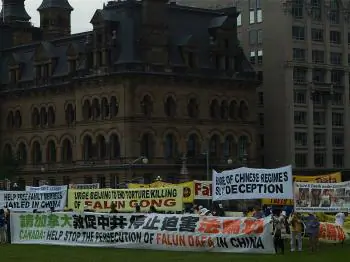

Evidence of Canada’s tangled ties with China has been splattered all over Parliament Hill in recent weeks, showing just how complicated relations are with the most powerful dictatorship in the world.
While the government is trying to curry favour with the Chinese regime by sending a deluge of ministers there (four in the past two weeks alone) to wrangle trade deals and agreements on various files, talk of China on Parliament Hill has been grim recently.
Like the tales told to a subcommittee last week about how the Chinese regime has become more repressive in recent years, cracking down on dissent with a fervour borne out of fear.
Fear of the Masses
“The discontent and alienation is so deep and widespread that more than 120,000 large-scale demonstrations occur each year in China that go largely unreported in the west,” Dr. Yang Jianli, president of Initiatives for China, told MPs on the human rights subcommittee last Thursday.
“To keep a lid on this cauldron of discontent, the Chinese government has constructed, in the past 20 years, an unprecedented police state, or as the Chinese government calls it, a stability-preserving system,” he said via videoconference from New York.
Researchers at Tsinghua University, China’s MIT, say the regime spent $77 billion on domestic security in 2009, just below its military budget of $80 billion.
“This security system is out of control and clearly shows the paranoia of this regime and its attitude that its citizens are enemies to be mentally and socially controlled at all costs,” Yang said.
“Many say that the situation in China has worsened, that the government is in full crackdown mode,” said Maran Turner, the executive director of Freedom Now.
Also speaking via videoconference from New York, Turner told the subcommittee that despite continued economic growth, human rights in China have deteriorated.
“The rule of law has been said for a while now to be in full retreat. As I said, individual activists and dissidents are targeted. They’re being arrested. They’re being put on trial. They’re generally being charged, with very few exceptions, under article 105 of the Chinese Criminal Code, which is subversion or splitism, or more often, they’re charged with merely inciting subversion or splitism.”
She said those vague laws have no real definition, a catch-all crime the regime uses to attack its targets, such as prominent human rights lawyer Gao Zhisheng and recent Nobel peace prize winner Liu Xiaobo.
Just days later, one of the world’s foremost experts on China’s security system also visited Parliament.
 Friends Read Free
Copy
Facebook
Tweet
Friends Read Free
Copy
Facebook
Tweet