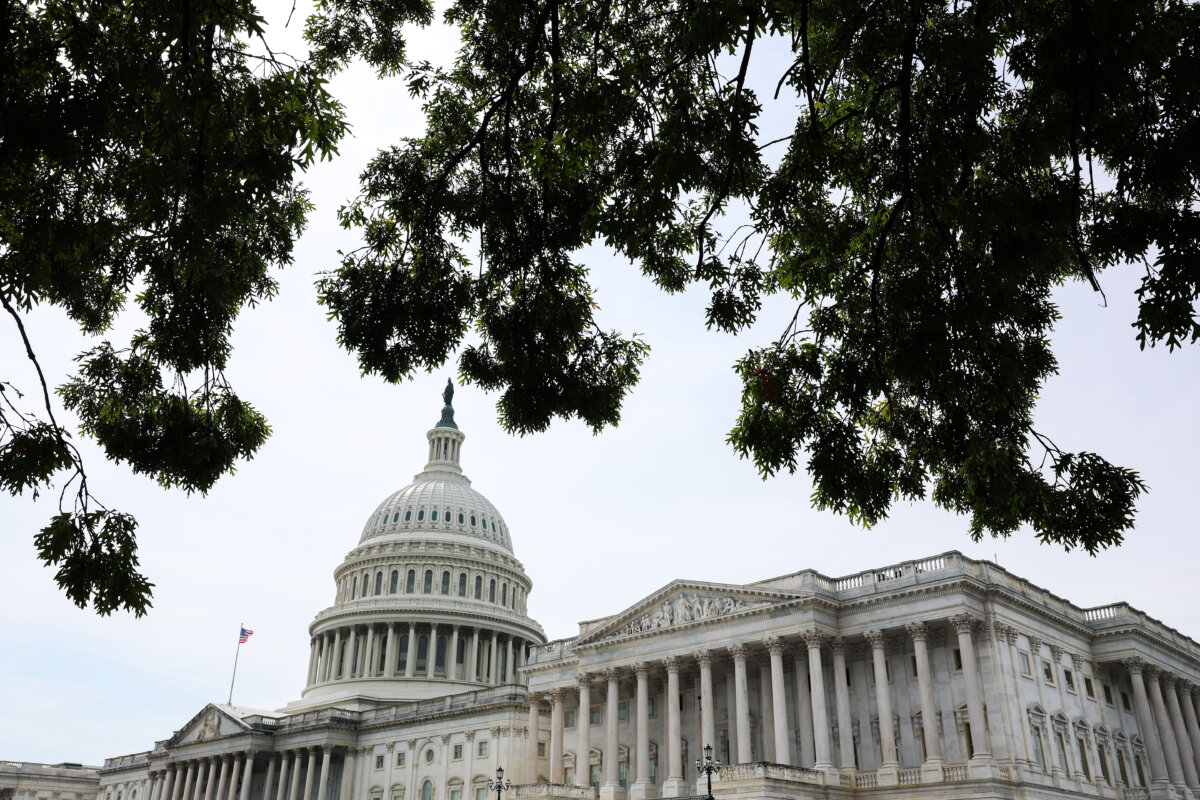

President Donald Trump will meet with top lawmakers in the House and Senate on Monday in a last-ditch effort to avert a shutdown set to go into effect on Sept. 30.
The meeting will include the two top-ranking Democrats, House Minority Leader Hakeem Jeffries (D-N.Y.) and Senate Minority Leader Chuck Schumer (D-N.Y.).
It will be held at the White House a day before a shutdown is set to begin. Government funding will expire after midnight on Tuesday, and so far, Washington is in a deadlock over the issue as both Democrats and Republicans refuse to budge.
The situation is in part because Republicans require Democrats’ support to pass the bill out of the Senate.
Unlike the One Big Beautiful Bill Act, which was passed earlier this year under the reconciliation process, government funding legislation must win sixty votes in the Senate. With Republicans holding 53 seats, they’d need at least 7 Democrats to defect to pass a government funding bill.
Republicans have been broadly united in their support of a clean continuing resolution (CR), Washington terminology for a stopgap funding bill. Trump has also backed a clean CR.
Last week, House Republicans passed such a bill in a 217–212 vote. It would extend government funding for around seven weeks, pushing the deadline to Nov. 21.
With the Senate set to return on Monday, and House lawmakers not due back until later in October, this bill—which was rejected in an initial vote in the Senate—is the one Republican leaders are pushing Senate Democrats to back.
So far, Democrats in the Senate have indicated that they aren’t willing to provide their backing for such a measure.
Instead, Democrats are demanding an extension in subsidies for low- and middle-income Americans who purchased health insurance through the Affordable Care Act, otherwise known as Obamacare, among $1 trillion in other healthcare funding-related demands.
Those Medicaid cuts helped offset the cost of making the bill’s tax cuts for top earners permanent, which would make it difficult for Republicans to accept Democrats’ demands even if they were open to the proposal.
Republican backers of the bill say that its Medicaid cuts solely targeted waste, fraud, and abuse. Democrats have pointed to Congressional Budget Office estimates that more than 10 million Americans will lose coverage under the bill and highlighted the potential impact the plan could have on small rural hospitals.
Trump and congressional Republicans have rebuffed Democrats’ demands as excessive. Republicans have so far indicated their intention to stand strong on rejecting Democrats’ demands.
During a Sunday interview on NBC’s “Meet the Press,“ Thune suggested openness to discussing insurance subsidies at a later date, but that the issue shouldn’t be attached to government funding.
“Keep the government open, and then let’s have a conversation about those premium tax credits,” he said. “I’m certainly open to that. I think we all are.
During an interview with CNN’s Jake Tapper, House Speaker Mike Johnson (R-La.) suggested that Republicans hadn’t changed their posture much, and indicated that extensive negotiations over the issue weren’t on the table.
“Just to be clear, there’s not gonna be any negotiation at this meeting? This is just gonna be you, [Senate Majority Leader John Thune (R-S.D.)], and Trump telling Jeffries and Schumer, ‘We’re not giving you anything?'” Tapper asked.
“I’m telling you where the president’s head is,” Johnson replied. “He wants to bring in the leaders to act like leaders.”
Last week, Trump had agreed to meet with Schumer and Jeffries, but later withdrew his support for the meeting.
In a Truth Social post, Trump accused Democrats of making “unserious and ridiculous” demands in return for their votes to keep the government open, adding that “no meeting with their Congressional Leaders could possibly be productive.”
A government shutdown occurs when Congress fails to fund one or multiple sectors of the federal government.
Every year, Congress must pass a total of 12 spending bills for various areas of federal appropriations, such as funding for defense, agriculture, education, and other outlays.
So far, Congress has not sent any of those finalized funding bills to Trump’s desk.
—Joseph Lord
BOOKMARKS
New York City Mayor Eric Adams dropped out of this year’s mayoral race on Sunday, The Epoch Times’ Jacob Burg reported. The controversial mayor cited mounting pressure that makes it difficult to continue his campaign. That makes it easier for former New York Gov. Andrew Cuomo—running an independent campaign—to take on Democratic nominee Zohran Mamdani.
In an exclusive interview with The Epoch Times, First Son Eric Trump—a 41-year-old husband and father of two—gave The Epoch Times’ Jan Jekeliek a behind-the-scenes look at how a decade of relentless attacks from the political left threatened to destroy his business and his family, and even take his father’s life.
At least four people were killed and at least eight were injured when a gunman opened fire inside a Church of Jesus Christ of Latter-day Saints chapel in Michigan and set the building ablaze, The Epoch Times’ Jack Phillips and Joseph Lord reported. One victim is in critical condition, while seven others are in stable condition.
Internet freedom company Dynamic Internet Technology has identified 193 developers behind the recent leak of 100,000 documents that shed light on how China is exporting mass surveillance and censorship tools to authoritarian clients, The Epoch Times’ Catherine Yang reported. The CCP’s technology used to suppress citizens was sold to the governments of Kazakhstan, Ethiopia, Pakistan, Burma, Xinjiang, and at least one other country.
Trump has increasingly taken an optimistic stance towards Ukraine’s prospects in reclaiming its pre-2014 territory. The Epoch Times’ Ryan Morgan reported on what’s at play as the administration’s stance shifts.
 Friends Read Free
Copy
Facebook
Tweet
Friends Read Free
Copy
Facebook
Tweet