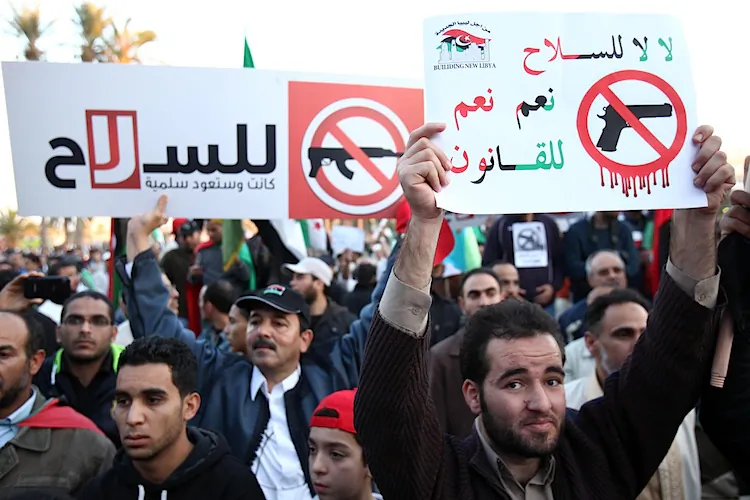

As Libya tries to rebuild its society after Gadhafi’s 40-year rule, the different militia groups that helped oust him are now becoming a security problem, as shown by recent violent clashes. In many places, the militias have far greater authority than the self-appointed National Transitional Council (NTC) and absorbing the former rebels into a new national army, police, or civilian role will be a crucial issue for Libya’s future.
Yet, the new Libyan leadership must be careful in its disarmament and demobilization of the militias to avoid further fragmentation, according to a recent report from the International Crisis Group (ICG), an NGO specialized in helping resolve deadly conflicts.
According to estimates in the ICG report, there are more than 125,000 armed Libyans and an unknown number of local militias, made up largely of untrained people. Some say there are about 100 separate groups, while others estimate a number three times higher.
These militias are now in control of security in their local areas, where they run checkpoints and arrest suspected loyalists. They have furthermore each established their own systems and routines, a direct result of how Libya was won. Especially in western Libya, cities essentially had to fend for themselves against Gadhafi’s forces, without substantial support from the NTC or defected army units in the already rebel-controlled east.
Not only do these local, geographically based militias feel they have proved themselves in combat and know their conditions better than anyone from the outside, they also have varying degrees of distrust or resentment against the NTC, says the ICG.
Some feel that the NTC is too secular and Western-oriented, and there is also a distrust of its leaders, since many of them are former members of Gadhafi’s elite. This sentiment has been compounded by the opaque structure and decision making of the NTC, according to the report.
Yet, most militias have also expressed the need to reintegrate into the greater national context. The question is how to make this happen in a smooth, efficient, and transparent way.
ICG recommends a “baby steps”-approach, where the NTC makes efforts to become more transparent and seeks a more consistent and orderly dialogue with the militias to include them in the decision-making process when it comes to disarmament and demobilization.
The militias, on the other hand, need to commit to following established codes of conduct to guarantee the rule of law, especially when it comes to how they arrest and detain people and solve their disputes with other militias. The United Nations should also assist this procedure, the report says.
However, the undertaking is not likely to be simple, since the situation has a “Catch-22” aspect to it. Jason Pack, a Libya scholar from Cambridge University, who also spent time in Libya during the war, told U.N.-funded news service IRIN that the militias said, “‘We can’t give up control because the national authorities can’t do it on their own.’ But the national authorities won’t be able to consolidate security as long as the militias are running around.”
Yet, as the almost daily security incidents in Tripoli show, the situation must be addressed soon. The longer the militias are left to themselves, the more entrenched in their ways they will become, which will make national unity more difficult to achieve in the long run.
“The longer it takes you to deal with the issue of the revolutionaries, the longer they stay in power. You create new centers of power that will not be easy for them to give up,” a U.N. official in Tripoli told IRIN.
 Friends Read Free
Copy
Facebook
Tweet
Friends Read Free
Copy
Facebook
Tweet