SAN DIEGO—Experts on human rights in China and victims of human rights abuses at the hands of the Chinese regime gathered on Wednesday, May 11, to discuss the practice of organ harvesting in China.
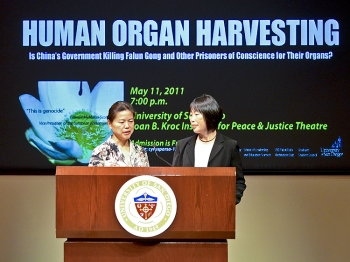
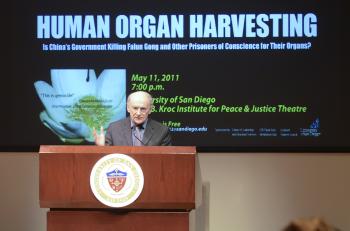
The event, titled “Human Organ Harvesting: Is China’s government killing Falun Gong and other prisoners of conscience for their organs?” was held at the Peace & Justice Theatre at the Joan B. Kroc Institute for Peace & Justice at University of San Diego (USD), and well attended by some 140 people. Two featured speakers were David Matas, an international human rights lawyer, and the Hon. David Kilgour, former Canadian MP, Queen’s barrister, and former head secretary of state, Asia-Pacific.
Jointly, Kilgour and Matas have been gleaning information on the subject of Chinese organ harvesting since being approached by several Falun Gong practitioners in 2006. Kilgour mentioned that 41,500 organ donors are unaccounted for in the calculations of the number of organs and donors provided by the Chinese Communist Party for the years 2000-2006. They conclude the most likely source for these organs is detained Falun Gong practitioners.
Falun Gong is a spiritual practice that has been brutally persecuted in China since 1999. The regime’s oppression was long known to include torture to the point of death, bankrupting practitioners, and setting Chinese society against adherents through extensive propaganda campaigns. But when allegations of organ harvesting emerged in March 2006, the world was exposed to a “new kind of evil,” said Matas upon releasing the first version of their report on the subject in July 2006.
By tradition, Chinese do not donate organs, and the regime had no donation program in place until recently. Executed prisoners are one admitted source of organs, but the health of the donor, who could have been a drug addict, HIV infected, etc., is in question. However, the figure of 41,500 unknown donors already takes into account the number of organs that could be sourced from executed criminals.
Organs, especially from around the years 2000 to 2006, before the organ extraction practice was revealed, were much more readily available in China than anywhere else in the world. A kidney may be available in as little as two weeks, or a liver in a month, meaning there would have to be a large pool of organ donors to support such a quick supply.
In their investigations, Kilgour and Matas made use of several recordings of Chinese doctors representing people needing organ transplants, who would make calls to hospitals in China and ask about the availability and quality of organs for their patients. These calls revealed, among other things, that hospitals claimed they were able to get organs from Falun Gong practitioners or were no longer able to, but once did.
Kilgour mentioned several key players in the human rights causes in China and how the regime has silenced, by torture and other tactics, these rights defenders.
Gao Zhisheng, called “the conscience of China”, has faced severe torture for standing up for the rights of Falun Gong practitioners. His legal practice was destroyed after writing three open letters to the highest levels of the Chinese regime, and after not relenting, he has been in and out of captivity, where he suffered severe torture. His current location is unknown, as is his health. His wife and two children fled out of fear to the United States.
Six years ago, an American teacher, Darren Russell of California, was killed in southern China. Chinese police said he died as a result of a truck-pedestrian accident. His mother, Maxine Russell, was present at Wednesday’s event and provided her story. She told how the Chinese authorities would not cooperate. She finally was able to have his body exhumed and returned to the United States. After an autopsy, it was determined he died of a blow to the head. No one has been held responsible for the death.
Another speaker at the event was a Chinese woman named Ms. Li, telling her story through a translator about her family being held in labor camps and the atrocities and brainwashing that were taking place there. Victims of these atrocities seldom dare to go public in this form.
Reactions
Steve Gelb, Ph.D., a professor and associate dean in the School of Leadership and Education Sciences at USD, was one of the attendees at the event.

“I think this is very important information that everyone in the United States should be aware of, and I wish that the world would respond to this the way it used to respond to South Africa, in which there were boycotts and people wouldn’t go there and wouldn’t buy things,” said Gelb.
Gelb said that he thought the United States should have some concern over the matter. “I think we have to worry about it because our relationship with [China] is very important, obviously, financially and politically. So we have been tolerating this, some horrible, horrible things that would not be tolerated by some other governments, right? So it seems like that’s not the human rights standard,” he said.
“When you get upset about it in one place, or in this case, which is maybe now one of the worst—if not the worst—governments in the world, how can we turn our back and say it’s not our business? Especially since we’re doing so much business with them,” he continued.
Also in the audience was Diane Brockington, the executive director of The John Brockington Foundation, an organization dedicated to promoting and supporting organ donation.
“It seems to me so horrifying, so obvious, so well-documented, it’s hard to believe we aren’t immediately halting imports of Chinese products,” said Brockington.
She was also concerned about how these organ transplants that take place in China affect those on organ waitlists in the United States.
“There should be some serious sanctions against Americans who participate in transplant tourism. When they come back and those organs fail, which they often do, those people should not be put back on the list—the transplant list. Medicare should not pay for all of their medical needs after those organs fail,” she said.
 Friends Read Free
Copy
Facebook
Tweet
Friends Read Free
Copy
Facebook
Tweet