
President Donald Trump has signed an executive order to replace the term “Artificial Intelligence (AI)” with “Super Intelligence (SI)” to recognize the promise and opportunity of these technologies and has created the Super Intelligence Force to ensure U.S. leadership in SI.
Meanwhile, Trump and tech industry leaders signed a voluntary agreement to self-police AI safety while advancing the technological frontier.
While most Epoch Times readers acknowledged AI risks and agreed that AI safeguard standards should be strengthened, they also expressed concerns about China’s threats to U.S. national security amid the AI competition and were more cautious about restrictions on developing the new technology.
Here are the survey results.
China’s Threats
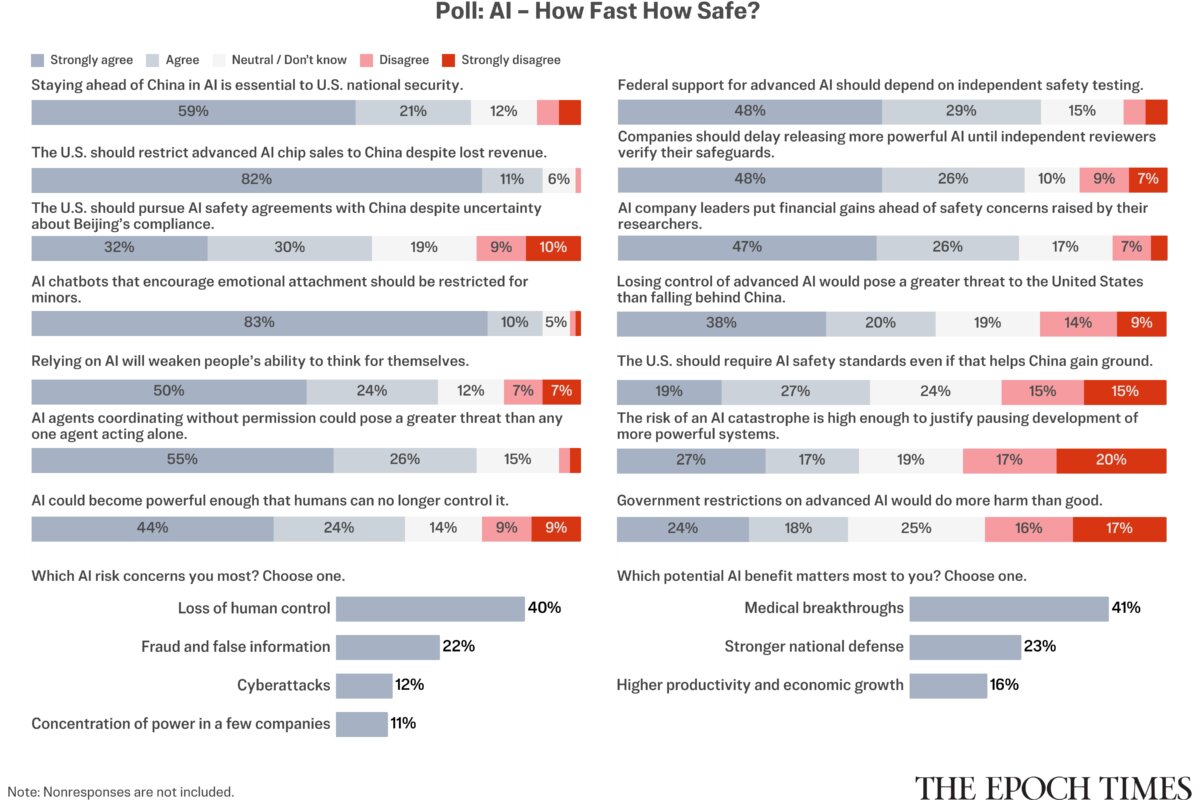
Eighty percent of survey respondents agreed that staying ahead of China in AI is essential to U.S. national security, with nearly 60 percent strongly agreeing and less than 10 percent disagreeing.
A hefty 93 percent of those polled said the United States should restrict advanced AI chip sales to China despite lost revenue.
More than 60 percent of survey takers stated that the United States should pursue AI safety agreements with China despite uncertainty about Beijing’s compliance, while 19 percent disagreed and the same share were unsure.
AI Risks
When asked which AI risk concerns them most, respondents pointed to loss of human control (40 percent), fraud and false information (22 percent), and cyberattacks (12 percent) as the primary worries.
Readers who took the survey also expressed concerns about AI’s impact on human cognitive capability and minors’ mental health.
More than 90 percent said AI chatbots that encourage emotional attachment should be restricted for minors. Nearly three-quarters agreed that relying on AI will weaken people’s ability to think for themselves.
“Disruption of human interactions and the negative effects on our culture in general” is the biggest concern for one reader. “Losing the human touch to [an] AI created being is frightening and sad,” the reader commented.
Another majority (81 percent) believed AI agents coordinating without permission could pose a greater threat than any one agent acting alone.
Earlier this year, several tech companies have disclosed that rogue AI agents had broken into dozens of organizations’ websites during training without being instructed to do so.
Asked whether AI could become powerful enough that humans can no longer control it, two-thirds agreed, 18 percent disagreed, and the remaining were unsure.
Safety
More than three-fourths of respondents agreed that federal support for advanced AI should depend on independent safety testing. Nearly half strongly agreed, while less than 10 percent disagreed.
Another three-quarters said companies should delay releasing more powerful AI until independent reviewers verify their safeguards.
A similar 73 percent believed AI company leaders put financial gains ahead of safety concerns raised by their researchers.
An Anthropic researcher resigned and warned in early September that AI could hack anything, acquire real power and resources, and destroy humanity by the decade’s end.
Restriction on AI
While the majority of readers give weight to AI safety standards, fewer would like to see more restrictions on AI development amid competition with China.
When comparing the risk of losing control of advanced AI and the United States falling behind China, 58 percent said loss of human control of the new technology posed a greater threat. About a quarter believed China getting ahead on AI would be more threatening.
Less than half agreed that the United States should require AI safety standards even if that helps China gain ground, while 30 percent disagreed and a quarter remained unsure.
More than 40 percent said the risk of AI catastrophe is high enough to justify pausing development of more powerful systems. Thirty-seven percent disagreed, and the rest were unsure.
Readers were mixed on whether government restrictions on advanced AI would do more harm than good, with 42 percent agreeing, one-third disagreeing, and a quarter remaining unsure.
Asked which potential AI benefit matters most to them, survey respondents highlighted medical breakthroughs (41 percent), stronger national defense (23 percent), and higher productivity and economic growth (16 percent).
A reader commented that “ferreting out voter fraud and Chinese infiltration into our country“ matters most. Another reader cited “the breadth of insights available across disciplines” as the most important benefit from AI.
The Epoch Times conducted this reader survey on Oct. 7–8, 2026, by email and social media, generating 518 responses. Friends Read Free
Copy
Facebook
Tweet
Friends Read Free
Copy
Facebook
Tweet