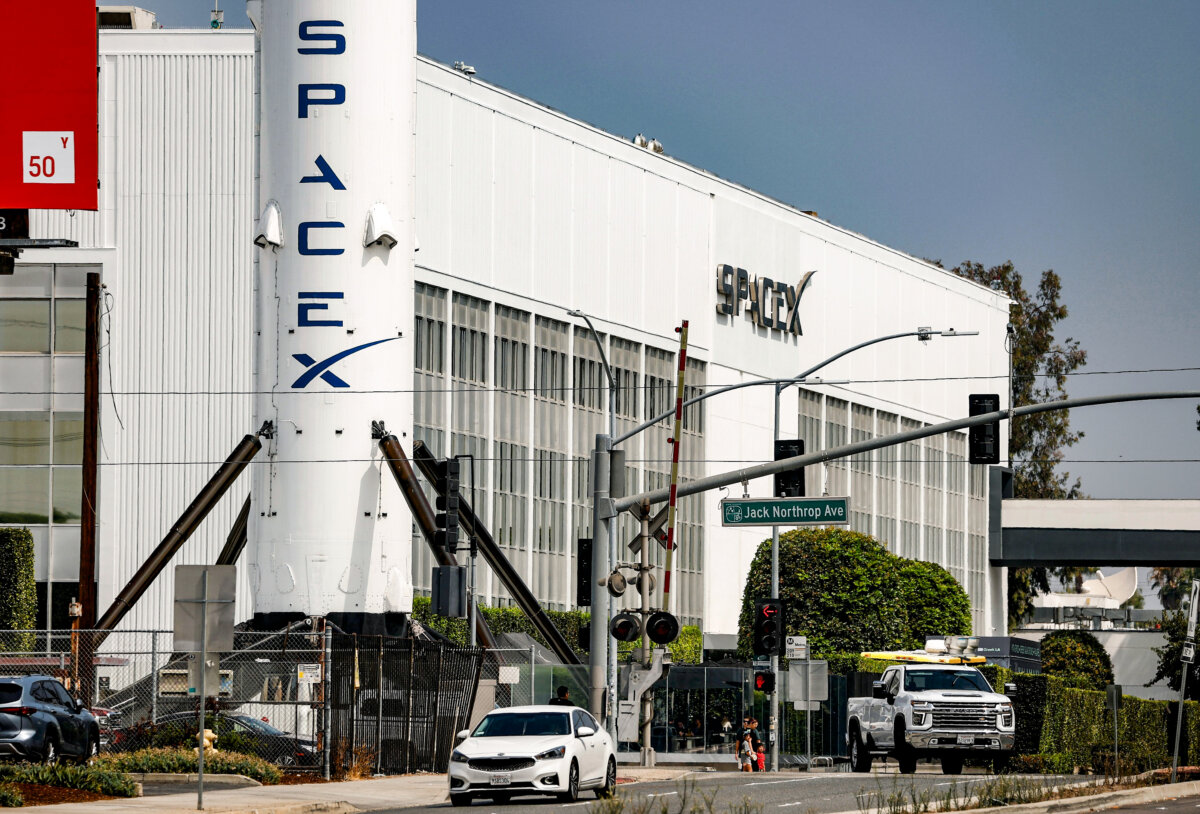

Elon Musk’s SpaceX has struck a deal to buy a nationwide low-band wireless spectrum, a move the company said would allow Starlink Mobile, its satellite-based cellular service, to become a full-fledged U.S. mobile carrier.
SpaceX said on Thursday that it will buy Grain Management’s entire nationwide portfolio of 800 megahertz (MHz) spectrum licenses, giving the company access to as much as 14 MHz of paired spectrum.
“This is the last critical piece of the spectrum puzzle needed for SpaceX to provide complete phone coverage in America,” Musk said in a post on X.
The acquisition addresses one of the biggest limitations of satellite-to-phone service, which is how to reliably get mobile phone signals through buildings and other physical obstacles.
Lower-frequency spectrum such as the 800 MHz band can travel longer distances and penetrate walls and roofs more effectively than higher-frequency signals. SpaceX said it plans to use the spectrum as a coverage layer alongside its 2 GHz mid-band spectrum, which provides greater capacity but does not penetrate structures as easily.
“While Starlink Mobile’s global 2 GHz mid-band spectrum will provide high-bandwidth capacity in the United States, this new low-band spectrum will provide a coverage layer that ensures Starlink Mobile’s signal penetrates through obstacles, such as walls,” SpaceX said.
Most existing mobile phones already support the 800 MHz band, according to the company, potentially allowing customers to connect without having to buy a specialized phone.
The deal remains subject to approval by the Federal Communications Commission (FCC) and other customary closing conditions.
From Satellite Backup to Mobile Network
Starlink’s direct-to-cell service started largely as a complement to conventional wireless networks.
In the United States, SpaceX has worked with T-Mobile to connect standard smartphones directly to Starlink satellites when users are outside normal cellular coverage. The system has already been used for messaging and other services in areas without terrestrial signals.
The spectrum SpaceX is buying from Grain was previously held by T-Mobile. Earlier this year, the FCC approved a swap in which T-Mobile transferred certain 800 MHz licenses to Grain in exchange for its 600 MHz spectrum, while establishing conditions intended to encourage both terrestrial deployment and satellite direct-to-device uses.
Once the FCC approves the latest deal, SpaceX said, Starlink Mobile would become the first network operator to deploy both satellite and terrestrial spectrum, servicing indoors, outdoors, and in conventional cellular dead zones all through a single network.
Earlier this week, the FCC authorized the company to deploy a next-generation direct-to-device constellation of up to 15,000 satellites optimized for 2 GHz spectrum globally.
SpaceX has also agreed to acquire 50 MHz of S-band spectrum from EchoStar for its next-generation Starlink Direct to Cell system.
SpaceX’s growing mobile ambitions could eventually put the company in more direct competition with traditional wireless carriers like AT&T, Verizon, and T-Mobile. The news of the acquisition sent shares of all three slipping in after-hours trading on Thursday, with AT&T down 6.6 percent, Verizon down 5.8 percent, and T-Mobile down 6.6 percent.
 Friends Read Free
Copy
Facebook
Tweet
Friends Read Free
Copy
Facebook
Tweet