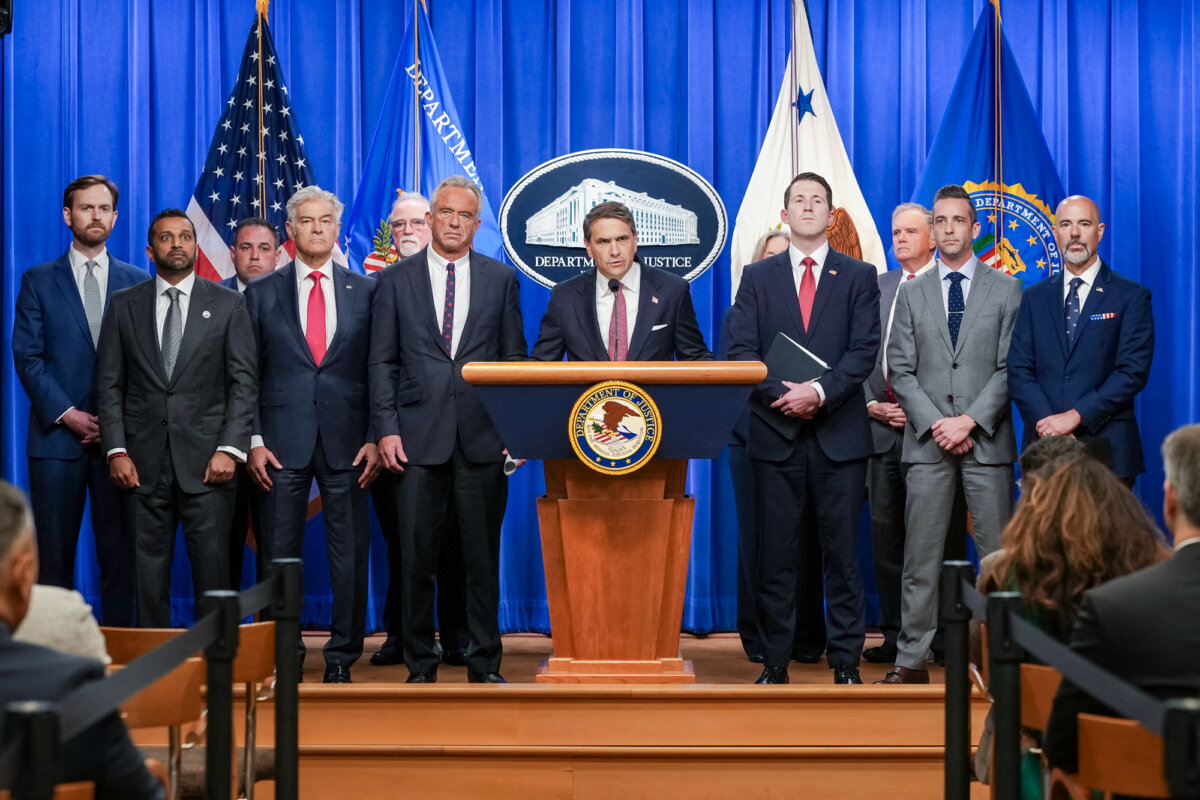

The Department of Justice has charged 455 individuals, including 90 medical professionals, for their involvement in healthcare fraud schemes totaling more than $6.5 billion, as part of the 2026 National Health Care Fraud Takedown, acting Attorney General Todd Blanche said on June 23.
The number of defendants is up from 324 in 2025 and 193 in 2024.
The operation represented “the greatest whole-of-government effort to combat healthcare fraud in our nation’s history,” Blanche told reporters. It involved cases across 45 states and 56 federal districts, and 50 state Medicaid fraud control units participated, the most in the department’s history.
The effort resulted in the apprehension and return to the United States of fraudsters operating from Cyprus, Estonia, and the Philippines, who had bilked taxpayers out of more than $15 billion, according to a federal statement. Officials have seized more than $182 million in assets since June 8, including cash and luxury cars.
But the greater offense was the physical harm to patients resulting from the fraud, according to Dr. Mehmet Oz, administrator of the Centers for Medicare and Medicaid Services.
“The actual cost is that of human health and the lives of humans hurt by these fraudsters,” Oz said.
Here is a look at the primary fraud schemes uncovered by this year’s takedown, the financial losses involved, and the severe cost to human health and lives.
Billing for Medicaid Services Not Provided
Medicaid, which provides health coverage to low-income and disabled Americans, is increasingly targeted by criminals, according to the Justice Department. The operation netted the largest number of Medicaid fraud charges in U.S. history, involving 295 defendants and $518 million in false claims.
Schemes included billing for services never provided and bribing individuals to obtain their Medicaid numbers, which could then be used to obtain fraudulent payments, according to a federal statement.
An Illinois defendant was charged for involvement in a $67 million scheme to bill Medicaid for behavioral health services that were never provided. Some of the supposed recipients were actually hospitalized at entirely separate health facilities during the period for which services were billed, Assistant Attorney General Colin McDonald said.
A mental health company in Virginia allegedly netted $49 million by bribing homeless individuals with hotel stays in exchange for their Medicaid numbers. The fraudsters then billed Medicaid for crisis stabilization services the patients never needed or received.
In New York City, eight people were charged in a $38 million scheme involving social adult daycare centers. The perpetrators allegedly offered kickbacks to get beneficiaries’ information, then billed Medicaid for services supposedly given to hundreds of people per day at a facility with room to accommodate just 30 people.
Medicare Hospice Services Targeted
Medicare hospice services have been a particular target for fraud in California, according to federal officials. Hospice services are intended to provide care and comfort to people who are not expected to live for more than six more months.
A fraud scheme in the Central District of California involved more than $27.7 million in hospice services billed to Medicare for people who either were not terminally ill or were already dead, according to the federal statement.
“One of the ways that we’ve been able to detect that fraud is that, in many of [the fraudulent hospices], the patients never die,” Health and Human Services Secretary Robert F. Kennedy Jr. said.
To make it appear that some of the patients were actually dying, a hospice owner bought the names of deceased individuals and enrolled them in hospice care, according to Kennedy.
The defendant allegedly paid a funeral home employee $1,000 to $3,000 for the Medicare information of each deceased person, according to the Department of Justice statement.
The administration’s recent efforts to crack down on hospice fraud have been praised by some patient advocates, including the American Association of Retired Persons.
“Families turn to hospice care at the most difficult moments in their lives,” the group wrote to Oz on May 29.
“Every family navigating this deeply difficult moment deserves high-quality, compassionate care they can trust.”
Wound Care Fraud
Investigators discovered fraudulent Medicare billing for allografts—the transplantation of donated human tissue, often for skin grafts used to treat wounds—after a spike in payments for the procedure over four years. Allograft payments increased to more than $14 billion in 2025 from less than $1 billion before 2021.
One Arizona company billed Medicare more than $4 billion for allografts, resulting in more than $2 billion in actual payments from December 2021 to 2024, according to government data. This spike in billing was allegedly driven by a kickback scheme rather than medical necessity, according to the Department of Justice.
The company allegedly bought tissue from tissue banks and increased the price by 2,000 percent when billing Medicare, according to federal authorities. Marketers and medical professionals allegedly received kickbacks of about 40 percent of the sale price for using allografts.
To maximize profits, defendants allegedly targeted hospice patients and applied expensive skin grafts to superficial wounds that did not require them, or used allografts that far exceeded the actual wound size to increase the payment, often without consultation with the patients’ treating physicians.
A Texas nurse practitioner was charged for a $906 million scheme in which she allegedly applied medically unnecessary allografts to patients, then billed Medicare for more than $1 million per patient on average.
Some Florida clinics allegedly billed Medicare for $27 million in allografts that were never actually provided to patients.
Cardiovascular Testing Fraud
While some fraudsters maximized profits by applying unneeded skin tissue to the elderly, others exploited the fears of young athletes and their parents, McDonald said.
One defendant was charged with conspiring to submit approximately $89 million in claims for cardiovascular tests that were never medically reviewed, according to McDonald.
The defendant allegedly preyed upon parents’ fears of a sudden cardiac event in their children to gain permission for the testing, but then failed to properly evaluate them. One student’s test showed an enlarged heart, but the defendant allegedly “signed off on the test results within approximately 11 seconds,” McDonald said.
That student then suffered cardiac arrest while playing basketball and died on the court within weeks, McDonald said.
Oz said: “I’ll speak as a heart physician, there’s no way you could miss this diagnosis. This child’s heart on autopsy was massive.
“I just want to highlight, this is a dead child, a dead child. Red state, blue state, it doesn’t matter.”
Having states on board with the federal effort “is a reinforcing element to the White House anti-fraud task force,” Oz said.
The Trump administration has been aggressive in Medicare and Medicaid fraud enforcement, including through the White House Task Force to Eliminate Fraud, chaired by Vice President JD Vance.
Although 24 Democratic state attorneys general declined to participate in a May 24 roundtable on the subject, citing short notice, the group wrote to Vance, saying, “We want to be clear: we share a strong and ongoing commitment to combating fraud in all its forms, including Medicaid fraud.”
Pill Mills
Thirty-six defendants—including 28 licensed medical professionals—were charged with illegally distributing opioids and other controlled substances, according to the federal statement.
One scheme in Pennsylvania involved a voicemail prescription refill line through which doctors allegedly prescribed drugs without having examined the patients, leading to some deaths, federal officials stated.
In Texas, a pharmacist and two clinic managers were charged with distributing more than 3.4 million opioid pills and controlled substances. Street-level traffickers allegedly brought patients to the clinics and the pharmacy to obtain the prescriptions for illicit distribution.
In another case, the Drug Enforcement Administration identified clinics issuing more than 2 million oxycodone prescriptions and 900,000 hydrocodone prescriptions.
“Dispensing controlled substances without a legitimate medical purpose not only violates federal law, it endangers the lives of the recipients,” U.S. Attorney John P. Heekin said in a June 23 statement, commenting on the enforcement action.
“Americans should never have to wonder whether a prescription was written because it was needed or because someone saw an opportunity to profit,” said administrator Terry Cole of the Drug Enforcement Administration.
Blanche promised continued, aggressive anti-fraud enforcement.
“This is just the beginning,” Blanche said. “Fraudsters can no longer rip off American taxpayers.
“If you seek to harm or cheat Americans, we will find you, seize any assets, and prosecute you to the fullest extent of the law.”
 Friends Read Free
Copy
Facebook
Tweet
Friends Read Free
Copy
Facebook
Tweet