When President Franklin Delano Roosevelt delivered his State of the Union Address to Congress in 1941, he articulated four fundamental freedoms: freedom of speech, freedom of worship, and freedom from want and fear.
That people “everywhere in the world” ought to be able to enjoy these freedoms was “no vision of a distant millennium,” he told a world reeling from the horrors of World War II. “It is a definite basis for a kind of world attainable in our own time and generation.”
The address became known as the “Four Freedoms Speech” and formed the basis for the Universal Declaration of Human Rights (UDHR), shepherded through the United Nations General Assembly by then first lady Eleanor Roosevelt, as chair of a U.N. commission of 17 countries including Australia, United Kingdom, Russia, China, and Iran.
The U.N. adopted the Four Freedoms Declaration on Dec. 10, 1948.
Last week President Barack Obama signed a proclamation recognizing that memorable day by declaring Dec. 10, 2011, International Human Rights Day in the United States, and declaring the following week Human Rights Week.
In a statement released to mark the event, the president’s tone was upbeat as he noted the “extraordinary change in the Middle East and North Africa” where demand for basic freedoms had finally broken through years of oppressive rule.
“Dictators seek to constrain these liberties through repressive laws and blunt force, but hope cannot be imprisoned and aspirations cannot be killed,” Obama said in a statement.
Elsewhere, in large and small events, the world was reminded of how much more there is to do.
At the U.N., United Nations High Commissioner for Human Rights Navi Pillay marked the day by encouraging a global social media conversation.
“In 2011, the very idea of ‘power’ shifted,” Pillay said in a Dec. 10 statement published on ohchr.org. “The message of this unexpected global awakening was carried in the first instance not by the satellites of major media conglomerates, or conferences, or other traditional means … but by the dynamic and irrepressible surge of social media.”
Thousands of questions were received in the lead-up to the day, the U.N. website noted. Many of the users posts originated from the Middle East, Africa, and China reflecting desperation or just resignation.
“When will the U.N. start asking why opponents of Kagame are being killed in #Rwanda, #Uganda? Rwandans’ #HumanRights are in jeopardy” tweeted one from Rwanda.
“When I search human rights I get taken to a government page full of rules and regulations. Is that a human right?” came another from China, translated from Chinese.
Concern Over China
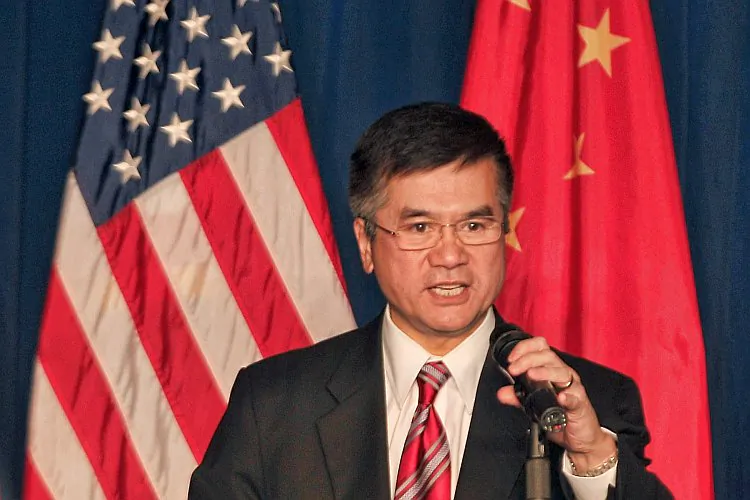
U.S. Ambassador to China Gary Locke, marked Human Rights Day by calling on Beijing to honor its commitment to the UDHR. In a statement released Saturday, Locke noted a range of human rights concerns in China, including constraints on religious freedom and the “disappearing” of human rights lawyer Gao Zhisheng.
Failure to address human rights would “not bring China closer to achieving its stated goals,” he said.
That point was further driven home at a Human Rights Day event at the National Press Club in Washington, D.C. Speaking on behalf of the D.C. Falun Dafa Association, Jared Pearman told the audience that there remain “hundreds of thousands” of Falun Gong (also known as Falun Dafa) practitioners detained extra-judicially in a variety of government Public Security facilities, including “transformation-through-reeducation” centers.
Pearman noted that there had been some positive developments in the more than decade-long persecution of Falun Gong practitioners in China, with increasing incidences of individuals—and more recently, whole communities—risking violent retribution to speak out in support. The “hopes” and “aspirations” of those people, however, were unlikely to be met while the present regime remains in control.
“To do so would be a potentially fatal admission of fallibility,” he said, exposing “the truth of a campaign” that had not only cost the country billions of dollars and thousands of lives, but also “deceived a nation.”
The National Press Club event, hosted by human rights group Responsibility for Equity and Liberty (R.E.A.L.), included other speakers: United for Equality representative Carolyn Cook, who argued passionately for an Equal Rights Amendment to recognize the rights of women in America; Ahmar Mustikhan, journalist and activist for the oppressed Baloch people in the fractious border region between Iran and Pakistan; Husain Abdulla, representing the oppressed in Bahrain; and Mohamed Yahya, on genocide in Darfur, Sudan.
Jeffery Imm, spokesperson for REAL, said the Human Rights Day forum had become an annual event; the aim to give voice to groups that may not get broad coverage in the mainstream media.
Speaking at the event, Imm said it was easy to ignore those who were different and those issues that did not immediately impact our lives. He added that universal human rights required a shared respect for all people and a commitment not only words but “more importantly, by actions.”
 Friends Read Free
Copy
Facebook
Tweet
Friends Read Free
Copy
Facebook
Tweet