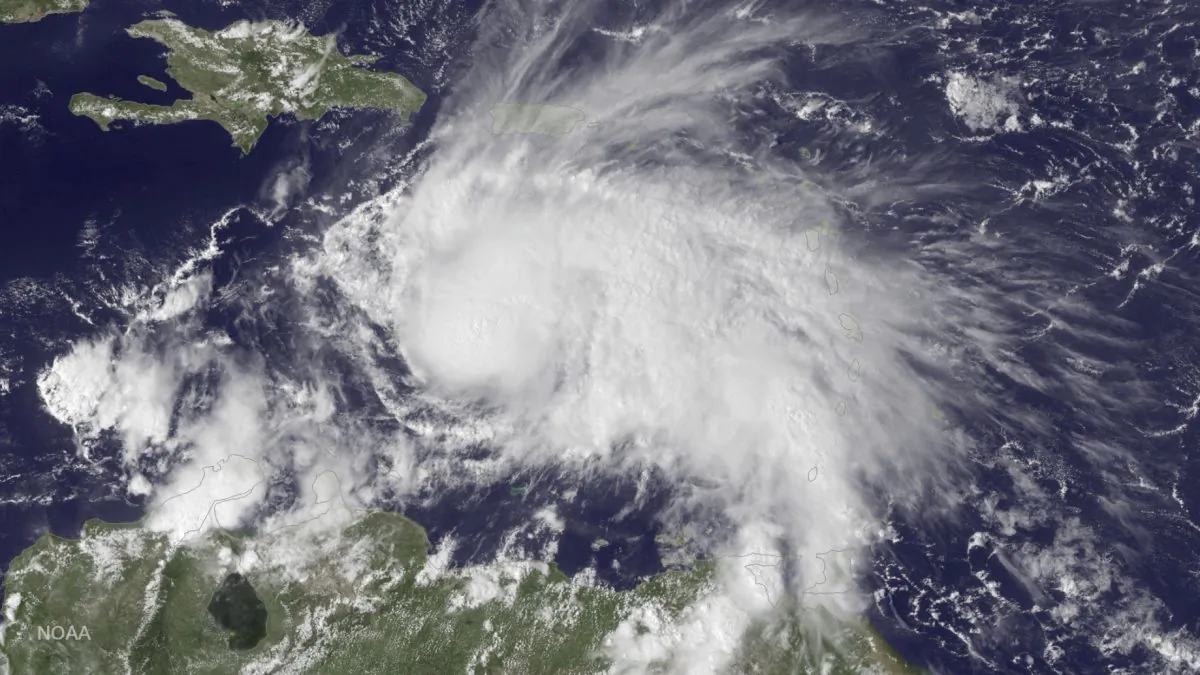

PETIT-GOAVE, Haiti—Hurricane Matthew slammed into Haiti’s southwestern tip with howling, 145 mph winds Tuesday, tearing off roofs in the poor and largely rural area, uprooting trees and leaving rivers bloated and choked with debris. At least nine deaths were blamed on the storm during its week-long march across the Caribbean.
Forecasters said Matthew could hit Florida toward the end of the week and push its way up the East Coast over the weekend. The forecast triggered a rush by Americans to stock up on food, gasoline and other emergency supplies.
The dangerous Category 4 storm — at one point the most powerful hurricane in the region in nearly a decade — blew ashore around dawn in the poorest country in the Western Hemisphere, hitting a corner of Haiti where many people live in shacks of wood or concrete blocks. It unloaded heavy rain as it swirled on toward a lightly populated part of Cuba and the Bahamas.
Damage in the hardest-hit part of Haiti appeared to be widespread, but because of spotty communications, blocked roads and washed-out bridges, the full extent was not immediately clear. Nor was the number of deaths.
 People carry suitcases as they move to a safer area before the arrival of Hurricane Matthew, in the village Paraguay, Guantanamo, Cuba, Monday, Oct. 3, 2016. A hurricane warning is in effect for Jamaica, Haiti, and the Cuban provinces of Guantanamo, Santiago de Cuba, Holguin, Granma and Las Tunas – as well as the southeastern Bahamas. (AP Photo/Ramon Espinosa)
The country’s Civil Protection Agency said many homes were damaged or destroyed.
“It’s the worst hurricane that I’ve seen during my life,” said Fidele Nicolas, a civil protection official in Nippes, just east of where Matthew came ashore. “It destroyed schools, roads, other structures.”
At least three deaths were blamed on the storm in Haiti, including one person whose home was crushed by a tree in Port Salut and a 26-year-old man who drowned trying to rescue a child who had fallen into a rushing river, authorities said. The child was saved.
Four deaths were recorded in the neighboring Dominican Republic and one each in Colombia and in St. Vincent and the Grenadines.
The storm left the peninsula that runs along the southern coast of Haiti cut off from the rest of the country. Many streets were impassable because of flooding, landslides or fallen trees. Local radio reported that the water was shoulder high in parts of the city of Les Cayes.
 A farmer carries his belongings in a horse cart toward a shelter for protecting prior the arrival of the Hurricane Matthew in Santiago, Cuba, Sunday, Oct 2, 2016. Hurricane Mathew, one of the most powerful Atlantic hurricanes in recent history weakened a little on Saturday as it drenched coastal Colombia and roared across the Caribbean on a course that threatened Jamaica, Haiti and Cuba.(AP Photo/Ramon Espinosa)
Milriste Nelson, a 65-year-old farmer in the town of Leogane, said his neighbors fled when the wind ripped the corrugated metal roof from their home. His own small yard was strewn with the fruit he depends on for his livelihood.
“All the banana trees, all the mangos, everything is gone,” Nelson said as he boiled breadfruit over a charcoal fire in the gray morning light. “This country is going to fall deeper into misery.”
Haitian authorities had tried to evacuate people from the most vulnerable areas ahead of the storm, but many were reluctant to leave their homes. Some sought shelter only after the worst was already upon them.
 Cars drive along a street under heavy rain in downtown Kingston Jamaica, Sunday Oct. 2 , 2016. An extremely dangerous Hurricane Matthew is moving slowly over the Caribbean. It’s following a track that authorities are warning could trigger devastation in parts of Haiti.(AP Photo/Collin Reid)
“Many people are now asking for help, but it’s too late because there is no way to go evacuate them,” said Fonie Pierre, director of Catholic Relief Services for the Les Cayes area, who was huddled in her office with about 20 people.
Matthew was expected to bring 15 to 25 inches of rain, and up to 40 inches (100 centimeters) in isolated places, along with up to 10 feet (3 meters) of storm surge and battering waves.
“They are getting everything a major hurricane can throw at them,” said Dennis Feltgen, a meteorologist with the U.S. National Hurricane Center in Miami.
Matthew briefly reached the top classification, Category 5, as it moved across the Caribbean late last week, becoming the strongest hurricane in the region since Felix in 2007.
 A girl watches as the authorities arrive to evacuate people from her house in Tabarre, Haiti, Monday, Oct. 3, 2016. The center of Hurricane Matthew is expected to pass near or over southwestern Haiti on Tuesday, but the area is already experiencing rain from the outer bands of the storm. (AP Photo/Dieu Nalio Chery)
As of 5 p.m. EDT (2100 GMT), the storm was centered about 30 miles (45 kilometers) southwest of the eastern tip of Cuba. It was moving north at close to 9 mph (15 kph). Its sustained winds were down slightly to 140 mph (220 kph).
The center was projected to pass about 50 miles northeast of the U.S. naval base at Guantanamo Bay, Cuba.
Hours before the hurricane’s expected arrival, a light rain fell on Cuba’s easternmost city, Baracoa, and the wind began whipping the palm trees. Authorities moved residents from the three blocks closest to the sea, and about 100 tourists were moved to a hotel in central Baracoa, where windows were covered with sheet metal and wood.
Workers removed traffic lights from poles in the Cuban city of Santiago to keep them from getting blown away.
In the U.S., Florida Gov. Rick Scott urged coastal residents to prepare for the possibility of a direct hit and line up three days’ worth of food, water and medicine. The Red Cross put out a call for volunteers in South Carolina. And the White House said relief supplies were being moved to emergency staging areas in the Southeast.
“We do not know yet whether the center of Matthew will actually come ashore in Florida. That’s possible,” said Rick Knabb, director of the hurricane center.
Americans raced to supermarkets, gas stations and hardware stores, buying up groceries, water, plywood, tarps, batteries and propane. South Carolina Gov. Nikki Haley said she would issue an evacuation order Wednesday so that 1 million people would have time to leave the coast.
 Friends Read Free
Copy
Facebook
Tweet
Friends Read Free
Copy
Facebook
Tweet