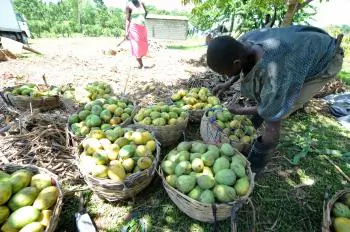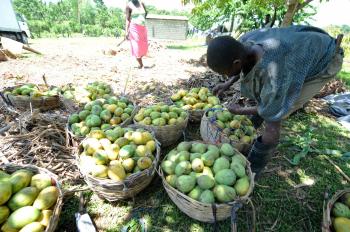
Poor infrastructure, a lack of training and knowledge for proper fruit treatment, and unsteady schedules of outbound transport owing to recovery activities, has put Haiti’s mango production and exports at stake. The government, local exporters, international organizations, and farmers have to work closely to overcome the challenges.
Perhaps surprisingly, however, last January’s earthquake is not the main obstacle to the mango business.
“We were not affected by the earthquake except for a few people who were displaced, running around and looking for their families. What has affected the mango industry are the weather conditions: rains and the expected hurricane Tomas at the end of this week—this is of a greater concern for us now,” said Jean Maurice Buteau, managing director of JMB S.A. one of the biggest exporters of mangoes in Haiti, by phone from Haiti.
Buteau, a native Haitian, says mango production is almost entirely in the hands of small local farmers who own their own land, and grow mango trees in their backyards. After being grown on plains and at altitude of up to 400 meters (approximately 0.25 miles) in the mountains, mangoes are transported on animals to local markets, or to wholesale points where middlemen buy the produce and sell it to exporters or to local markets. Buteau’s company works with a network of people covering almost all parts of the country.
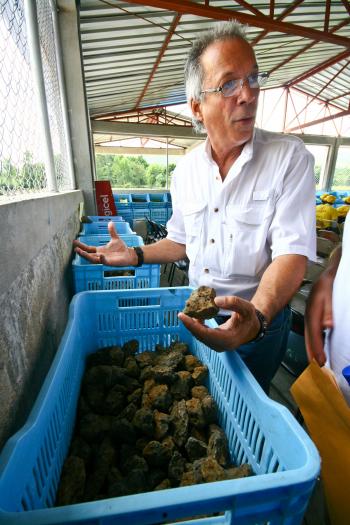
The entrepreneur says Haiti is doing major work on road construction, trying to create road links between cities. But this is not of much help for his business.
“We live in the tropics, during the rainy seasons some roads are washed out, so the government is working on that, but they cannot reach everywhere. A priority is connecting major cities, but we need to get mangoes not from cities, but from rural areas. So the poor infrastructure is a major impediment for mango exports.”
But the biggest challenge for Buteau this year was getting good boat schedules because the port is still not functioning properly, and he has to compete with the humanitarian boats unloading at the dock. American Airlines (AA), which ship large quantities of mangoes didn’t ship any this year because the earthquake destroyed the airport, AA gave over their building to receive passengers.
Continued on the next page…
 Friends Read Free
Copy
Facebook
Tweet
Friends Read Free
Copy
Facebook
Tweet