
Reports of organized funding, paid participation, and outside coordination in political protests in recent months have ignited debate over the limits of the First Amendment of the U.S. Constitution.
When does the legitimate exercise of free speech become civil disorder? Who is responsible for any criminal acts or property damage that may occur during a political demonstration?
We asked readers of The Epoch Times to weigh in on matters of transparency, accountability, and governmental authority in cases when the exercise of free speech becomes orchestrated violence.
Penalties for Organizers
Most respondents (80 percent) named outside funding and coordination as the primary factor in protests that turn violent. Opportunistic crime was a distant second at 12 percent. A large number of respondents commented that “all of the above” were factors in sparking violence.
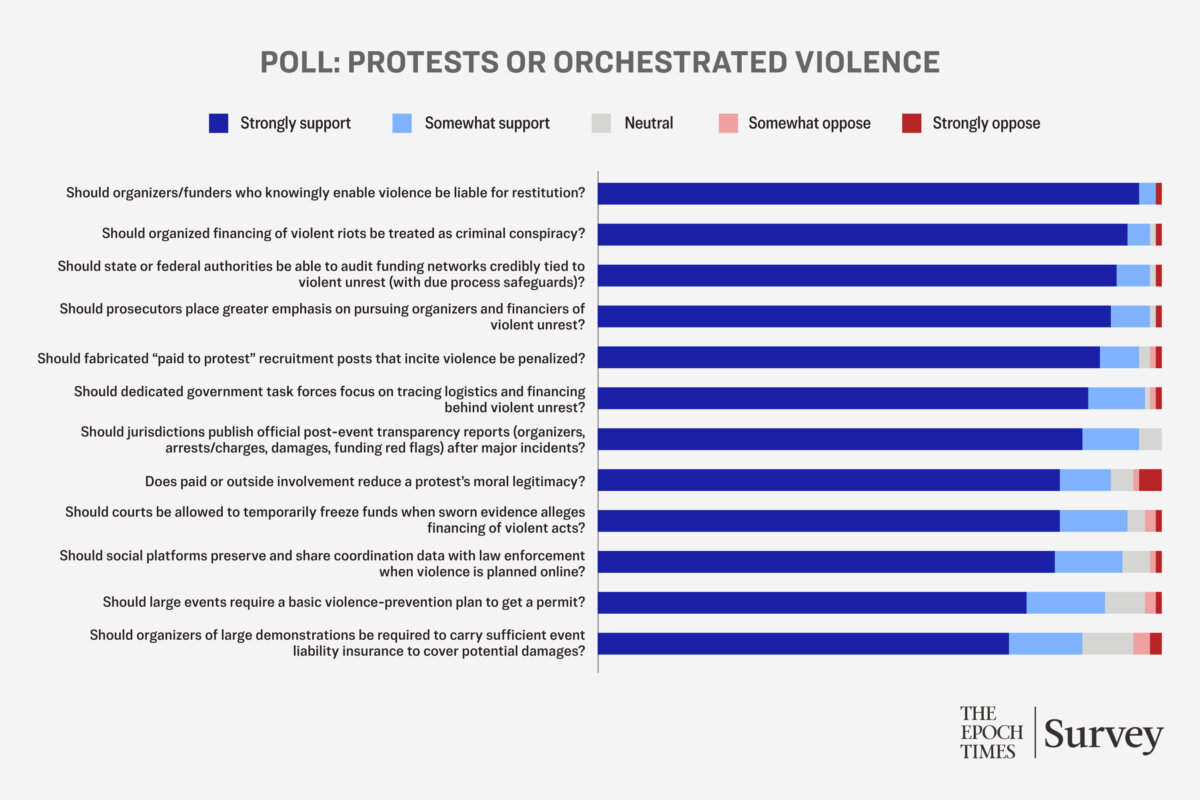
The vast majority of respondents (90 percent) thought the use of paid protesters or outside involvement reduces a protest’s moral legitimacy.
Nearly all (99 percent) of respondents agreed that organizers and funders who knowingly enable political violence should be liable for restitution. Ninety-six percent believed so strongly.
Intention is required to produce liability for political violence according to the Supreme Court. In the 2024 case McKesson v. Doe, the court affirmed that negligence alone does not make a protest organizer liable for violence that may result. [Mckesson v. Doe]
Respondents also agreed that fabricated “paid to protest” recruitment posts that incite violence should be penalized. Ninety-six percent affirmed this, 89 percent strongly.
Organizers include those who fund political violence, according to respondents, as 98 percent agreed that financers of violent riots should be treated as criminal conspiracists.
Some 97 percent agreed that state or federal authorities have the power to audit funding networks that have credible ties to violent unrest, so long as safeguards for due process are observed.
The U.S. government defines domestic terrorism as “ideologically driven crimes committed by individuals in the United States that are intended to intimidate or coerce a civilian population or influence the policy or conduct of a government.”
However, domestic terrorism is not a chargeable offense because there is no federal law that prohibits it, according to the Congressional Research Service. Perpetrators of such violence can be charged with other crimes.
Government Response
Prosecutors should place greater emphasis on pursuing organizers and financers of violent unrest, according to 98 percent of respondents.
That should include dedicated government task forces to trace logistics and financing behind violent unrest, 97 percent said. However, the number who felt strongly about this dipped somewhat to 87 percent.
Eighty-two percent strongly affirmed that courts should be allowed to temporarily freeze funds when sworn evidence alleges the financing of violent acts. Here the number disagreeing (3 percent) or expressing neutrality (3 percent) crept up slightly.
The USA PATRIOT Act, enacted within weeks of the Sept. 11 terrorist attacks in 2001, allows federal authorities to “subject to special scrutiny foreign jurisdictions, foreign financial institutions, and classes of international transactions or types of accounts that are susceptible to criminal abuse,” according to the U.S. Financial Crimes Enforcement Network.
Some lawmakers have been critical of the expansive powers granted to law enforcement by the Act, including Rep. Thomas Massie (R-Ky.).
“The Patriot Act contains many provisions that violate the Fourth Amendment and have led to a dramatic expansion of our domestic surveillance state,” Massie stated in a press release in 2015. “It is long past time to repeal the Patriot Act and reassert the constitutional rights of all Americans.”
Civic Responsibility
Respondents favored an increase in civic responsibility surrounding political protests, both from the government and the public.
Nearly all (96 percent) agreed that jurisdictions should publish official post-event transparency reports after major incidents, listing the organizers, arrests made, damages, and funding red flags. Virtually no respondents disagreed with this.
A similar number (93 percent) thought social media companies should preserve and share coordination data with law enforcement when violence was planned through their platforms.
Ninety percent agreed that large event organizers should be required to have a basic violence-prevention plan to get a permit; though here, the number strongly agreeing dipped to 76 percent.
A similar number (86 percent) said organizers of large demonstrations should be required to carry sufficient event liability insurance to cover potential damages, with 73 percent strongly affirming the idea.
One respondent said, “All cities should require payment for a permit and proof of liability insurance for any group over 50 people.”
Permits are generally not required for protests or demonstrations held in public spaces such as sidewalks.
Cities including New York City require permits for activities in public streets. New York does require insurance for street events that involve rides and for large events in public parks. [NYC liability ins] [Protest Permit] [Ins. for large events in parks]
This reader poll was conducted Oct. 15–16, 2025, by email and social media and received 28,350 responses.
 Friends Read Free
Copy
Facebook
Tweet
Friends Read Free
Copy
Facebook
Tweet