
U.S. President Donald Trump ordered the capture of wanted Venezuelan leader Nicolás Maduro on Jan. 2 in a raid by U.S. forces in the country’s capital city of Caracas.
Maduro and his wife, Cilia Flores, were brought to the United States and arraigned in federal court on charges of narco trafficking, to which they pleaded not guilty.
The United States has long considered Maduro an illegitimate leader due to alleged election tampering, human rights abuses, and drug trafficking.
The State Department offered a $15 million reward for information leading to the capture of Maduro in 2020, which was increased to $25 million under the Biden administration, and to $50 million in August 2025.
While agreement is widespread that Maduro posed a threat to the security of the United States, many Democrats and a few Republicans have been critical of the use of force to remove him from power.
Was it necessary? Was it legal? What unintended consequences may follow?
We asked readers to weigh in on Trump’s action, as well as its possible value and implications for the future.
Public Opinion
Survey respondents were highly supportive of Maduro’s removal. Overall, 94 percent said they supported the U.S. military action, with 85 percent strongly supporting it.
Some Venezuelan expatriates celebrated the news of Maduro’s capture in Doral, Florida, home to the largest U.S. community of Venezuelan immigrants.
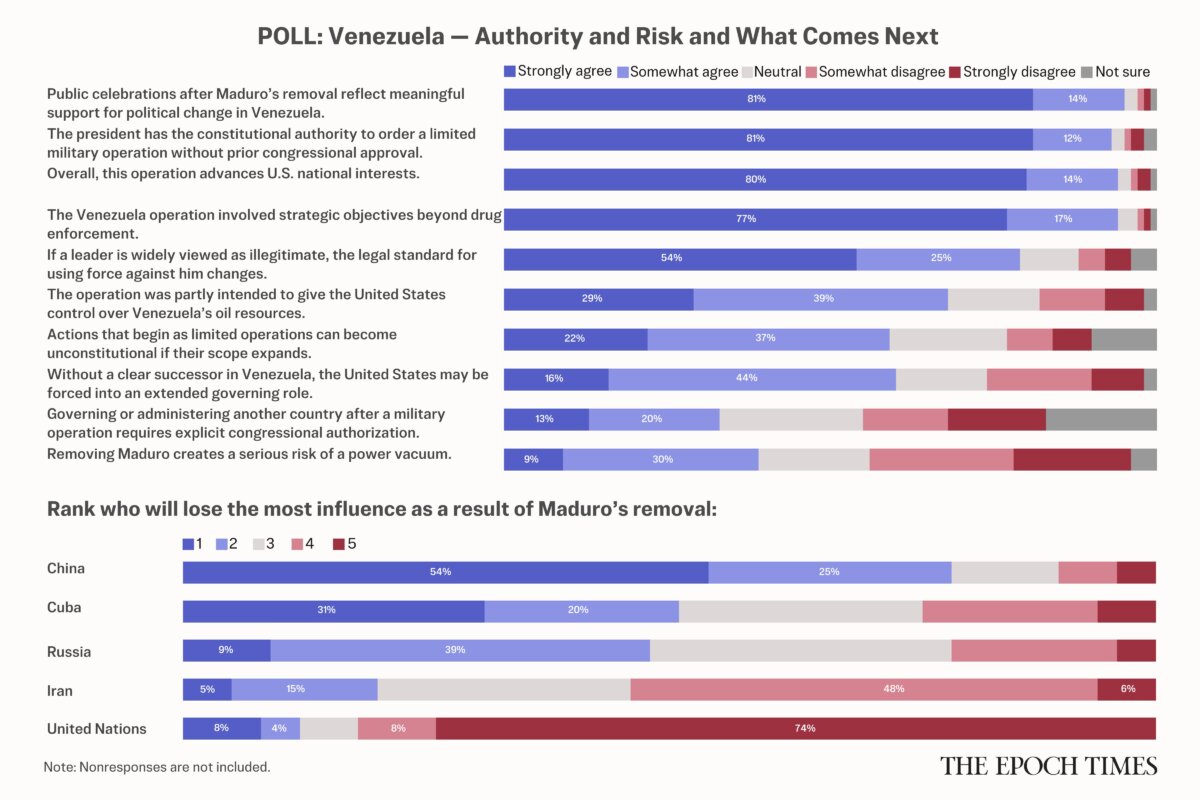
Some 95 percent of survey respondents said those and other public celebrations reflect meaningful support for political change in Venezuela. Eighty-one percent strongly agreed that it was the case.
Legality
Criticism of the Maduro operation has focused on the legality of the use of military force without congressional approval.
The U.S. Senate voted on Jan. 8 to advance a resolution to curtail Trump’s authority to order further military action in Venezuela. Five Republicans broke with the rest of the party to support the resolution.
Respondents felt strongly that the president has the constitutional authority to order a limited military operation without prior congressional approval. Ninety-three percent agreed that he does, and 81 percent agreed strongly.
Reader support diminished noticeably on whether the widespread perception that a leader is illegitimate alters the legal standard for forcible removal.
Here, 79 percent agreed that the standard differs for a leader facing widespread condemnation, but the number strongly agreeing dipped to 54 percent. A quarter of respondents (25 percent) “somewhat” agreed that it was the case.
Opinions were mixed on whether actions that begin as limited operations can become unconstitutional if their scope expands. A clear majority (59 percent) agreed that the legality of the action could change if expanded, though just 22 percent felt strongly about it.
Just 6 percent strongly disagreed that widening the scope of the operation would alter its constitutionality.
Value
Overall, the Maduro operation advances U.S. national interests according to 94 percent of respondents, 80 percent strongly affirming that it does.
U.S. forces had already carried out at least 35 strikes on boats officials said were smuggling drugs in the Caribbean and Eastern Pacific since September, killing more than 115 people who were confirmed narco-terrorists, according to the administration.
The majority of poll respondents (94 percent) believed the strategic objectives of the Venezuela operation go beyond drug enforcement. More than three-quarters (77 percent) believed so strongly.
Most respondents (68 percent) believed the operation was at least partly intended to give the United States control of Venezuela’s oil reserves.
Consequences
Despite their support for the operation, respondents saw potential negative consequences.
A majority (60 percent) agreed that the United States may be forced into an extended governing role in the absence of a clear successor to Maduro. Trump himself has hinted that U.S. oversight of the South American nation may be required for several years.
Opinion was evenly split on whether the removal of Maduro does (39 percent) or does not (40 percent) create a serious risk of a power vacuum.
Delcy Rodriguez, the acting leader of Venezuela, has said she welcomes cooperation with the United States in developing lasting coexistence between the two countries.
Reader opinion was also split on whether administering another country after a military operation requires explicit congressional authorization, with 33 percent saying it does and 28 percent saying it does not.
On this question, a plurality of respondents (39 percent) were either neutral (22 percent) or not sure (17 percent).
China will suffer the greatest loss of influence as a result of Maduro’s removal, respondents said. Beijing’s influence in Venezuela had been growing in recent years, after the announcement of a strategic partnership between the two in 2023.
Cuba will face the second-greatest loss of influence, respondents said, followed by Russia and Iran, with the United Nations being the least affected among the five.
The Epoch Times conducted this reader survey on Jan. 7–8, 2026, by email and social media, generating 1,851 responses.
 Friends Read Free
Copy
Facebook
Tweet
Friends Read Free
Copy
Facebook
Tweet