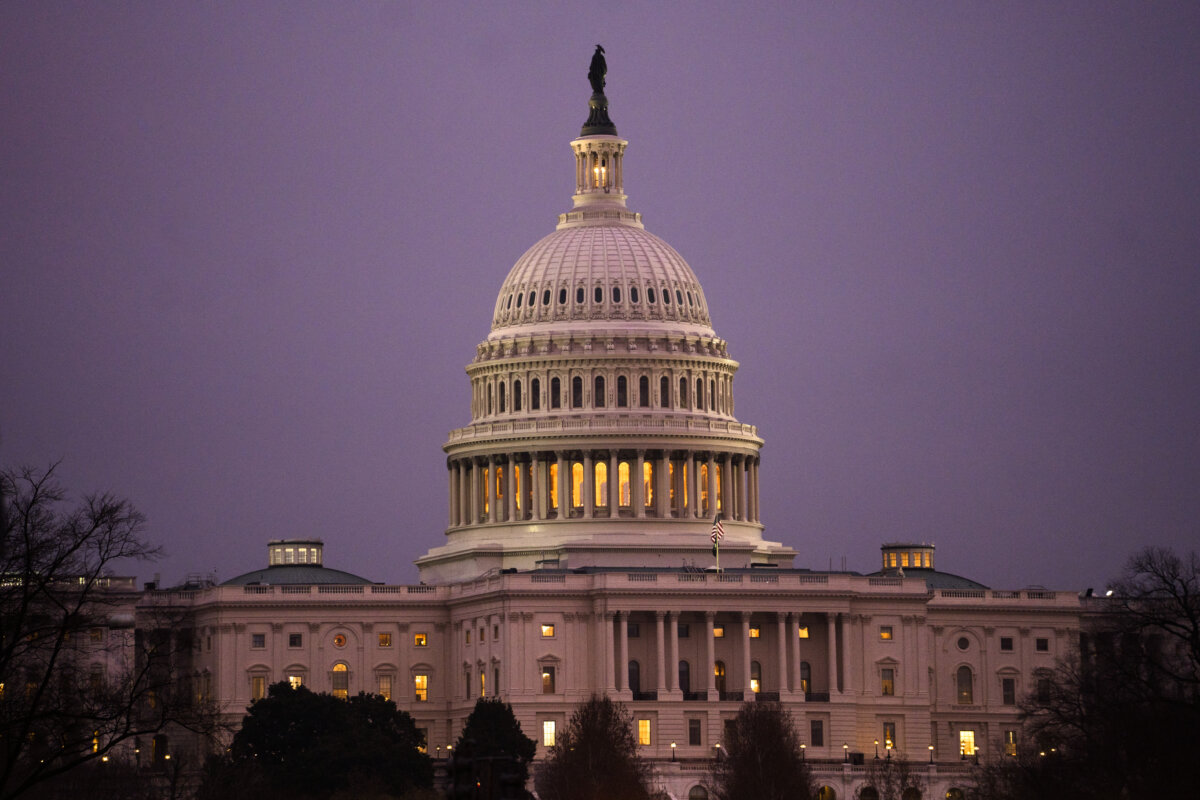




WASHINGTON—The Senate has voted to advance a resolution to curtail President Donald Trump’s authority to order further military action on Venezuela in the days after U.S. forces captured Venezuelan leader Nicolás Maduro from a fortified compound in the capital city of Caracas.
Senators on Jan. 8 voted 52–47 in favor of advancing the War Powers Act resolution to a final vote.
Sens. Lisa Murkowski (R-Alaska), Susan Collins (R-Maine), Rand Paul (R-Ky.), Todd Young (R-Ind.), and Josh Hawley (R-Mo.) joined the Democrats, who voted unanimously in favor of advancing the bill.
“The question of whether United States forces should be engaged in hostilities within or against Venezuela should be answered following a full briefing to Congress and the American public of the issues at stake, a public debate in Congress, and a congressional vote as contemplated by the Constitution,” reads the resolution introduced by Sen. Tim Kaine (D-Va.) and cosponsored by Paul.
The resolution would prohibit Trump from undertaking additional military actions in Venezuela without approval from Congress, directing him to “terminate the use of United States Armed Forces for hostilities within or against Venezuela, unless explicitly authorized by a declaration of war or specific authorization for use of military force.”
The resolution is privileged in line with the War Powers Act, meaning that Senate Majority Leader John Thune (R-S.D.) cannot block it from reaching the floor.
It is the fourth attempt at passing such a law during Trump’s second term. Congress also failed to overcome vetoes of similar resolutions twice in Trump’s first term: once in 2019 to end U.S. involvement in Yemen and once in 2020 to limit the president’s actions in Iran.
Maduro was captured by U.S. forces in the capital of Caracas during an early-morning raid on Jan. 3 and brought to New York City.
In the operation—during which Maduro’s wife, Cilia Flores, was also apprehended—some U.S. service members received minor injuries, while at least 24 Venezuelan security officers and 32 Cuban officers were killed.
Maduro and Flores are now facing drug and weapons charges in federal court.
However, in the halls of the U.S. Capitol, lawmakers are split on how to view the engagement.
Republicans have largely expressed favorable attitudes toward the action, describing its function as being largely law enforcement rather than military-related. Democrats have been more critical, rejecting Republicans’ arguments that the operation was a law enforcement operation.
Meanwhile, U.S. adversaries in the Western Hemisphere such as Cuba and Colombia, as well as Venezuela’s allies in the Eastern Hemisphere, including Russia and China, have criticized the move.
Nevertheless, Trump has declined to rule out the possibility of a second military strike within Venezuela, saying that such an action is a possibility if the acting leaders “don’t behave.”
Trump Reacts
Trump criticized the five Republican senators who joined Democrats in voting to advance the war powers resolution.
“Republicans should be ashamed of the Senators that just voted with Democrats in attempting to take away our Powers to fight and defend the United States of America,” Trump wrote in a post on Truth Social following the Jan. 8 vote. “Susan Collins, Lisa Murkowski, Rand Paul, Josh Hawley, and Todd Young should never be elected to office again.”
The president said the vote could hinder American self-defense and national security by impeding his ability to act.
“In any event, and despite their ‘stupidity,’ the War Powers Act is Unconstitutional, totally violating Article II of the Constitution, as all Presidents, and their Departments of Justice, have determined before me,” Trump wrote.
The resolution would still need to pass a final Senate vote. It remains to be seen whether the five Republicans who voted to advance the resolution will still support it in a final vote.
“A more important Senate Vote will be taking place next week on this very subject,” Trump wrote.
Murkowski and Collins have long been moderates in the Senate, frequently breaking with Republicans on numerous votes over the years. Collins is also up for reelection later this year and faces a potentially tough race in Maine.
Paul and Hawley have shown skepticism toward foreign military action.
“With regard to Venezuela, my read of the Constitution is that if the President feels the need to put boots on the ground there in the future, Congress would need to vote on it,” Hawley wrote in a post on X explaining his vote. “That’s why I voted yes on this morning’s Senate resolution.”
Vice President JD Vance reiterated Trump’s opposition to the war powers resolution at a White House news briefing on Jan. 8.
“The President, I believe, himself has already said every president, Democrat or Republican, believes the War Powers Act is ultimately fake and unconstitutional,” Vance told reporters.
“It’s not going to change anything about how we conduct foreign policy over the next couple of weeks, the next couple of months, and that will continue to be how we approach things [going] ahead.”
War Powers Resolution
The resolution prohibiting Trump from continuing military involvement in Venezuela is authorized under the War Powers Act of 1973, a bill passed as U.S. involvement in the Vietnam War was winding down. It was designed to prevent future conflicts of the sort.
The bill requires the president to notify Congress of any military action involving a commitment of troops within 48 hours. It also limits the duration of any such activities to 60 days without explicit congressional approval, such as through the passage of an authorization for use of military force.
Such an authorization was passed ahead of the U.S. War on Terror, ultimately serving as the basis for extended U.S. military activity in more than 20 countries.
Although Trump notified Congress of the strike in line with requirements under the War Powers Act, the administration has argued that the limitations are largely non-applicable in this case.
Instead, Trump, House Speaker Mike Johnson (R-La.), and other officials have said the action constituted law enforcement activity and was not a formal military action.
Secretary of State Marco Rubio has repeatedly reiterated that the United States is “not at war” with Venezuela.
Senators Weigh In
Speaking to The Epoch Times ahead of the vote, senators gave reactions that were largely in line with party positions.
“If it is framed as President Trump cannot take further action without authorization, that’s a yes,” Sen. Chris Coons (D-Del.) told The Epoch Times when asked how he would vote.
Sen. Eric Schmitt (R-Mo.) told The Epoch Times that he would vote against the resolution, citing the argument that capturing Maduro was “a law enforcement action.”
Sen. James Lankford (R-Okla.) also said he would vote against the resolution, suggesting that any criticisms of the action were irrelevant to the current situation.
“The hard part is to deal with the reality that we have, not the reality we want,” Lankford told The Epoch Times. “So at this point, we put as much leverage as we can to be able to protect the rights of individuals, to be able to have free elections in the future, [and] not to have chaos in the whole region.”
Paul said he believes that the operation “is an act of war,” rejecting the administration’s claims that the operation constitutes law enforcement activity.
“I will vote for the war powers resolution because I think that invading a nation, invading a nation’s capital, bombing a nation’s capital, and removing the leader of another nation is an act of war,” he said in response to a question from The Epoch Times.
“This was planned out over a several-month period. And I think that the Constitution, our Founding Fathers, were very clear that war should not be initiated without the approval of Congress.”
Kaine agreed, saying during a news conference also attended by Paul: “This is not the surgical execution of an arrest warrant. It was much bigger than that before last Saturday, and it’s going to be much bigger than that from now for the next few years, if you listen to the administration. So this is something that should happen.”
 Friends Read Free
Copy
Facebook
Tweet
Friends Read Free
Copy
Facebook
Tweet