
TEMPE, Ariz.—One Christmas shopping season, a young boy sat on Tim Connaghan’s lap and asked Santa for a very special gift: To bring his mother back from heaven.
Connaghan paused, searching for the right words. With gentle care, he leaned in and told the boy that even Santa could not do everything.
Santa’s abilities were limited to creating toys—but he could also pray for his mother.
The boy nodded.
Being Santa is not always fun or easy, says Connaghan.
“You’ve got to be ready for what happens,” he said, adding that becoming the best Santa is essential, meaningful, and most importantly, “magical.”
Connaghan has been teaching that magic for the last two decades to dozens of people each year who wish to join the ranks of the nation’s thousands of professional Santas.
His school—the International University of Santa Claus, also known as School4Santas—has taught more than 5,000 Santas over the last 23 years.
During the Christmas holiday season, shopping malls belong to old Saint Nick, company parties flow with the holiday spirit, and special events provide significant earnings for professional Santas.
But for Connaghan, the lesson season begins in the spring.
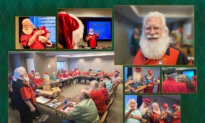
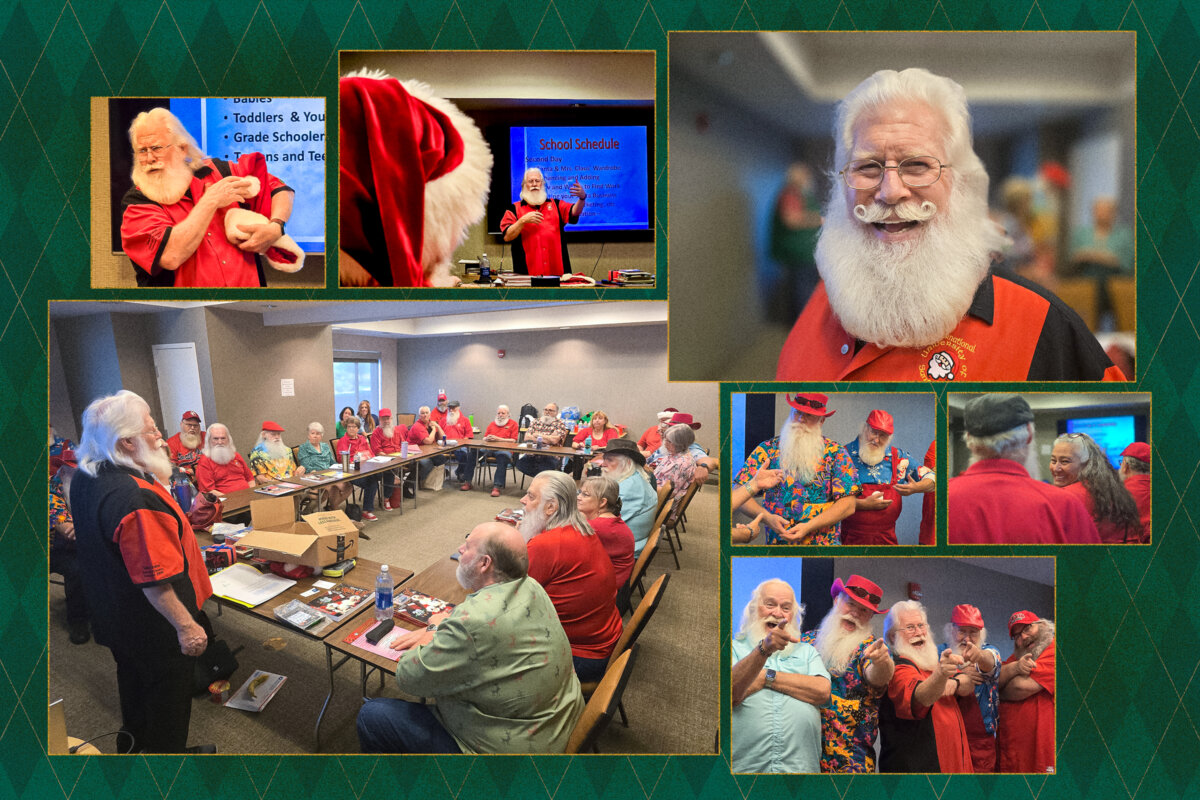
The Epoch Times joined his first lesson of the year in Tempe, Arizona, on May 3.
His students included more than two dozen professional Santas and those soon to enter the profession, hailing from Arizona, California, Idaho, and Utah.
They donned red hats and long white beards and shared a fervent desire to excel in their craft.
The real Santa will shine through, Connaghan told the class, and children are the best judges of character: “So give me a ho!”
“Ho!”
“Give me ho-ho!”
“Ho-ho!”
“Give me a ho-ho-ho!”
“Ho-ho-ho!”
Thus began the all-day class covering various textbook and anecdotal topics, including the historic origins of Santa Claus, how Santa should dress and behave in the 21st century, and how to manage children and parents—as his work never ends and is constantly evolving.
Connaghan said being Santa requires a lot of energy, dedication, mental focus, and the ability to communicate and handle stressful situations.
After all, children are in charge, and not every boss is easy to work with.
“It is a conversation. It’s not one-way,” Connaghan said.
“Act like Santa is a rock star—you are a rock star. You are one of the most important people they have ever met.”
Every year, Connaghan, 76, travels the world to teach others not only how to play Santa, but also how to embody the spirit of Kris Kringle in every way.
His own journey began two days before Christmas in 1969, when his unit returned from the field in Vietnam. It was now time to distribute holiday gift bags from the Red Cross.
One soldier had a creative idea for the festive occasion. He applied Barbasol shaving cream to his face, donned a red hat, and posed for pictures with the troops.
Under the tropical sun, the cream began to melt. Connaghan quickly smeared the white foam on his face and stepped in to take his place as Santa.
Since then, Connaghan has devoted more than 50 years to mastering his role as a professional Santa.
He is the national Santa for the U.S. Marines’ Toys for Tots program and an inductee into the National Santa Claus Hall of Fame.
In addition, he has appeared in advertisements and served as the official Santa for the Hollywood Christmas Parade from 2004 to 2023.
Even better, he no longer requires shaving cream and has a long, well-groomed white beard that is entirely his own. He uses a curling iron to achieve that special look.
In fact, based on Connaghan’s count, 90 percent of his Santas have real beards. Most also have their own round bellies. Connaghan says his graduates weigh an average of 252 pounds.
There isn’t an official count of Santas, but nationalsanta.com estimates there are at least 8,000 in the United States.
The average age of a Santa is 63 and the oldest working Santa is 94.
Being Santa Pays
The Worldwide Santa Claus Network observed that, as a portrayal artist, the salary for a professional Santa in 2022 ranged from $150 to $500 per hour.
This rate can be even higher for engagements involving commercials and advertising. Some Santas have earned $60,000 or more annually as product brand ambassadors.
Virtual visits exploded in 2020 during the pandemic as physical venues were canceled, and many people discovered something unexpected: visiting Santa [online] is actually a lot of fun,” the network noted.
Jeff Vrba from Meridian, Idaho, graduated on May 3, wearing a red cowboy hat and a printed shirt featuring Santa riding a bucking bull while sporting a salt-and-pepper beard.
His wife, Julie, is known as Mrs. Claus.
Vrba said that it took him six months to grow the beard for the role of Santa, which he has been performing for private events and various gigs over the past three years.
“It’s a mixture of everything. I haven’t done any mall-work in our area,” said Vrba, 60.
“I love kids, spreading the Christmas cheer, and also sharing the true meaning of Christmas.”
Vrba began his Santa career about a year after the pandemic began, which led to many Zoom visits as Vrba learned how to use the technology.
“We had to do a lot of visits that way,” Vrba told The Epoch Times.
Like any profession, he said, there are specific occupational hazards and unpleasant episodes with being Santa.
“I’ve had three pulled beards. Once, I think his Dad set it up because [the child] pulled and pulled,” Vrba said.
Full Santa Recovery
Allen Cornwell, 56, the president of the Fraternal Order of Real Bearded Santas, arrived from Fontana, California, to attend Santa class in Phoenix on May 3.
Even an experienced Santa can benefit from a refresher course, he said.
“I’ve been a professional Santa for about four years,” Cornwell told The Epoch Times. “I’d done it a couple of times before that.”
Cornwell embraced the role of Santa after surviving a serious illness that nearly took his life.
He let his beard grow long. He continued his recovery. Then he met another Santa who said, “You could be Santa.”
“Oh, I don’t know,” he told the man.
“But the longer I thought about it, I said, ‘Yeah, let me do this for the kids and the family,'” Cornwell said.
“It’s really changed my life. It’s sort of a subculture that I never knew existed.”
In a time of politics and division, Cornwell believes that people of all ages need Santa more than ever.
“It gives them a message of hope and generosity, and caring for each other,” he said.
 Friends Read Free
Copy
Facebook
Tweet
Friends Read Free
Copy
Facebook
Tweet