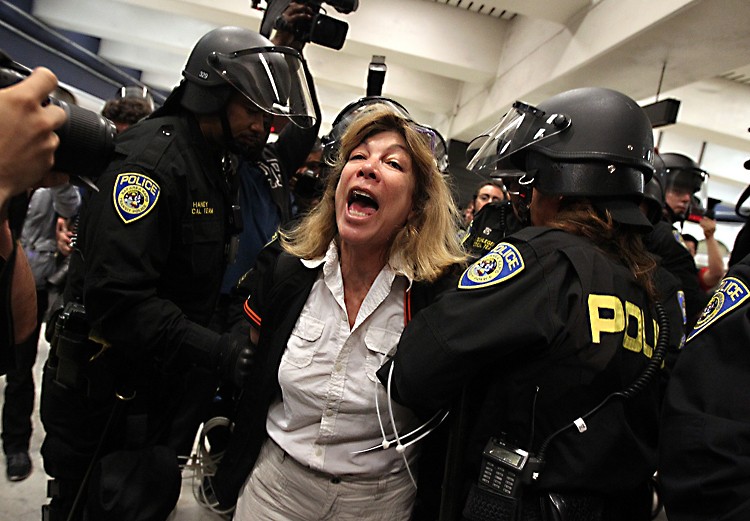
“No justice, no peace,” chanted a masked crowd of approximately 100 protesters in downtown San Francisco last week. A similar protest was staged the week before, and organizers held another protest on Monday, August 22—a pattern with no end in sight. But what began as a protest against police violence has morphed into a heated debate about freedom of speech in the digital age.
This long string of protests began on New Year’s Day 2009 when Bay Area Rapid Transit (BART) police killed an unarmed man, 22-year old Oscar Grant III. Tensions escalated last month when two BART officers shot and killed 45-year old Charles Hill on July 3. Following the incident, demonstrators marched from one station to another demanding that BART officers be fired and punished for the fatal shootings.
But on Aug. 11, when BART received information that another demonstration was planned for afternoon rush hour at a downtown station, officials turned off four cell transmission sites, preventing protesters from using their cell phones to effectively coordinate their demonstration.
“A civil disturbance during commute times at busy downtown San Francisco stations could lead to platform overcrowding and unsafe conditions for BART customers, employees, and demonstrators,” said BART, justifying the action in a statement following the event.
While BART’s action defeated that protest, the shutdown sparked a fury that has burned beyond the Bay Area. Digital and civil rights groups from across the country have condemned the shutdown, and have raised concerns over the power authorities have to tamper with digital communication.
The American Civil Liberties Union compared the action to that of former Egyptian President Hosni Mubarak who ordered the shutdown of cell phone service in Tahrir Square in response to peaceful protests earlier this year. Although BART argues that the shutdown was made to ensure safety, the Electronic Frontier Foundation argued that functional cell service instead promotes safety, noting, “New Yorkers had found cell phones to be invaluable to communicating with authorities and loved ones in the midst of citywide confusion” of 9/11. The Federal Communications Commission (FCC) is examining BART’s decision to silence its critics.
The cell service shutdown also attracted the attention of the mysterious hacker-activist group Anonymous, an organization that often targets incidents it considers to be government oppression and abuses of power. Anonymous hacked into BART’s website and posted names, phone numbers, street and e-mail addresses of thousands of BART subscribers.
“This is but one of many actions to come,” wrote Anonymous in an online post. While the hacker group has its sights set on BART, many transit riders believe they have been victimized by the ordeal. Anonymous apologized to citizens who had their information exposed, but argued, “You should go to BART and ask them why your information wasn’t secure with them.”
Since Anonymous joined the effort against BART, the protests have taken on a new look. Demonstrators now don Guy Fawkes masks—a caricature with an eerie blank smile from the 2006 dystopian film “V for Vendetta” who has become the symbol for the Anonymous group. While the protests have garnered national attention, many local residents say they have become more about theatrics than effective demonstration. BART has been forced to shut down several terminals during recent protests, further frustrating transit users.
“BART riders should not be the protesters’ focus,” said one transit rider who asked to have his name withheld to avoid an attack from Anonymous, which he described as “ruthless and could wreak havoc on my life.”
“This is not civil disobedience,” he stated. “Walden and Thoreau would be spinning in their graves. The BART Board should be the focus of the protest.”
 Friends Read Free
Copy
Facebook
Tweet
Friends Read Free
Copy
Facebook
Tweet