The Democrats’ sit-in overnight on Wednesday, June 22, looked successful on social media, but is unlikely to impact gun control before the election, say experts.
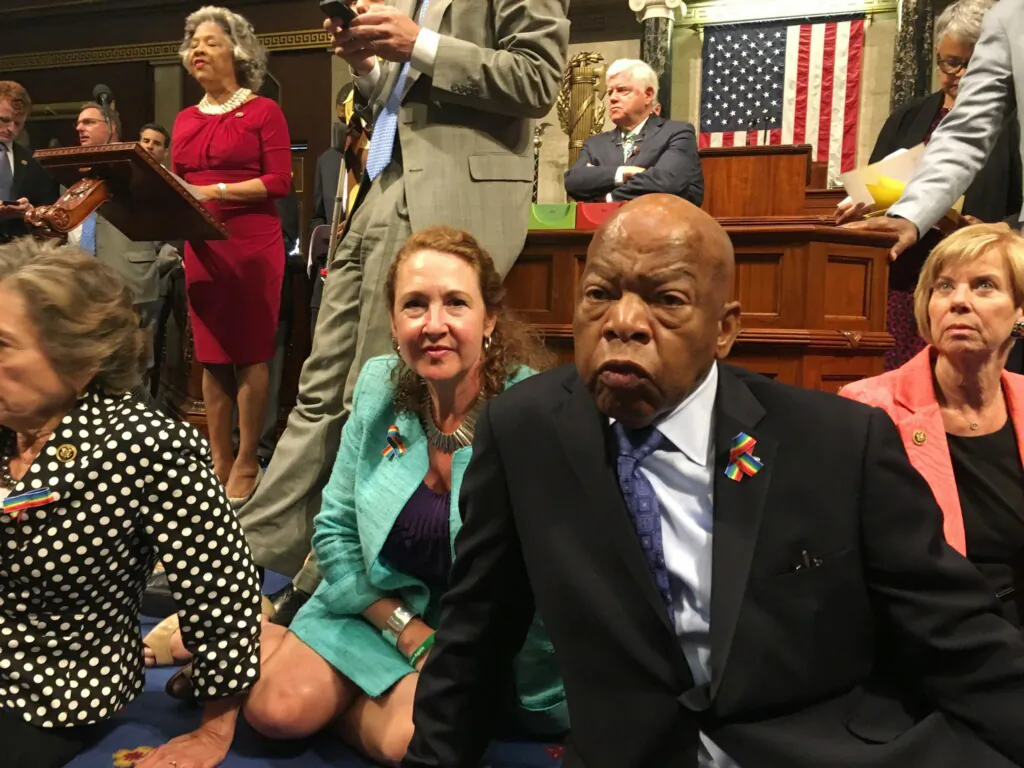
Led by congressman and civil rights leader John Lewis (D-Ga.), Democrats staged a 26-hour sit-in, following a string of failed gun control measures after the Orlando shooting on June 12 that left 49 people dead and 53 injured.
Lewis had the Floor when he asked his colleagues to join him for the sit-in on the morning of June 22. “Sometimes you have to do something out of the ordinary. Sometimes you have to make a way out of no way. We have been too quiet for too long,” Lewis said.
He was joined by about two dozen colleagues through the night as Democrats called for a vote on proposed bills that would ban gun sales to suspected terrorists on the no-fly list and impose universal background checks.
C-Span cameras were cut off after the sit-in began, but images were shared by politicians on Twitter and live video feeds posted on Periscope and Facebook Live, along with the hashtag #NoBillNoBreak.
The sit-in immediately began trending on social media, as crowds gathered outside the Capitol.
LIVE on #Periscope: It’s 5AM & we aren’t sleeping. House Dems continue to demand action to end gun violence. #NoBil… https://t.co/ujY3zIUuJi
— Rep. Eric Swalwell (@RepSwalwell) June 23, 2016
“Without platforms like Periscope and Facebook live, Americans may not have learned about—or witnessed—this political protest,” said Deana Rohlinger, professor of sociology at Florida State University.
“Democrats took advantage of the right technology at the right political moment,” she said, pointing out that progressive groups like MoveOn.org and Momsrising.org also spread the word via email and encouraged supporters to show their support for the cause.
“Support for gun control legislation is high in America and, given the recent tragedies, it is the right political moment for Democrats to push for change.”
 Supporters of House Democrats taking part in a sit-in on the House Chamber shout encouragement from outside the U.S. Capitol on June 22, 2016 in Washington, DC. Led by civil rights icon Rep. John Lewis (D-GA) Democrats have maintained control of the House chamber since this morning demanding a vote on gun control legislation. (Pete Marovich/Getty Images)
Although the sit-in attracted plenty of attention in cyberspace, it might not have a major impact on gun control legislation.
“[It’s] pretty unlikely in this moment, during the election,” said Daniel DiSalvo, associate professor of political science in the Colin Powell School at The City College of New York (CUNY).
He said if anything is passed, it would be a “watered down legislation” or “just symbolic.”
“Republican leaders control a lot,” said DiSalvo. “They’re not going to roll over and say, ‘You protested, therefore we’ll do what you want.’ The Speaker won’t go for that.”
At around 3 a.m. on Thursday morning, Speaker Paul Ryan (R-Wis.) adjourned the House until July 5. He called the sit-in a “publicity stunt,” in a post on Twitter.
But DiSalvo says the sit-in did have an impact on the public image of Republicans, who may be seen as supporting the National Rifle Association (NRA) and other interest groups over the victims of gun-related crimes.
“It’s good election-year politics,” said DiSalvo. “It puts pressure on both the Democrats and the Republicans because they’re not doing anything in the face of mass shootings.”
It’s not the first time a sit-in was held in the House. In 1995, Democrats staged a sit-in to protest a Republican-passed budget. In 2008, Republicans protested against an energy bill. On that occasion, the House was not in session—even the lights were off.
“This is different, this is directly interrupting the House,” said DiSalvo. “They are definitely getting more attention, [it’s] more controversial.”
 Georgia Rep. John Lewis, center, leads a sit-in of more than 20 Democrats in demanding a vote on measures to expand background checks and block gun purchases by some suspected terrorists. Rebellious Democrats shut down the House’s legislative work on Wednesday, June 22, 2016. (AP Photo)
DiSalvo also noted that having Lewis, a civil rights leader who has protested against injustice, lead the sit-in was a smart move. Overall, the sit-in was “well orchestrated,” but “for now this protest won’t lead to a whole lot,” he said.
 Friends Read Free
Copy
Facebook
Tweet
Friends Read Free
Copy
Facebook
Tweet