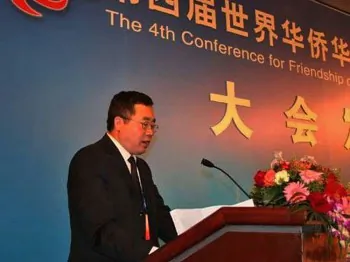

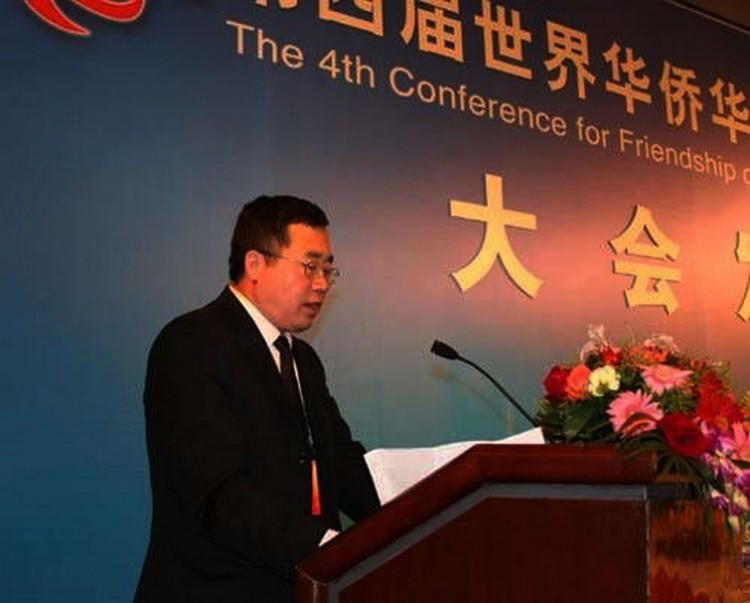
Yang Chunlai, 49, was taken into custody on July 1 at his office in Chicago. He was discovered to have downloaded thousands of files to flash drives, including many critical files that are considered proprietary in nature and contain protected source codes, according to the FBI.
Yang may have stolen the information in connection with a Hong Kong futures exchange firm in which he is an investor and the head technical person, according to Reuters, which quoted an affidavit obtained from the FBI.
Alongside his active interest in business ventures, Yang has maintained a lively political presence, and has been an outspoken supporter of the Chinese Communist Party (CCP) in the United States.
Patriotic Front
Yang is deeply involved with overseas Chinese patriotic organizations and Chinese Embassy-backed groups in the United States.
He headed the Chicago-based Association of Chinese Scientists and Engineers-USA (ACSE) between October 2005 and October 2009, and has since served as the association’s consultant, according to an official Chinese website; the ACSE is part of the Overseas Chinese Affairs Office (OCAO) of the Shanghai municipal administration. Yang has also been a standing council member of the Greater Chicago Overseas Chinese Federation (GCOCF) since August 2008.
Both organizations, though claiming to be independent, maintain close ties with the CCP and the Chinese Consulate General in Chicago. Not only do the current and former consuls frequently attend both organizations’ activities, and invite the organization leaders to attend consulate events, but the organization leaders, including Yang himself, are invited to visit China for business and political purposes.
As front groups that uphold the Party line on important political matters, both organizations have participated in activities that support the Chinese regime’s suppression of dissidents, ethnic activists, and religious believers.
In 2007, for example, Yang spoke as the ACSE chairman at an anti-Taiwan-separatists forum to condemn former Taiwan President Chen Shui-bian. “[The ACSE] will firmly curb the Taiwan separatists’ endeavors to split the country,” Yang announced. “We will make our due contributions to protect the integrity of our homeland’s land and sovereignty and to realize our country’s peaceful reunification.”
The Greater Chicago Overseas Chinese Federation, of which Yang is a standing council member, has participated in embassy-organized events denouncing Falun Gong, a persecuted spiritual practice in China.
Party Ties
Yang, born in 1963 in Beijing, came to the United States in 1991 to attend a doctoral program at Boston College. He joined Chicago Mercantile Exchange (CME) in 2000 and was a senior programmer.
He became the head of Chicago Association of Chinese Scientists and Engineers in 2005, and soon after established a close relationship with the Communist Party.
Before 2006, Yang visited China only about once every two years, according to statements he made to Chinese media. But after he attended a heavily politicized “training session” for “overseas Chinese leaders” in Beijing in May 2006, he stepped up the frequency of his visits.
Yang attended state-sponsored conferences and business events in 2007, 2008, 2010, and 2011, according to reports in the Chinese press and official propaganda organs. (2007, 2008, 2010, 2011)
In 2008, Yang became a member of the Overseas Expert Consultative Committee, a coveted position overseen by the Overseas Chinese Affairs Office of the State Council. The committee’s 50 members include some of the most prominent Chinese scientists and scholars residing outside China, and the position is arguably the highest recognition that the regime awards overseas patriotic Chinese.
Yang’s academic achievements may be dwarfed by some other members of the committee, but his allegiance to the Chinese Communist Party is not to be questioned. In a 2007 speech at an overseas Chinese conference in Beijing, Yang spoke about his determination to influence U.S. social elites in favor of China.
He said the CCP’s expectations for overseas Chinese had changed. Rather than attempt to get them back to China, it would now encourage these individuals to participate in political activities in their residing countries, to increase their personal influence and that of the China brand.
Next…Money Talks
 Friends Read Free
Copy
Facebook
Tweet
Friends Read Free
Copy
Facebook
Tweet