
FLORENCE, Italy—“People are looking for rare objects—for marvelous objects,” said Tomaso Piva, a debonair gallerist based in Milan who specializes in baroque and neoclassical Venetian art.
“There’s only one of these,” he told The Epoch Times, nodding at a table centerpiece from the mid-18th century. “It’s complete, it arrived to us in great condition, but more than anything, it’s extremely rare.”
To the uninitiated, the miniature garden tableau, made of Venetian blown glass and set on a mirrored base with a lacquered wood rim, may look like elevated bric-a-brac.
Its tiny flowers and fruit trees in gilded vases would not be out of place—in spirit, at least—among my Italian great-grandmother’s romantic porcelain miniatures.
But “Italian Garden” is a museum-quality masterpiece from the workshop of Giuseppe Briati, the most celebrated Venetian glassmaker of the 18th century, the likes of which rarely surfaces on the private market.
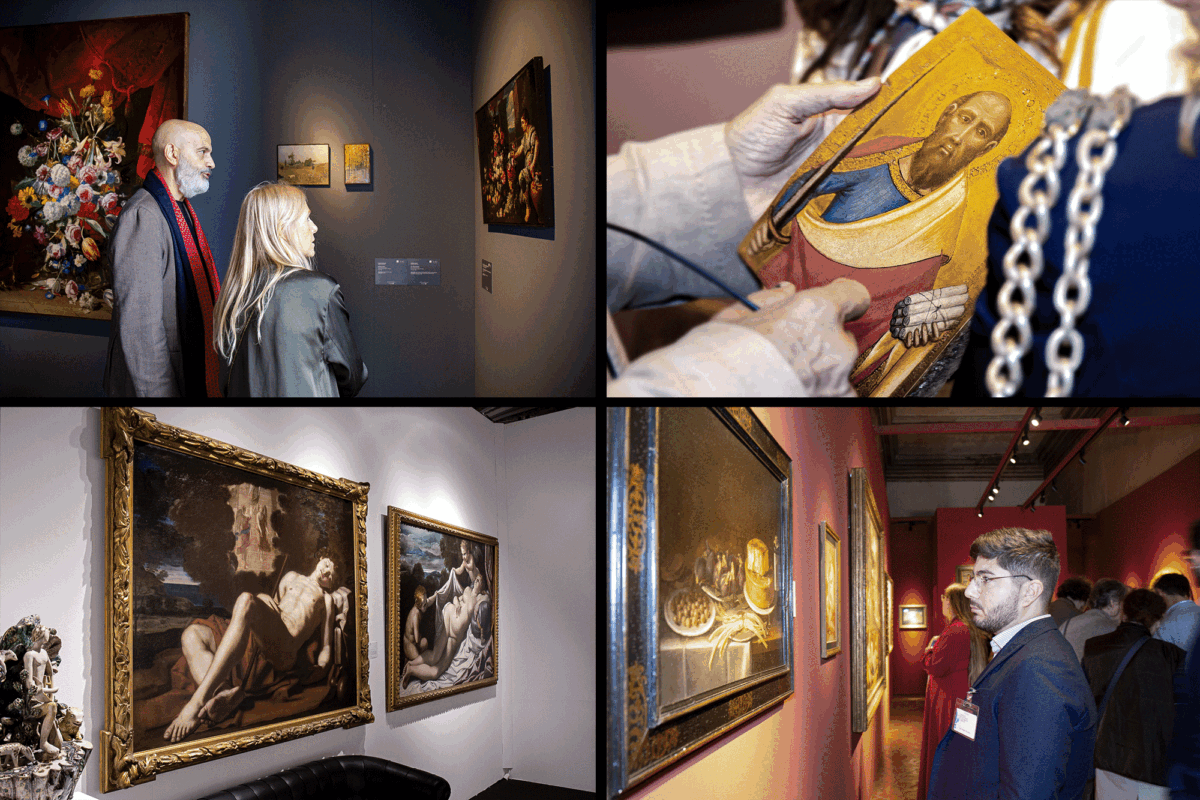
It is among thousands of such treasures—Old Master oil paintings, sculpture, textiles, furniture, and much more—showcased by more than 80 galleries this year at the International Biennial of Antiques in Florence, Italy (Biennale Internazionale dell’ Antiquariato di Firenze). The elite extravaganza unfolds over 10 days of public exhibitions and private galas in and around a baroque palazzo on the city’s Arno River.
At the time of the biennial’s inception in 1959, the founders looked to build on the legacy of Florence as a bastion of humanist culture—“understood as a refined and passionate renewal of ethical, aesthetic, and spiritual values,” according to organizers.
The Italian Renaissance, which began in the late 14th century in Florence, was driven by a revival of classical antiquity—a renewed interest in the art, literature, and values of ancient Greece and Rome. Its focus on human potential and emotion, natural beauty, and civic virtue led to centuries of unparalleled flourishing and breakthroughs that transformed Western civilization.
Today, amid the diffusion and aggressive obsolescence of the digital age, the biennial offers a refreshing counter-narrative: a celebration of skilled craftsmanship and painstaking restoration, of manual expertise passed down through generations and enduring beauty.
There is a resurgent interest in analog existence and authenticity-as-luxury among younger generations, and a buoyant antiques market. And the fair’s mix of ancient and modern works, this year extending through the end of the 1990s, builds on a growing theme in the contemporary art world, in which boundaries between fine arts and decorative and functional design are increasingly softening.
But under a new director, the biennial also seems keen to cultivate a forward-thinking dialogue in which the classics are not just a refuge or marketable nostalgia, but a way to understand and confront our current cultural moment.
‘Time Is What We Need’
In conversation with The Epoch Times, Bruno Botticelli, the biennial’s secretary general, described a vision for the antiquarian movement in the digital age.
“I think, at the moment, digital and artificial intelligence are tools that we use, for example on social media. But then we bring the physical, like the Michaelangelo here,” he said, pointing to an unfinished drawing by Michelangelo Buonarroti displayed in the throne room of the Palazzo Corsini.
“Drawing No. 45 A” is a centerpiece of the biennial, both for its importance among the remaining works of the Renaissance master—a perfectionist known to have burned many of his own drawings—and because it showcases a painstaking and ever-evolving restoration process that combines traditional expertise with new technology.
Commissioned by Pope Leo X in 1516, Michelangelo’s drawing depicts a study for the marble façade of the Basilica San Lorenzo, executed in layers of silverpoint, pencil, and ink. The intent, according to Cristina Acidini, president of the Casa Buonarroti Foundation, which preserves the largest collection of the artist’s works, was to adapt classical forms of Roman antiquity to a Christian place of worship. It was one of a series of incomplete models he likely submitted before the Pope annulled the contract in 1521, “leaving Michelangelo dismayed and sorrowful,” Acidini wrote in a recent article.
Currently, a team of conservators, chemists, physicists, art historians, and diagnostic experts are studying the drawing to understand the artist’s techniques, according to the Opificio delle Pietri Dure, an organization founded in 1588 that is currently overseeing the restoration project.
Before that work begins, experts will need to reconstruct Michelangelo’s deceptively “simple” technique, and understand how time and conservation may have altered the drawing over the centuries, a process Opificio’s superintendent, Emanuela Daffra, describes as a “balance between hand, eye, history, and science.”
“I think time is what we need. All I hear is with digital, they make things faster. With this you do the same thing in two minutes; one year ago, you needed one day. Well, I want my day. I want my time,” said Botticelli, apologizing for his English and his Tuscan dialect. “It is the language of Dante,” he said, referring to the Florentine Renaissance poet-philosopher.
Digitized masterpieces, including those created with a patented technology by an Italian nonprofit whose cards were strewn throughout Palazzo Corsini during the biennial, are gaining ground as a way to preserve artworks by exhibiting them without physically transporting them.
But Botticelli noted the physicality of art and antiques remains paramount.
“The smell of the varnish, the smell of the wax, it’s like a human body,” he said.
Is the inlaid-wood cadenza, or a master oil painting, a living organism?
“Yes, they are,” he said. “They become older and older, the wood becomes more dry, dry, dry, so you need to wax it. They’re still living. And I think the meaning of what we do, we have [a] relationship with living things and living people. Antiques work is still like this.”
A Dying Art?
In the shadow of the biennial, down a narrow street a few blocks from Palazzo Corsini, Franco Macciò sat outside his antiques shop, named Vecchie Cose—literally, “old things”— chatting with neighbors.
In business for 42 years, Macciò began apprenticing at the age of 14, learning how to restore canvas and wood paintings.
Now, he says, the industry is highly professionalized by an elite cadre of museum-quality restoration experts, but there are fewer artisans doing the quotidian work of preservation, and dealers struggle to sell their wares.
Restoration and antiques are “a dying art,” said Macciò, who continues his own restoration work only as a free service when clients buy something from him.
“The furniture, nobody wants to buy them, not even if I give them away,” he told The Epoch Times. Figurative painting is also less popular than it used to be, he added, while abstract and contemporary art continue to be in high demand.
Whereas most of his business in decades past was from local residents, now his income comes primarily from tourists, meaning that it’s unstable and very seasonal.
But where Americans or other visitors with buying power might come in search of large oil paintings, for example, they give up when they run into trouble with shipping or an export license.
Italy has long had strict protections governing what art can be removed from the country and how, but recent legislation has softened the rules.
“The government has opened the door,” said Botticelli, referring to a recent expansion of the monetary threshold to 50,000 euros (about $57,000) from 13,500 euros (about $15,000) for which you can export without a license. This is applicable to works created by deceased artists more than 70 years ago, but not to antiques, archeological finds, or rare manuscripts.
“We have a lot of masterpieces on the market, more than any other country, and every year we still discover more,” he said, noting he agreed with the regulatory change but also with the idea that Italy should safeguard its unique heritage.
“This is the most important fair in Italy. You can only get in by invitation, and the dealers are the best dealers—including maybe me,” Paulo Antonacci said with a laugh.
The gallerist, who specializes in “19th-century views,” this year counts the 1919 masterpiece by Umberto Brunelleschi, “Le Fait du Soleil,” among his selections.
“It’s a showcase, and hopefully we’re going to sell,” he said.
Like Antonacci, the vast majority of the biennial’s vendors, around 85 percent, are Italian and specialize in Italian art.
“Italian art is an international brand,” Boticelli said. “We don’t need to have Chinese art to be international. In that way you lose your identity.”
‘A Captivating Mix’
Just across the river from Palazzo Corsini, Roberto Casamonti, one of Italy’s most powerful gallerists and a participant in the biennial, was celebrating the opening of an expanded museum housing his private collection of around 250 modern and contemporary masterpieces in a 19th century palazzo.
Through 28 rooms, the Collezione Casamonti traces Italian and international art from the late 19th century through the current moment.
“Bringing together such a broad selection of works means sharing with the public not only extraordinary works but also a personal and cultural journal that continues to evolve,” Casamonti said in a statement.
Fabio Benzi, an art historian and professor at the University of Chieti-Pescara who was among thousands of VIP visitors the day before the biennial officially opened, praised the density of masterpieces and mix of genres there.
“You can find many Renaissance stands, and many contemporary pieces of art, but the market is more alive in contemporary art than ancient art, or that from the Renaissance to Baroque to the 19th century,” he told The Epoch Times.
Benzi noted that while tastes generally lean contemporary, the market is increasingly embracing unique historical pieces.
‘A Visual Education’
In a tiny shop not far from the biennial, Giuliana Grilloti, an art historian, turned a 17th-century wall sconce over in her hands, noting the gold-leaf painting, original mercury mirror, and hand-carved wood.
“Art was always a visual education,” she told The Epoch Times. “In the past, think of churches—full of frescoes representing Jesus or stories of the Final Judgement. Or Greek mythology, it helped people understand how they live, their feelings.”
Around her, centuries-old relics—tabernacles, statues, mirrors, sets of child-sized armor—sat mixed with reproductions made by her husband, a restoration expert.
“Now when you want to know something, you can know it exactly and instantly,” Grilloti said. “But art is always first an emotion. And if you have time to stop and study a painting or a statue, it can teach you what it represented for people of the time, but also what it means for us today. It’s like a witness to the past—what people loved to do, what they tried to do.”
In an age increasingly devoid of mystery, she suggested, such legacies are especially powerful.
Think of the Duomo, she said, referring to the architectural marvel by Renaissance Master Giuseppe Brunelleschi—still the largest masonry dome ever built—at the nearby cathedral of Santa Maria del Fiore.
“It was an experiment. They still couldn’t explain exactly how he did it. He wanted to keep it a secret,” she said.
Italians, she said, are lucky to be surrounded by so much beauty.
“But it’s not because all the people here believe it’s important. It’s thanks to people who realized that art was a visual education. … And when you don’t know the exact story behind a painting, it’s the emotion that translates, the way we feel something so personal,” she said.
Like many objects on display in the biennial, Giuseppe Briati’s “Italian Garden” comes with a lore that propels it through the centuries.
By the early 1700s, European nobility had become obsessed with Bohemian crystal, a brilliant, durable glass that artisans could cut like gemstones to dazzling effect—refracting candlelight in opulent chandeliers that illuminated Baroque and Rococo palaces.
As a Bohemian crystal monopoly threatened to put Venetian glassmakers out of business, Briati traveled to Bohemia, in current-day Czech Republic, to learn (or steal) artisans’ closely kept secrets. He used them to pioneer a new style that would again elevate Venetian glassmaking to an elite art, including in his Rezzonico chandeliers.
Briati’s revival of Murano glass, named after the Venetian island where artisans were historically located, is also an example of artists using technology—in this case, a chemical formulation that made the work more beautiful and durable—to radically alter the future of their craft.
Antiquarians today use digital technology to advance conservation and promote interest in relics of the past; some hope it will lead to a revival of the aesthetic and spiritual values that shaped them.
Asked about a new generation taking up the mantle of antiquarianism, Botticelli said he sees signs that young people are celebrating aesthetics and rituals that might seem anachronistic in an era of hyper-connectivity and instant gratification.
He recalls a recent trip to Japan where he found a charming coffee culture and a passion among young people for a slower way of life.
“I think we can have young people involved in this market when they discover the beauty of slowness,” he said. “While they think life has been concluded with everything in one day, this field will not work for them.”
As the biennial continues to expand and grow, incorporating new eras of artistic expression, the secretary general suggested the frame of what is considered a master work, including in design and decorative arts, is always changing.
“Look at the fashion world. Until five years ago, it seemed the best market, it was growing. Now, it’s falling down,” he said. “All the fashion brands sell only in a few very rich countries, but in Europe, the shops are empty.
“It’s not so chic to have Gucci clothes now. It’s better to have a vintage one.”
Sept. 26–Oct. 4
Palazzo Corsini
Lungarno Corsini, 10, 50123 Firenze FI
Tel. +39 055 282635
Email: info@biennaleantiquariato.it
 Friends Read Free
Copy
Facebook
Tweet
Friends Read Free
Copy
Facebook
Tweet