
Thursday marked the 52nd anniversary of the 1959 Tibetan National Uprising against Chinese communist regime’s military occupation of Tibet. But it had added meaning this year, with the Dalai Lama announcing he would step aside from his role as the political leader of the Tibetan government in exile and pass that role to a democratically elected alternate.
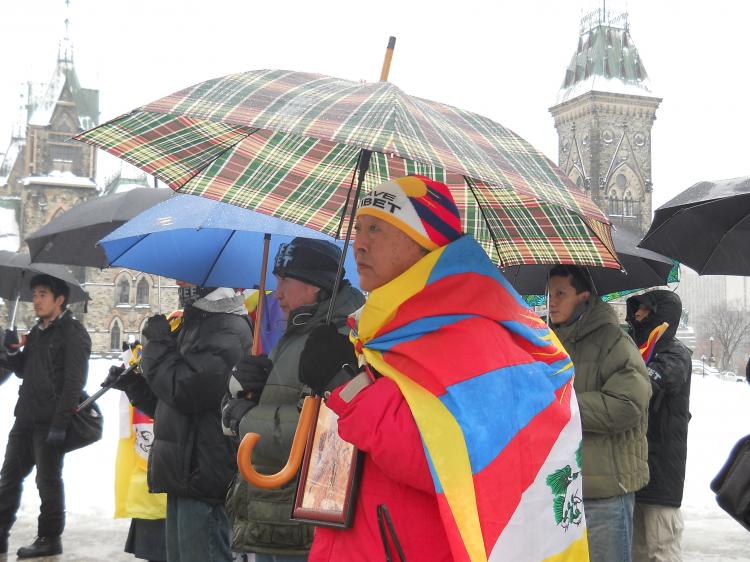
As onlookers stood in the slush of wet snow, Jigme Duntak of Students for Free Tibet Canada read a statement from the Dalai Lama from earlier that day. Umbrellas and Tibetan flags spotted the small crowd of two dozen.
“On this occasion, I would like to pay tribute to and pray for those brave men and women who sacrificed their lives for the just cause of Tibet,” read Duntak.
“This Earth belongs to humanity and the People’s Republic of China (PRC) belongs to its 1.3 billion citizens, who have the right to know the truth about the state of affairs in their country and the world at large. If citizens are fully informed, they have the ability to distinguish right from wrong. Censorship and the restriction of information violate basic human decency.”
In the statement, the Dalai Lama laid out his previous decision to have an elected leader take the helm of the government in exile and said he was not trying to shirk responsibility, only ensure the Tibetan cause would be served in the long term.
Duntak said later the Tibetan community had always expected the Dalai Lama to make this announcement since it has been his decision for many years.
“It wasn’t something that was shocking,” he said.
But with the Dalai Lama and his near universal support about to take a parallel role to an elected leader and political movement, Duntak said there could be changes in how the Tibetan community deals with the suppression in Tibet. While the Tibetan leader has called for greater autonomy for Tibet, he has not demanded freedom and a separation from China. A political leader may change that path.
“Most Tibetans want freedom, but his Holiness moderated our views because of the middle path approach that he took.”
Duntak said if the Dalai Lama remains silent on political issue, the voices of Tibetans with a stronger position on freedom will likely come through more loudly.
“That is possible. They will be more responsive to the actual concerns and wishes of the people.”
The Chinese regime has stepped up its denunciations of the Dalai Lama in recent days and foreign visitors have been barred from Tibet ahead of the anniversary.
Members of Parliament from all parties stood under umbrellas or wide-brimmed hats, adding their voices of support.
NDP MP Wayne Marston says that the movement has always remained peaceful and respectful, a tribute to the character of the Tibetan leader.
“His holiness the Dalai Lama has shown us a way that so many other countries of the world could learn from. And it is time for China to set aside the old ways and to come together with the people of Tibet to resolve what they call the ‘Tibetan situation.’ The reality is, it is time for that change.”
Tory MP David Sweet, who moved a parliamentary motion that granted the Dalai Lama honorary Canadian citizenship, said the fact they the group held a rally in such poor weather showed the resilience of the Tibetan people.
Long-time China rights supporter Liberal MP Larry Bagnell said that even with a small crowd and bad weather, there was reason for hope in Tibet despite an opponent with a huge military capacity.
“You think it is like a grain of sand against a big stone wall. But you think of the river bottoms and you see on the river bottoms these little holes, bowl-like, holes that go right through the solid rock. That was created by a grain of sand that just kept on going round and round and round with the current and ultimately won. And that is the way the Tibetan people are, they are peaceful, they are non-military … like you are, standing out today in these awful conditions and going round and round and round and keeping up doing what is right.”
He said, in the end, like that grain of sand they would win.
“The Tibetan people will preserve their culture, the beauty, for the world, and you will have the whole world behind you.”
“You have no fairweather friends here today. The people you have here are the ones who will be with you through the tough times,” noted Conservative MP Rob Anders.
 Friends Read Free
Copy
Facebook
Tweet
Friends Read Free
Copy
Facebook
Tweet